


The integrin alpha4beta7 forms a complex with cell-surface CD4 and defines a T-cell subset that is highly susceptible to infection by HIV-1
- PMID: 19933330
- PMCID: PMC2780317
- DOI: 10.1073/pnas.0911796106
The integrin alpha4beta7 forms a complex with cell-surface CD4 and defines a T-cell subset that is highly susceptible to infection by HIV-1
Abstract
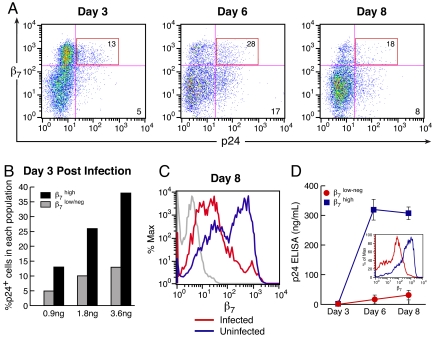
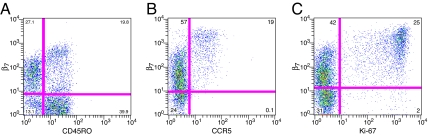
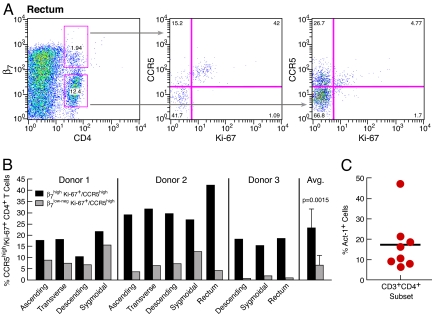
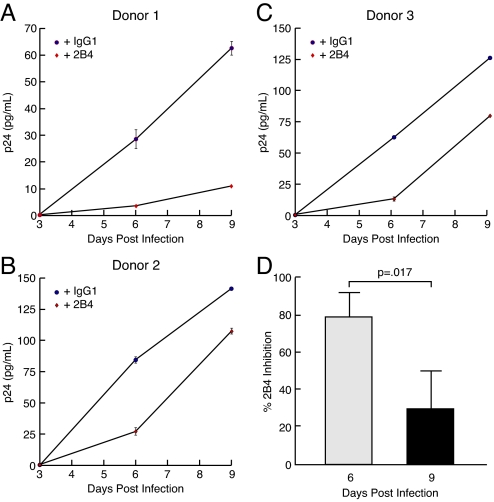
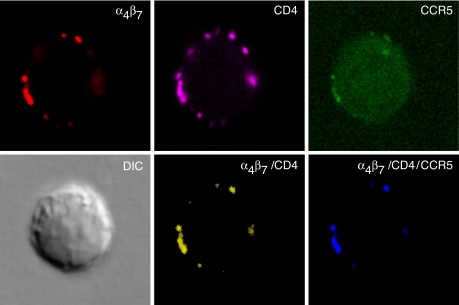
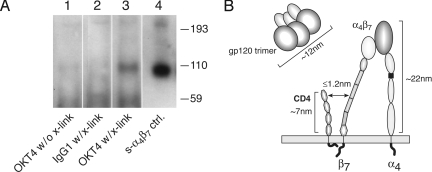
Both activated and resting CD4(+) T cells in mucosal tissues play important roles in the earliest phases of infection after sexual transmission of HIV-1, a process that is inefficient. HIV-1 gp120 binds to integrin alpha(4)beta(7) (alpha(4)beta(7)), the gut mucosal homing receptor. We find that alpha(4)beta(7)(high) CD4(+) T cells are more susceptible to productive infection than are alpha(4)beta(7)(low-neg) CD4(+) T cells in part because this cellular subset is enriched with metabolically active CD4(+) T cells. alpha(4)beta(7)(high) CD4(+) T cells are CCR5(high) and CXCR4(low); on these cells, alpha(4)beta(7) appears in a complex with CD4. The specific affinity of gp120 for alpha(4)beta(7) provides a mechanism for HIV-1 to target activated cells that are critical for efficient virus propagation and dissemination following sexual transmission.
Conflict of interest statement
The authors declare no conflict of interest.
Figures
References
-
- von Andrian UH, Mackay CR. T-cell function and migration. Two sides of the same coin. N Engl J Med. 2000;343:1020–1034. - PubMed
-
- Wagner N, et al. Critical role for beta7 integrins in formation of the gut-associated lymphoid tissue. Nature. 1996;382:366–370. - PubMed
-
- Haase AT. Perils at mucosal front lines for HIV and SIV and their hosts. Nat Rev Immunol. 2005;5:783–792. - PubMed
Publication types
MeSH terms
Substances
Grants and funding
LinkOut - more resources
Full Text Sources
Other Literature Sources
Medical
Research Materials
