


Association of tobacco and lead exposures with attention-deficit/hyperactivity disorder
- PMID: 19933729
- PMCID: PMC2853804
- DOI: 10.1542/peds.2009-0738
Association of tobacco and lead exposures with attention-deficit/hyperactivity disorder
Abstract
Objective: The study objective was to determine the independent and joint associations of prenatal tobacco and childhood lead exposures with attention-deficit/hyperactivity disorder (ADHD), as defined by current diagnostic criteria, in a national sample of US children.
Methods: Data are from the 2001-2004 National Health and Nutrition Examination Survey, a cross-sectional, nationally representative sample of the US population. Participants were 8 to 15 years of age (N = 2588). Prenatal tobacco exposure was measured by report of maternal cigarette use during pregnancy. Lead exposure was assessed by using current blood lead levels. The Diagnostic Interview Schedule for Children was used to ascertain the presence of ADHD in the past year, on the basis of Diagnostic and Statistical Manual of Mental Disorders, Fourth Edition, criteria.
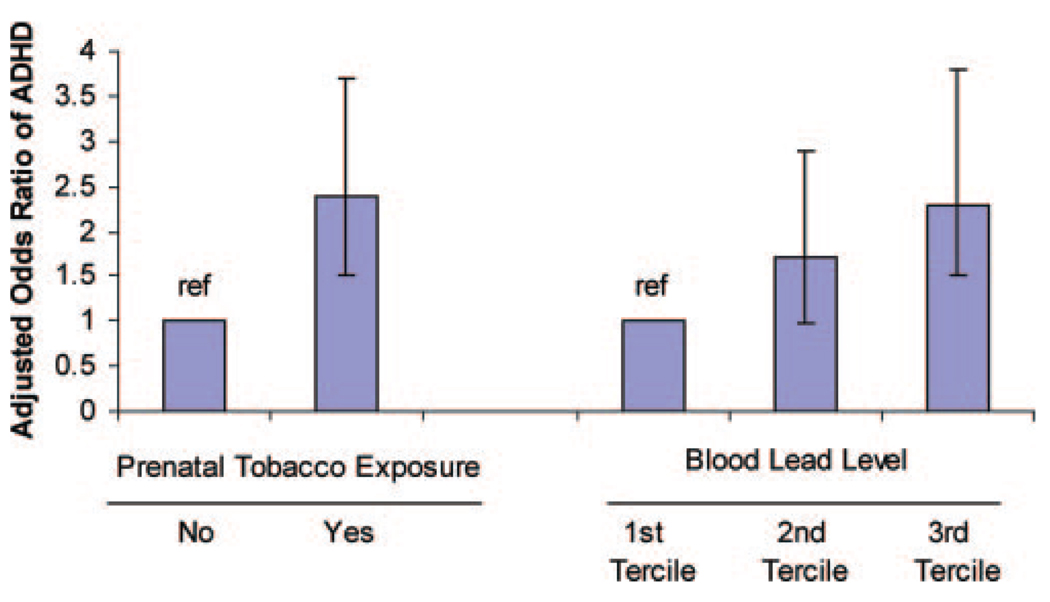
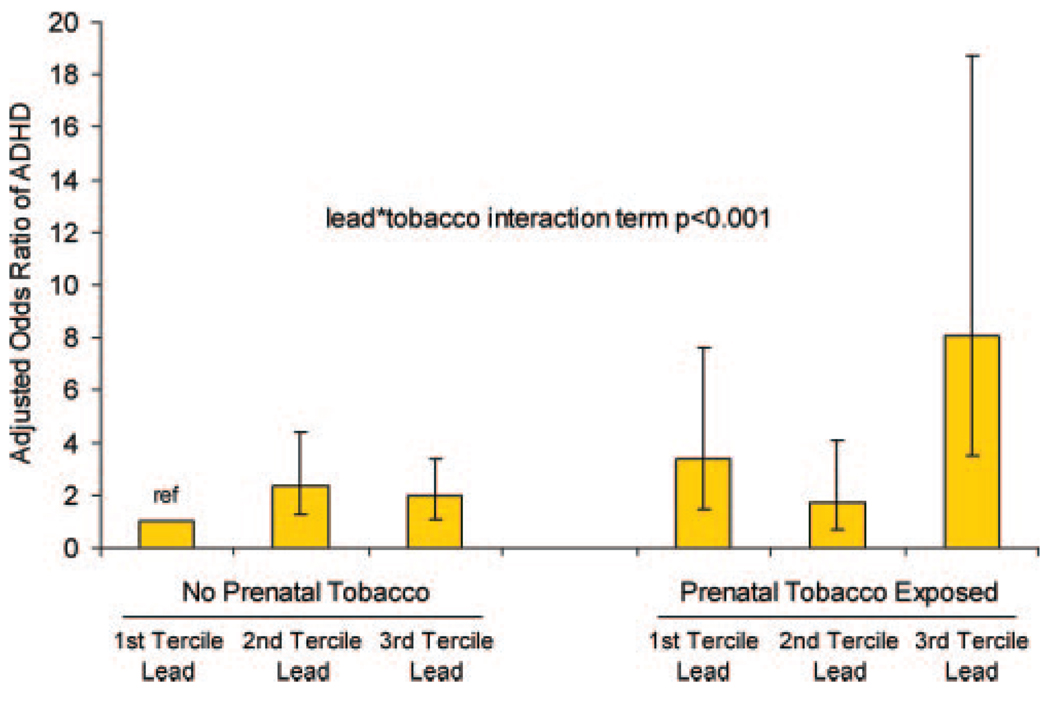
Results: A total of 8.7% (95% confidence interval [CI]: 7.3%-10.1%) of children met criteria for ADHD. Prenatal tobacco exposure (adjusted odds ratio [aOR]: 2.4 [95% CI: 1.5-3.7]) and higher current blood lead concentrations (aOR for third versus first tertile: 2.3 [95% CI: 1.5-3.8]) were independently associated with ADHD. Compared with children with neither exposure, children with both exposures (prenatal tobacco exposure and third-tertile lead levels) had an even greater risk of ADHD (aOR: 8.1 [95% CI: 3.5-18.7]) than would be expected if the independent risks were multiplied (tobacco-lead exposure interaction term, P < .001).
Conclusions: Prenatal tobacco and childhood lead exposures are associated with ADHD in US children, especially among those with both exposures. Reduction of these common toxicant exposures may be an important avenue for ADHD prevention.
Figures
References
-
- Leibson CL, Katusic SK, Barbaresi WJ, Ransom J, O’Brien PC. Use and costs of medical care for children and adolescents with and without attention-deficit/hyperactivity disorder. JAMA. 2001;285(1):60–66. - PubMed
-
- Loe IM, Feldman HM. Academic and educational outcomes of children with ADHD. J Pediatr Psychol. 2007;32(6):643–654. - PubMed
-
- Mannuzza S, Klein RG, Bessler A, Malloy P, LaPadula M. Adult outcome of hyperactive boys: educational achievement, occupational rank, and psychiatric status. Arch Gen Psychiatry. 1993;50(7):565–576. - PubMed
-
- Sherman DK, McGue MK, Iacono WG. Twin concordance for attention deficit hyperactivity disorder: a comparison of teachers’ and mothers’ reports. Am J Psychiatry. 1997;154(4):532–535. - PubMed
Publication types
MeSH terms
Substances
Grants and funding
LinkOut - more resources
Full Text Sources
Medical
Miscellaneous
