


Excitatory amino acid involvement in dendritic spine formation, maintenance and remodelling
- PMID: 19933758
- PMCID: PMC2821552
- DOI: 10.1113/jphysiol.2009.178905
Excitatory amino acid involvement in dendritic spine formation, maintenance and remodelling
Abstract
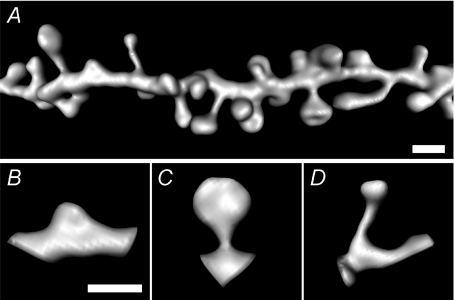
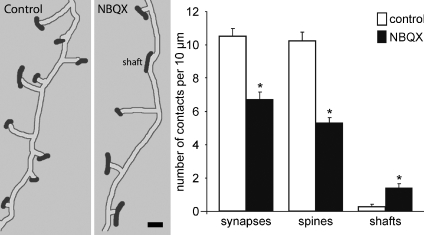
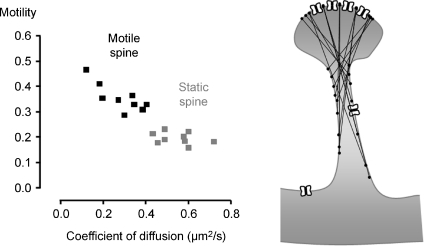
In the central nervous system, most excitatory synapses occur on dendritic spines, which are small protrusions from the dendritic tree. In the mature cortex and hippocampus, dendritic spines are heterogeneous in shape. It has been shown that the shapes of the spine can affect synapse stability and synaptic function. Dendritic spines are highly motile structures that can undergo actin-dependent shape changes, which occur over a time scale ranging from seconds to tens of minutes or even days. The formation, remodelling and elimination of excitatory synapses on dendritic spines represent ways of refining the microcircuitry in the brain. Here I review the current knowledge on the effects of modulation of AMPA and NMDA ionotropic glutamate receptors on dendritic spine formation, motility and remodelling.
Figures

References
-
- Baude A, Nusser Z, Molnar E, McIlhinney RA, Somogyi P. High-resolution immunogold localization of AMPA type glutamate receptor subunits at synaptic and non-synaptic sites in rat hippocampus. Neuroscience. 1995;69:1031–1055. - PubMed
-
- Bhatt DH, Zhang S, Gan WB. Dendritic spine dynamics. Annu Rev Physiol. 2009;71:261–282. - PubMed
Publication types
MeSH terms
Substances
LinkOut - more resources
Full Text Sources
Other Literature Sources
