. 2011:2011:154108.
doi: 10.1093/ecam/nep186. Epub 2011 Feb 15.

Acupuncture treatment for plantar fasciitis: a randomized controlled trial with six months follow-up

Affiliations

Acupuncture treatment for plantar fasciitis: a randomized controlled trial with six months follow-up

Shi Ping Zhang et al. Evid Based Complement Alternat Med. 2011.

Abstract

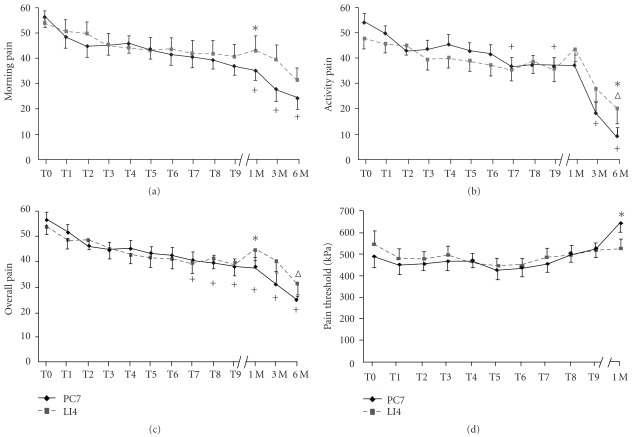
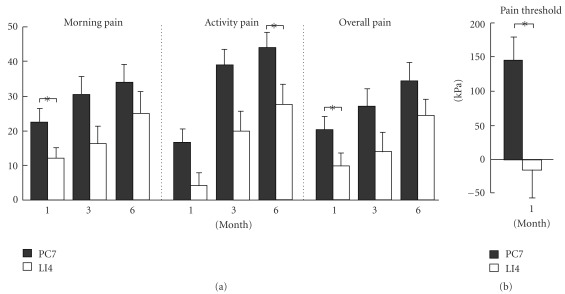
Plantar fasciitis is a common cause of heel pain. It has been suggested that some acupoints have a specific effect on heel pain. The aim of this study was to determine the efficacy and specificity of acupuncture treatment for plantar fasciitis. Subjects were randomly assigned to the treatment group (n = 28) or control group (n = 25). The treatment group received needling at the acupoint PC 7, which is purported to have a specific effect for heel pain. The control group received needling at the acupoint Hegu (LI 4), which has analgesic properties. Treatment was administered five times a week for 2 weeks, with an identical method of manual needling applied to the two acupoints. The primary outcome measure was morning pain on a 100-point visual analog scale (VAS) at one month post-treatment. Secondary outcome measures included a VAS for activity pain, overall pain rating as well as pressure pain threshold using algometry. Significant differences in reduction in pain scores, favoring the treatment group, were seen at one month for morning pain (22.6 ± 4.0 versus 12.0 ± 3.0, mean ± SEM), overall pain (20.3 ± 3.7 versus 9.5 ± 3.6) and pressure pain threshold (145.5 ± 32.9 versus -15.5 ± 39.4). No serious adverse event was observed in either group. The results indicate that acupuncture can provide pain relief to patient with plantar fasciitis, and that PC 7 is a relatively specific acupoint for heel pain.


Figures
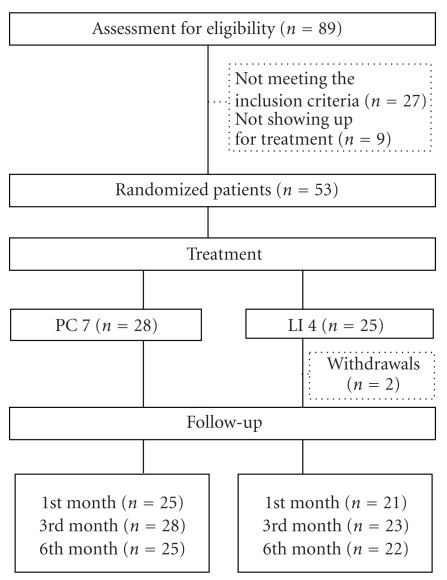
Figure 1
Figure 1
CONSORT chart of the clinical trial process.
Figure 2
Figure 2
(a)–(d) Line graphs showing the effects of acupuncture treatment at two different acupoints. Patients were randomized into the treatment group (n = 28), receiving acupuncture at acupoint PC7 (diamonds), and the control group (n = 25), receiving acupuncture at acupoint LI4 (squares). Values are mean ± SEM taken at different time points. T0, just prior to the first treatment; T1, after the first treatment and just prior to the second treatment; T9, after the ninth treatment just prior to the tenth treatment; 1 M, 1 month post-treatment; and so forth. Crosses and empty triangles indicate statistical significant differences compared with T0 in the PC7 group and the LI4 group, respectively (P < .05; one-way ANOVA with Bonferroni post hoc test). Stars indicate statistical significant differences between the PC7 and LI4 groups at a given time point using a multivariate general linear model, with baseline values as covariate (P < .05, with Bonferroni correction).
Figure 3
Figure 3
Histograms showing mean changes of morning pain, activity pain, overall pain and algometric pain threshold from the baseline in the specific acupoint group (PC7, n = 28) and the non-specific acupoint group (LI4, n = 25). Number of feet in algometric measurement: PC7, n = 43; LI4, n = 38. *P < .05.
Figure 4
Figure 4
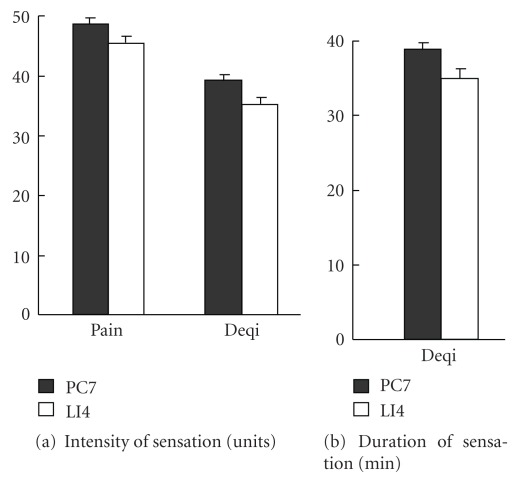
Assessment of perception of acupuncture stimulation. (a) Intensity of pain or Deqi sensation. (b) duration of Deqi sensation. No difference was found between the two groups.
Figure 5
Figure 5
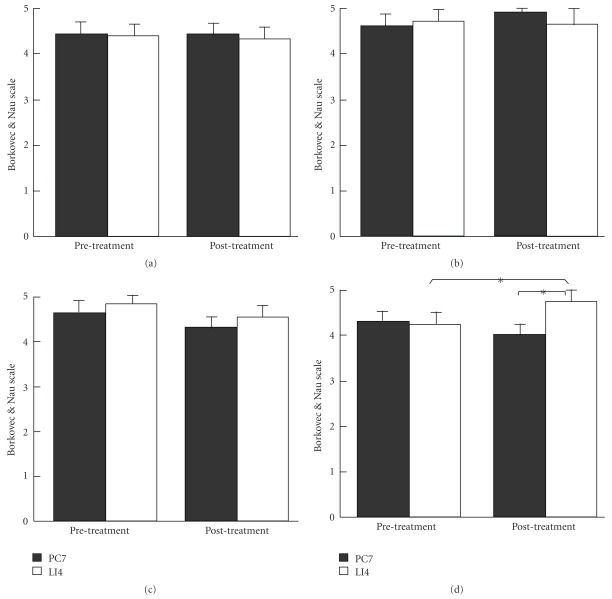
Credibility assessment of acupuncture treatments using a six point Borkovec and Nau scale. (a) How confident do you feel that this treatment can alleviate your complaint? (b) How confident would you be in recommending this treatment to a friend who suffered from similar complaints? (c) How logical does this treatment seem to you? (d) How successful do you think this treatment would be in alleviating other complaints? (*P < .05; PC7: n = 28, LI4: n = 25).
Figure 6
Figure 6
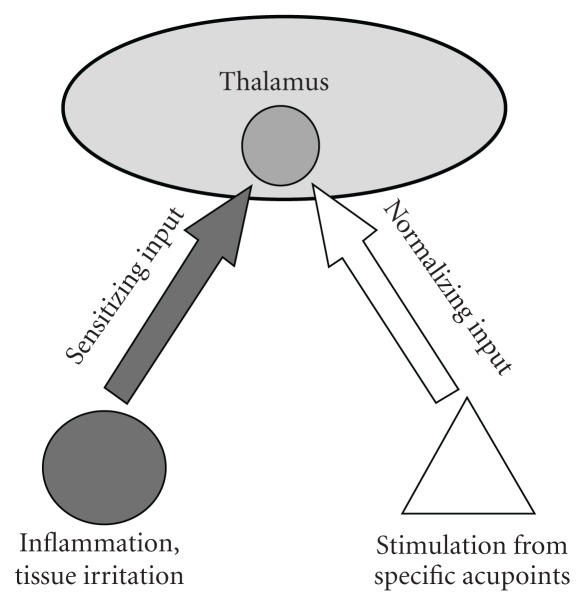
A hypothetical diagram illustrating the possible mechanism of acupuncture treatment for plantar fasciitis. Repeated stimulation from inflammation and tissue irritation of the heel will sensitize neurons in the thalamus and habituate them to a state of hyperexcitability, leading to a state of chronic pain. Repeated stimulation from specific acupoints will send input to the same thalamic focus and normalize the excitability of hyperexcitable neurons.

References

    1. DeMaio M, Paine R, Mangine RE, Drez D., Jr. Plantar fasciitis. Orthopedics. 1993;16(10):1153–1163. - PubMed
    1. Barrett SL, O’Malley R. Plantar fasciitis and other causes of heel pain. American Family Physician. 1999;59(8):2200–2206. - PubMed
    1. Crawford F, Thomson C. Interventions for treating plantar heel pain. Cochrane Database of Systematic Reviews. 2003;(3) Article ID CD000416. - PubMed
    1. Dequeker J. NSAIDs/Corticosteroids—primum non nocere. Advances in Experimental Medicine and Biology. 1999;455:319–325. - PubMed
    1. Yip TP. Clinical research report of the acupuncture effect on calcanodynia. Hong Kong: The Chinese University; 2006. M.S. thesis.

LinkOut - more resources