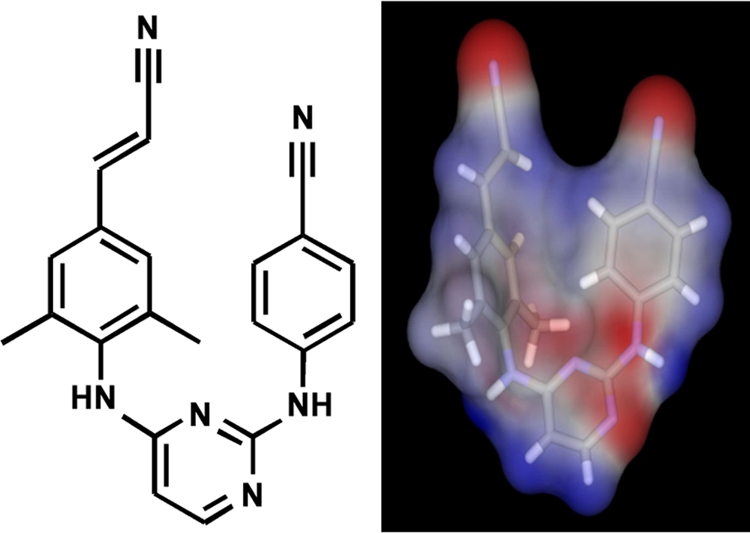
TMC278, a next-generation nonnucleoside reverse transcriptase inhibitor (NNRTI), active against wild-type and NNRTI-resistant HIV-1
- PMID: 19933797
- PMCID: PMC2812151
- DOI: 10.1128/AAC.00986-09
TMC278, a next-generation nonnucleoside reverse transcriptase inhibitor (NNRTI), active against wild-type and NNRTI-resistant HIV-1
Abstract
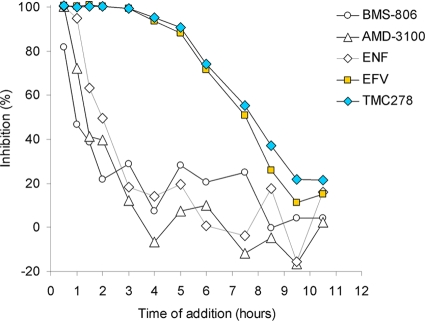
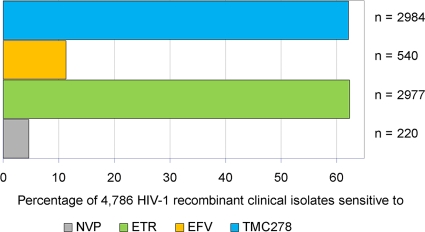
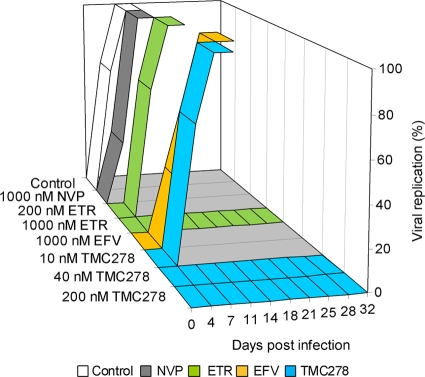
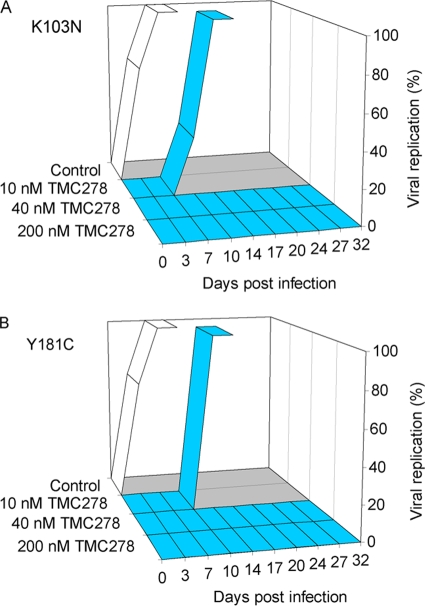
Nonnucleoside reverse transcriptase inhibitors (NNRTIs) have proven efficacy against human immunodeficiency virus type 1 (HIV-1). However, in the setting of incomplete viral suppression, efavirenz and nevirapine select for resistant viruses. The diarylpyrimidine etravirine has demonstrated durable efficacy for patients infected with NNRTI-resistant HIV-1. A screening strategy used to test NNRTI candidates from the same series as etravirine identified TMC278 (rilpivirine). TMC278 is an NNRTI showing subnanomolar 50% effective concentrations (EC50 values) against wild-type HIV-1 group M isolates (0.07 to 1.01 nM) and nanomolar EC50 values against group O isolates (2.88 to 8.45 nM). Sensitivity to TMC278 was not affected by the presence of most single NNRTI resistance-associated mutations (RAMs), including those at positions 100, 103, 106, 138, 179, 188, 190, 221, 230, and 236. The HIV-1 site-directed mutant with Y181C was sensitive to TMC278, whereas that with K101P or Y181I/V was resistant. In vitro, considerable cross-resistance between TMC278 and etravirine was observed. Sensitivity to TMC278 was observed for 62% of efavirenz- and/or nevirapine-resistant HIV-1 recombinant clinical isolates. TMC278 inhibited viral replication at concentrations at which first-generation NNRTIs could not suppress replication. The rates of selection of TMC278-resistant strains were comparable among HIV-1 group M subtypes. NNRTI RAMs emerging in HIV-1 under selective pressure from TMC278 included combinations of V90I, L100I, K101E, V106A/I, V108I, E138G/K/Q/R, V179F/I, Y181C/I, V189I, G190E, H221Y, F227C, and M230I/L. E138R was identified as a new NNRTI RAM. These in vitro analyses demonstrate that TMC278 is a potent next-generation NNRTI, with a high genetic barrier to resistance development.
Figures
References
-
- Andries, K., H. Azijn, T. Thielemans, D. Ludovici, M. Kukla, J. Heeres, P. Janssen, B. De Corte, J. Vingerhoets, R. Pauwels, and M.-P. de Béthune. 2004. TMC125, a novel next-generation nonnucleoside reverse transcriptase inhibitor active against nonnucleoside reverse transcriptase inhibitor-resistant human immunodeficiency virus type 1. Antimicrob. Agents Chemother. 48:4680-4686. - PMC - PubMed
-
- Antinori, A., M. Zaccarelli, A. Cingolani, F. Forbici, M. G. Rizzo, M. P. Trotta, S. Di Giambenedetto, P. Narciso, A. Ammassari, E. Girardi, A. De Luca, and C. F. Perno. 2002. Cross-resistance among nonnucleoside reverse transcriptase inhibitors limits recycling efavirenz after nevirapine failure. AIDS Res. Hum. Retroviruses 18:835-838. - PubMed
-
- Bacheler, L., S. Jeffrey, G. Hanna, R. D'Aquila, L. Wallace, K. Logue, B. Cordova, K. Hertogs, B. Larder, R. Buckery, D. Baker, K. Gallagher, H. Scarnati, R. Tritch, and C. Rizzo. 2001. Genotypic correlates of phenotypic resistance to efavirenz in virus isolates from patients failing nonnucleoside reverse transcriptase inhibitor therapy. J. Virol. 75:4999-5008. - PMC - PubMed
-
- Balotta, C., G. Facchi, M. Violin, S. Van Dooren, A. Cozzi-Lepri, F. Forbici, A. Bertoli, C. Riva, D. Senese, P. Caramello, G. Carnevale, G. Rizzardini, L. Cremonini, L. Monno, G. Rezza, C. F. Perno, G. Ippolito, A. d'Arminio-Monforte, A. M. Vandamme, and M. Moroni. 2001. Increasing prevalence of non-clade B HIV-1 strains in heterosexual men and women, as monitored by analysis of reverse transcriptase and protease sequences. J. Acquir. Immune Defic. Syndr. 27:499-505. - PubMed
-
- Basavapathruni, A., J. Vingerhoets, M. P. de Béthune, R. Chung, C. M. Bailey, J. Kim, and K. S. Anderson. 2006. Modulation of human immunodeficiency virus type 1 synergistic inhibition by reverse transcriptase mutations. Biochemistry 45:7334-7340. - PubMed
Publication types
MeSH terms
Substances
LinkOut - more resources
Full Text Sources
Other Literature Sources
Chemical Information
Medical
Molecular Biology Databases