. 2010 Feb;78(2):872-83.
doi: 10.1128/IAI.00427-09. Epub 2009 Nov 23.

Plasmodium falciparum merozoite surface protein 1 (MSP-1)-MSP-3 chimeric protein: immunogenicity determined with human-compatible adjuvants and induction of protective immune response

Affiliations

Plasmodium falciparum merozoite surface protein 1 (MSP-1)-MSP-3 chimeric protein: immunogenicity determined with human-compatible adjuvants and induction of protective immune response

Suman Mazumdar et al. Infect Immun. 2010 Feb.

Abstract

A chimeric gene, MSP-Fu(24), was constructed by genetically coupling immunodominant, conserved regions of the two leading malaria vaccine candidates, Plasmodium falciparum merozoite surface protein 1 (C-terminal 19-kDa region [PfMSP-1(19)]) and merozoite surface protein 3 (11-kDa conserved region [PfMSP-3(11)]). The recombinant MSP-Fu(24) protein was produced in Escherichia coli cells and purified to homogeneity by a two-step purification process with a yield of approximately 30 mg/liter. Analyses of conformational properties of MSP-Fu(24) using PfMSP-1(19)-specific monoclonal antibody showed that the conformational epitopes of PfMSP-1(19) that may be critical for the generation of the antiparasitic immune response remained intact in the fusion protein. Recombinant MSP-Fu(24) was highly immunogenic in mice and in rabbits when formulated with two different human-compatible adjuvants and induced an immune response against both PfMSP-1(19) and PfMSP-3(11). Purified anti-MSP-Fu(24) antibodies showed invasion inhibition of P. falciparum 3D7 and FCR parasites, and this effect was found to be dependent on antibodies specific for the PfMSP-1(19) component. The protective potential of MSP-Fu(24) was demonstrated by in vitro parasite growth inhibition using an antibody-dependent cell inhibition (ADCI) assay with anti-MSP-Fu(24) antibodies. Overall, the antiparasitic activity was mediated by a combination of growth-inhibitory antibodies generated by both the PfMSP-1(19) and PfMSP-3(11) components of the MSP-Fu(24) protein. The antiparasitic activities elicited by anti-MSP-Fu(24) antibodies were comparable to those elicited by antibodies generated with immunization with a physical mixture of two component antigens, PfMSP-1(19) and PfMSP-3(11). The fusion protein induces a protective immune response with human-compatible adjuvants and may form a part of a multicomponent malaria vaccine.


Figures
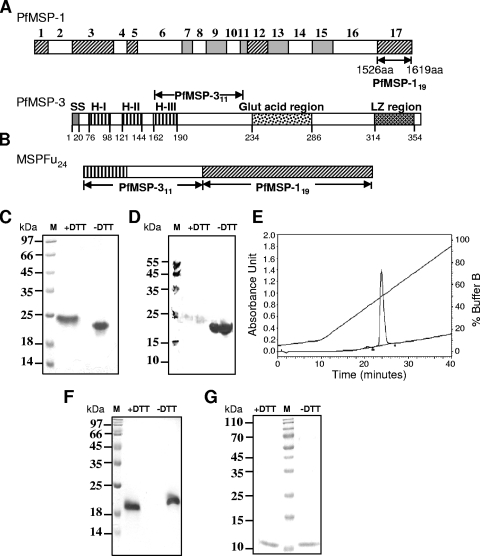
FIG. 1.
FIG. 1.
Design and expression of the chimeric protein MSP-Fu24. (A) Schematic diagram of P. falciparum MSP-1 (PfMSP-1) and PfMSP-3 showing the locations of the MSP-119 and MSP-311 regions. The conserved (hatched), semiconserved (filled), and variable (open) sequence blocks of PfMSP-1 are marked. The signal sequences (SS), heptad repeat regions (HI to HIII), glutamic acid-rich region, and leucine zipper region (LZ region) of PfMSP-3 are also marked. (B) Schematic diagram of MSP-Fu24 consisting of MSP-119 and MSP-311. (C to E) Expression and purification of recombinant MSP-Fu24. (C) Coomassie blue-stained SDS-PAGE gel showing purified recombinant MSP-Fu24 under reducing (with dithiothreitol [+DTT]) and nonreducing (−DTT) conditions. (D) Western blot analysis of MSP-Fu24 under reducing (+DTT) and nonreducing (−DTT) conditions using MAb 5.2. (E) RP-HPLC profile of purified MSP-Fu24 that eluted as a single sharp peak. (F) Coomassie blue-stained SDS-PAGE gel showing purified recombinant MSP-119 under reducing (+DTT) and nonreducing (−DTT) conditions. (G) Coomassie blue-stained SDS-PAGE gel showing purified recombinant MSP-311 under reducing (+DTT) and nonreducing (−DTT) conditions. M, molecular mass marker.
FIG. 2.
FIG. 2.
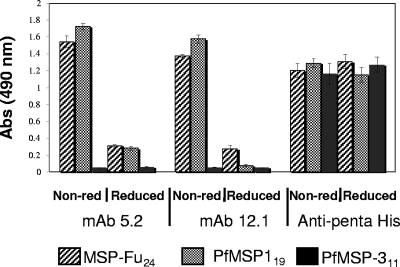
Reactivity of MSP-Fu24, PfMSp-119, and PfMSP-311 with anti-PfMSP-1 conformation-specific MAb 12.1 and MAb 5.2 by ELISA under nonreducing (Non-red) and reducing conditions. The assay for the reactivity of each recombinant protein with anti-penta-His antibody was carried out in parallel as a positive control to ascertain an equal amount of coating of the antigens under reducing and nonreducing conditions.
FIG. 3.
FIG. 3.
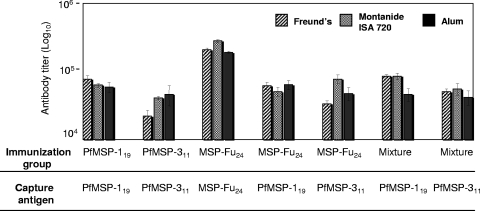
Immune response in groups of BALB/c mice immunized with MSP-Fu24, PfMSP119, PfMSP-311, or a mixture of PfMSP119 and PfMSP-311 formulated in different adjuvants. End point titers for anti-PfMSP119, anti-PfMSP-311, and anti-MSP-Fu24 were determined by ELISA using the respective capture antigens and mouse sera collected on day 70. The highest dilution of sera showing an OD greater than or equal to the reactivity of the preimmune sera plus 2 SDs was considered to be the end point titer. Recombinant PfMSP-119 and PfMSP-311 were used as the capture antigens to determine the immune response to the component antigens (PfMSP-119 and PfMSP-311) in the sera from group of mice immunized with MSP-Fu24 or with a physical mixture of the two components.
FIG. 4.
FIG. 4.
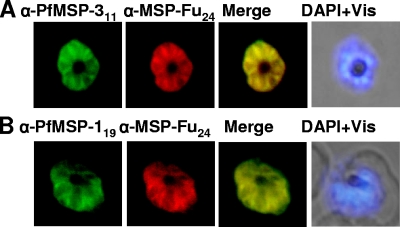
Immunofluorescence assay with P. falciparum 3D7 parasites using anti-MSP-Fu24 antibodies. Shown are fluorescence and bright-field images of acetone-methanol-fixed P. falciparum 3D7 parasites at the schizont stage immunostained with purified anti-MSP-Fu24 (red) and anti-PfMSP-119 (green) or anti-MSP-311 (green) antibody. Parasite nuclei were stained with DAPI (blue).
FIG. 5.
FIG. 5.
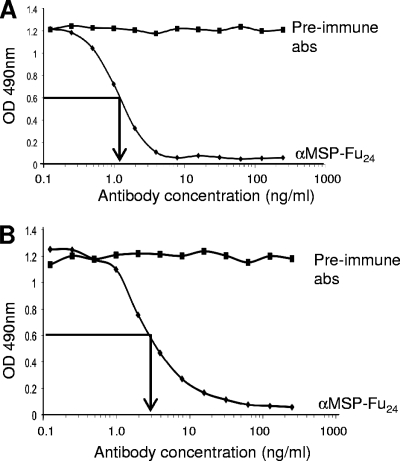
Inhibition of binding of conformation-dependent anti-PfMSP119 MAb 12.10 (A) and MAb 5.2 (B) with recombinant PfMSP-119 by purified anti-MSP-Fu24 antibodies. The reactivity of monoclonal antibodies with PfMSP119 preincubated with different concentrations of purified anti-MSP-Fu24 antibodies was assessed by use of a competitive ELISA. The arrow indicates the concentration of anti-MSP-Fu24 antibodies that brings about a 50% decrease in reactivity. Antibodies purified from preimmune sera were used as negative controls.
FIG. 6.
FIG. 6.
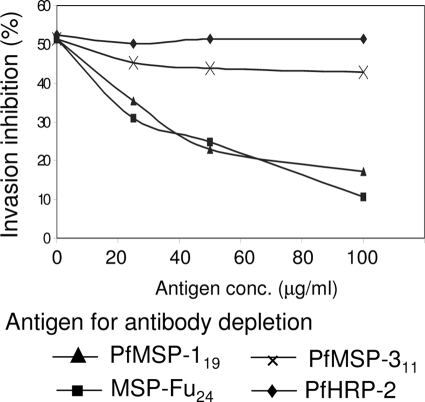
Reversal of anti-MSP-Fu24 antibody-mediated inhibition of P. falciparum invasion after depletion of antigen-specific antibodies. The invasion inhibition by anti-MSP-Fu24 antibodies (250 μg/ml) was assessed after the preincubation of antibodies with different amount of recombinant MSP-Fu24, PfMSP119, or PfMSP-311 to deplete antibodies specific to the respective antigens. PfHRP-2 was also used as one of the antigens for antibody depletion in the assay as a negative control. The percent reversal of invasion inhibition was calculated based upon invasion inhibition without any antibody depletion.
FIG. 7.
FIG. 7.
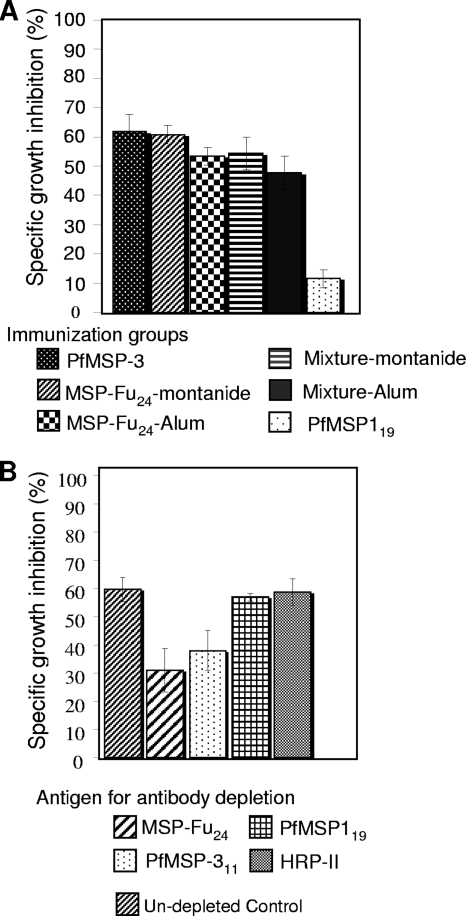
(A) Specific growth inhibition (SGI) index of antibody-dependent cellular inhibition (ADCI) of parasite growth by total IgG purified from sera of mice immunized with MSP-Fu24, PfMSP119, PfMSP-311, or a mixture of PfMSP119 and PfMSP-311 formulated in Montanide ISA720 or alum. Parasites at the schizont stage were cocultured with human monocytes in the presence of purified antibodies (50 μg/ml of culture in the assay), and parasite growth was monitored after 96 h. (B) Reversal of antibody-dependent cellular inhibition of parasite growth by depletion of antigen-specific antibodies. The SGI index of ADCI of parasite growth purified from sera of mice immunized with MSP-Fu24-Montanide after incubation of antibodies with recombinant MSP-Fu24, PfMSP119, or PfMSP-311 to deplete antibodies specific to the respective antigen was determined.

References

    1. Blackman, M. J., T. J. Scott-Finnigan, S. Shai, and A. A. Holder. 1994. Antibodies inhibit the protease-mediated processing of a malaria merozoite surface protein. J. Exp. Med. 180:389-393. - PMC - PubMed
    1. Blackman, M. J., H. G. Heidrich, S. Donachie, J. S. McBride, and A. A. Holder. 1990. A single fragment of a malaria merozoite surface protein remains on the parasite during red cell invasion and is the target of invasion-inhibiting antibodies. J. Exp. Med. 172:379-382. - PMC - PubMed
    1. Bouharoun-Tayoun, H., C. Oeuvray, F. Lunel, and P. Druilhe. 1995. Mechanisms underlying the monocyte-mediated antibody-dependent killing of Plasmodium falciparum asexual blood stages. J. Exp. Med. 182:409-418. - PMC - PubMed
    1. Bouharoun-Tayoun, H., P. Attanath, A. Sabchareon, T. Chongsuphajaisiddhi, and P. Druilhe. 1990. Antibodies that protect humans against Plasmodium falciparum blood stages do not on their own inhibit parasite growth and invasion in vitro, but act in cooperation with monocytes. J. Exp. Med. 172:1633-1641. - PMC - PubMed
    1. Burghaus, P. A., and A. A. Holder. 1994. Expression of the 19-kilodalton carboxy-terminal fragment of the Plasmodium falciparum merozoite surface protein-1 in Escherichia coli as a correctly folded protein. Mol. Biochem. Parasitol. 64:165-169. - PubMed