


The aging immune system and its relationship to the development of chronic obstructive pulmonary disease
- PMID: 19934352
- PMCID: PMC5820858
- DOI: 10.1513/pats.200904-022RM
The aging immune system and its relationship to the development of chronic obstructive pulmonary disease
Abstract
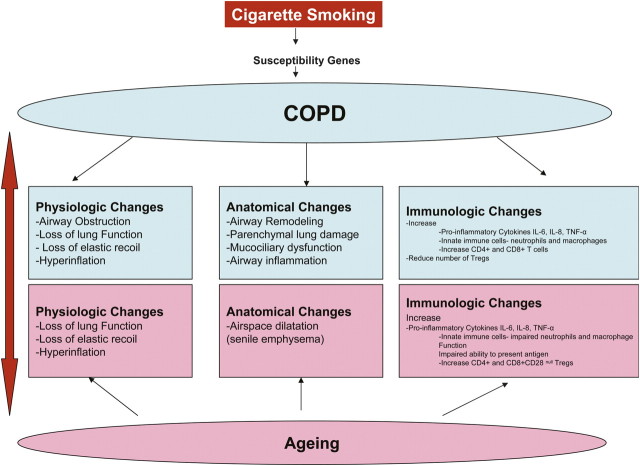
Chronic obstructive pulmonary disease (COPD) is a chronic inflammatory disease of the lungs that usually manifests late in life. Physiologic and immunologic changes that occur in COPD often mimic changes seen in the aging lung. This has led some to characterize COPD as an "accelerated aging phenotype." At the molecular level, COPD and aging share common mechanisms and are associated with significant dysregulation of the immune systems. Aging and COPD are characterized by increases in proinflammatory cytokines such as interleukin (IL)-6 and tumor necrosis factor (TNF)-alpha, which are implicated in aging-related inflammatory diseases and correlate with degree of obstruction in COPD. There is an age-dependent decline in naïve T cells with oligoclonal expansion of CD8(+) CD28(null) T cells from chronic antigenic stimulation. The increase in CD8(+) CD28 (null) T regulatory cells inhibits antigen-specific CD4(+) T cell responses, leading to a decline in adaptive immune response. To compensate for the decline in the adaptive immune function there is a paradoxical up-regulation of innate immune system resulting in a proinflammatory state. The dysregulated adaptive immune system with activated innate immune responses seen with aging results in recruitment and retention of neutrophils, macrophages, and CD4(+) and CD8(+) T cells in the lungs of smokers with COPD. Once the inflammation is triggered, there is a self-perpetuating cascade of inflammation and lung parenchymal damage. This review will focus on how the aging immune system may contribute to COPD development later in life in susceptible individuals.
Figures
References
-
- Centers for Disease Control/National Center for Health Statistics. FastStats: chronic obstructive pulmonary disease (COPD). Includes: chronic bronchitis and emphysema [Internet]. Hyattsville, MD: NCHS (accessed 2009 Mar 1). Available from: http://www.cdc.gov/nchs/fastats/copd.htm
-
- Centers for Disease Control. Chronic obstructive pulmonary disease (COPD) [Internet]. Atlanta, GA: CDC (accessed 2009 Mar 1). Available from: http://www.cdc.gov/copd/index.htm
-
- Chung KF, Adcock IM. Multifaceted mechanisms in COPD: inflammation, immunity, and tissue repair and destruction. Eur Respir J 2008;31:1334–1356. - PubMed
Publication types
MeSH terms
Substances
Grants and funding
LinkOut - more resources
Full Text Sources
Medical
Research Materials