


Review
doi: 10.1097/ALN.0b013e3181bf1d61.
Neurotoxicity of general anesthetics: cause for concern?
Affiliations
- PMID: 19934883
- PMCID: PMC2784653
- DOI: 10.1097/ALN.0b013e3181bf1d61
Item in Clipboard
Review
Neurotoxicity of general anesthetics: cause for concern?
Anesthesiology.
2009 Dec.
No abstract available
Figures
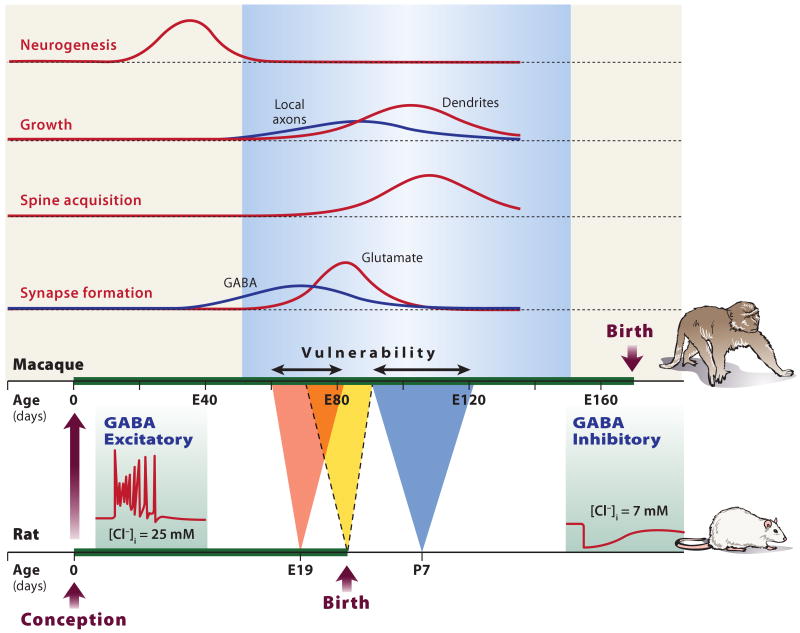
Animal models have provided convincing evidence for drug-induced apoptotic neurodegeneration. The peaks of vulnerability to early (E19) and late (P7) apoptotic neurodegeneration induced by ethanol in rat brain are indicated. The development of rat brain compared to that of the macaque is shown in the lower axes with approximate corresponding developmental milestones. Neurogenesis occurs before E80 in primate, which corresponds to birth in rat. A single day in rat neurodevelopment (P7) translates to 32 days in the primate. Note that axons develop before dendrites and spines, and GABA synapses before glutamate synapses. Excitotoxicty resulting from GABAA-enhancing anesthetics is considered a plausible model for neurodegeneration. During development, GABA changes from excitatory (depolarizing) to inhibitory (hyperpolarizing) because the intracellular chloride concentration decreases due to changes in the expression of the two major chloride cotransporters, KCC2 and NKCC1 that are differentially expressed during development. Paradoxical excitation of immature neurons by activation of GABAA receptors generates an efflux of chloride and excitation in immature neurons (left inset), in contrast to the influx of chloride with inhibition in mature neurons (right inset.
References
-
- Baranov D, Bickler PE, Crosby GJ, Culley DJ, Eckenhoff MF, Eckenhoff RG, Hogan KJ, Jevtovic-Todorovic V, Palotas A, Perouansky M, Planel E, Silverstein JH, Wei H, Whittington RA, Xie Z, Zuo Z. Consensus statement: First International Workshop on Anesthetics and Alzheimer's disease. Anesth Analg. 2009;108:1627–30. - PMC - PubMed
-
- Moller JT, Cluitmans P, Rasmussen LS, Houx P, Rasmussen H, Canet J, Rabbitt P, Jolles J, Larsen K, Hanning CD, Langeron O, Johnson T, Lauven PM, Kristensen PA, Biedler A, van Beem H, Fraidakis O, Silverstein JH, Beneken JE, Gravenstein JS. Long-term postoperative cognitive dysfunction in the elderly ISPOCD1 study. ISPOCD investigators. International Study of Post-Operative Cognitive Dysfunction. Lancet. 1998;351:857–61. - PubMed
-
- Rivera R, Antognini JF. Perioperative drug therapy in elderly patients. Anesthesiology. 2009;110:1176–81. - PubMed
-
- Bohnen NI, Warner MA, Kokmen E, Beard CM, Kurland LT. Alzheimer's disease and cumulative exposure to anesthesia: A case-control study. J Am Geriatr Soc. 1994;42:198–201. - PubMed
-
- Olney JW, Young C, Wozniak DF, Jevtovic-Todorovic V, Ikonomidou C. Do pediatric drugs cause developing neurons to commit suicide? Trends Pharmacol Sci. 2004;25:135–9. - PubMed
Publication types
MeSH terms
Substances
Grants and funding
LinkOut - more resources
Full Text Sources
Other Literature Sources
Medical
