Clinical Trial
. 2010 Mar;18(3):651-9.
doi: 10.1038/mt.2009.275. Epub 2009 Nov 24.

Intranodal immunization with a vaccinia virus encoding multiple antigenic epitopes and costimulatory molecules in metastatic melanoma

Affiliations
Clinical Trial

Intranodal immunization with a vaccinia virus encoding multiple antigenic epitopes and costimulatory molecules in metastatic melanoma

Michel Adamina et al. Mol Ther. 2010 Mar.

Abstract

Recombinant vaccinia virus (rVV) encoding tumor-associated antigens (TAAs) and adhesion or costimulatory molecules may represent important immunogenic reagents for cancer immunotherapy. Recently, intranodal (IN) antigen administration was suggested to be more immunogenic than intradermal (ID) vaccination. However, IN rVV administration has not been attempted so far. We used a rVV encoding gp100(280-288), Melan-A/MART-1(27-35) and tyrosinase(1-9) HLA-A0201 restricted epitopes and CD80 and CD86 costimulatory molecules in stage III and IV melanoma patients in a phase 1/2 trial. Of 15 patients initiating treatment, including two cycles of IN immunization, each comprising one rVV administration and three recall injections of the corresponding peptides, accompanied by subcutaneous granulocyte macrophage-colony stimulating factor supplementation, five withdrew due to progressing disease. Of 10 remaining patients seven showed evidence of induction of cytotoxic T lymphocytes (CTLs) directed against at least one epitope under investigation, as detectable by limiting dilution analysis (LDA) of specific precursors and multimer staining. Adverse reactions were mild (National Cancer Institute (NCI) grade 1-2) and mainly represented by fever, skin rashes, and pruritus. These data indicate that IN administration of rVV encoding melanoma-associated epitopes and costimulatory molecules is safe and immunogenic.


Figures
<b>Figure 1</b>
Figure 1
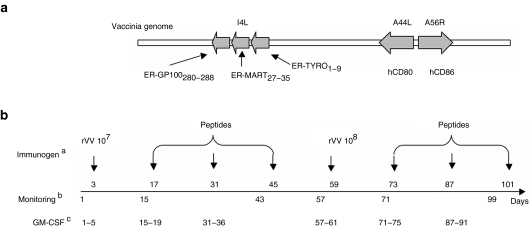
Recombinant vaccinia virus and design of the study. (a) The recombinant vaccinia virus (rVV) used in this study encodes gp100280–288, Melan-A/MART-127–35, and tyrosinase1–9 tumor-associated antigen epitopes, in the form of fusion peptides targeted to the endoplasmic reticulum (ER), in the nonessential viral locus I4L and human CD80 and CD86 in the nonessential viral loci A44L and A56R, respectively. (b) aImmunogens were administered intranodally at the indicated days of the trial. bBlood samples for monitoring purposes were obtained at the indicated days. cGranulocyte macrophage–colony stimulating factor (GM–CSF) was administered subcutaneously for five consecutive days each week, as indicated.
<b>Figure 2</b>
Figure 2
Evolution of multimer staining during treatment. CD8+ T cells from patient no.9 were sampled at the indicated days during the clinical trial and stimulated “in vitro” with Melan-A/MART-127–35 peptide, as detailed in the “Materials and Methods” section. Cells were then stained with phycoerythrin-labeled HLA-A0201-Melan-A/MART-126–35 multimers and fluorescein isothiocyanate labeled anti-CD8 monoclonal antibodies. Digits refer to percentages of CD8+ T cells stained with specific multimers.
<b>Figure 3</b>
Figure 3
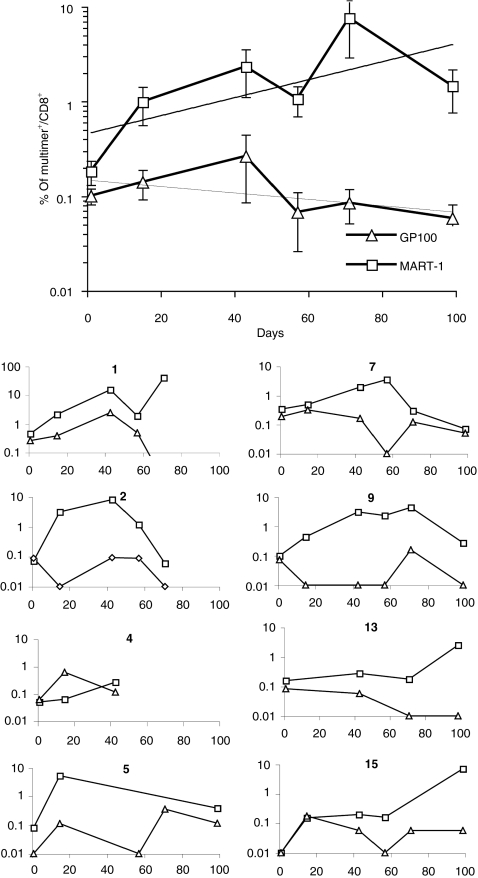
Phenotypic monitoring of CD8+ T cell response by multimer staining. CD8+ T cells from the indicated patients participating to the study were cultured in the presence of gp100280–288 (triangles) or Melan-A/MART-127–35 (squares) peptides as detailed in “Materials and Methods”. Cells were then stained with the corresponding HLA-A0201 multimers and anti-CD8. Specific binding was evaluated by flow cytometry. Data are reported as percentages of CD8+ T cells. The top panel refers to the average ± SEM including trend lines, of all observed values from the 15 patients treated. The 10 small panels, labeled with patients' numbers detail data from each individual responsive patient.
<b>Figure 4</b>
Figure 4
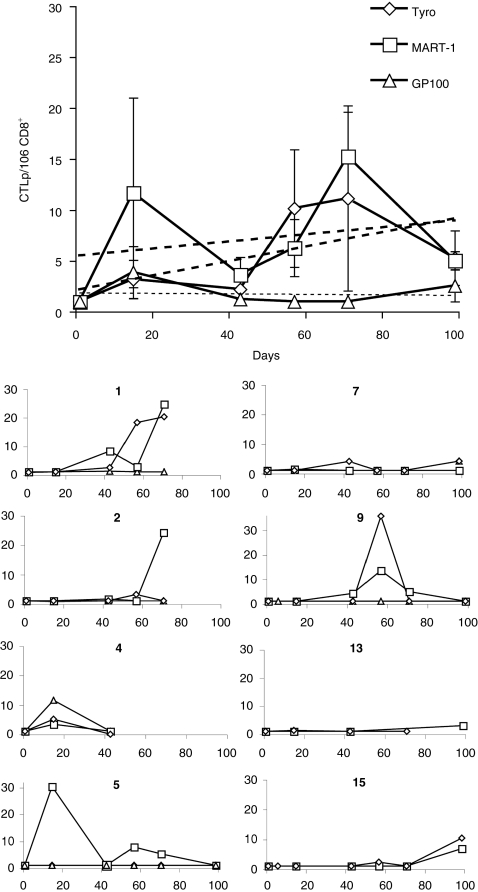
Monitoring of tumor-associated antigen–specific CTLp frequency by limiting dilution analysis during treatment. CD8+ T cells from the indicated patients participating to the study were cultured in the presence of gp100280–288 (triangles), Melan-A/MART-127–35 (squares), or tyrosinase1–9 (diamonds) peptides in limiting dilution conditions, as detailed in “Materials and Methods”. Cytotoxic activity of split wells was then evaluated by 51Cr release assays, using, as targets T2 cells pulsed with specific or control peptides. Data are reported as specific cytotoxic T lymphocyte precursor (CTLp) per 106 CD8+ T cells. The top panel refers to the average ± SEM including trend lines of all values observed in the 15 patients. The 10 small panels labeled with patients' numbers detail the results of each individual responsive patient.

References

    1. Novellino L, Castelli C., and , Parmiani G. A listing of human tumor antigens recognized by T cells: March 2004 update. Cancer Immunol Immunother. 2005;54:187–207. - PMC - PubMed
    1. Gardner JM, Devoss JJ, Friedman RS, Wong DJ, Tan YX, Zhou X, et al. Deletional tolerance mediated by extrathymic Aire-expressing cells. Science. 2008;321:843–847. - PMC - PubMed
    1. Gotter J, Brors B, Hergenhahn M., and , Kyewski B. Medullary epithelial cells of the human thymus express a highly diverse selection of tissue-specific genes colocalized in chromosomal clusters. J Exp Med. 2004;199:155–166. - PMC - PubMed
    1. Dutoit V, Rubio-Godoy V, Dietrich PY, Quiqueres AL, Schnuriger V, Rimoldi D, et al. Heterogeneous T-cell response to MAGE-A10(254-262): high avidity-specific cytolytic T lymphocytes show superior antitumor activity. Cancer Res. 2001;61:5850–5856. - PubMed
    1. Schaed SG, Klimek VM, Panageas KS, Musselli CM, Butterworth L, Hwu WJ, et al. T-cell responses against tyrosinase 368-376(370D) peptide in HLA*A0201+ melanoma patients: randomized trial comparing incomplete Freund's adjuvant, granulocyte macrophage colony-stimulating factor, and QS-21 as immunological adjuvants. Clin Cancer Res. 2002;8:967–972. - PubMed

Publication types