


Pseudomonas aeruginosa population structure revisited
- PMID: 19936230
- PMCID: PMC2777410
- DOI: 10.1371/journal.pone.0007740
Pseudomonas aeruginosa population structure revisited
Abstract
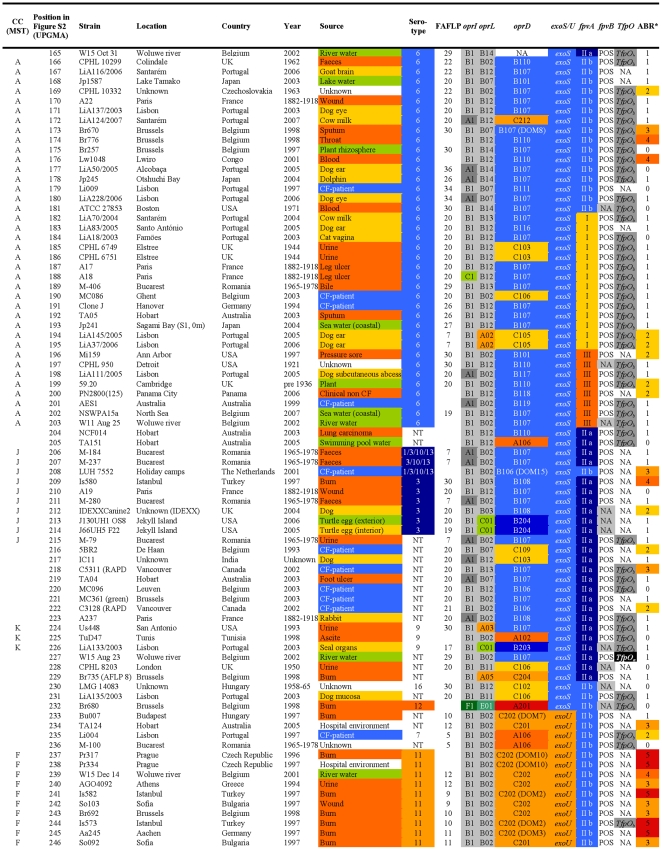
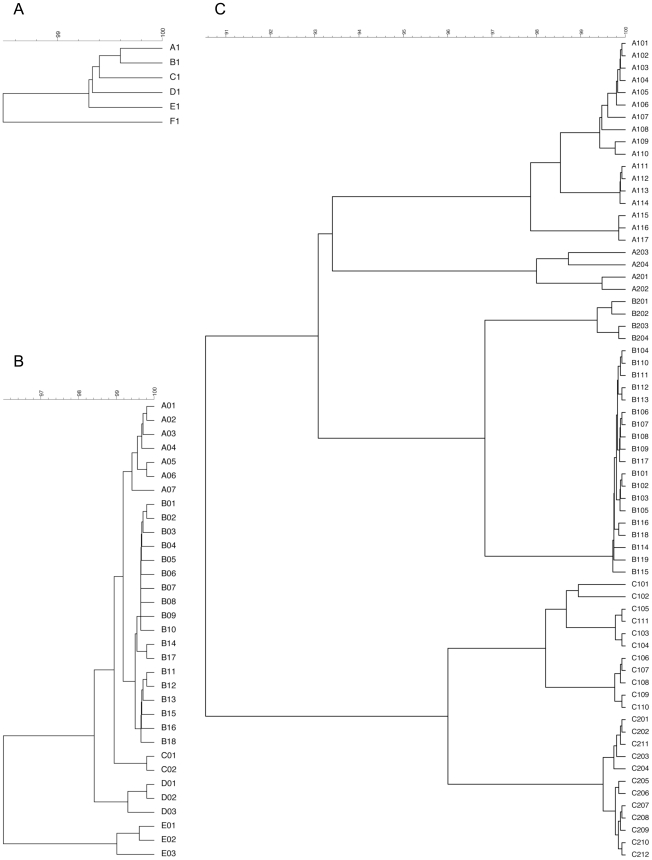
At present there are strong indications that Pseudomonas aeruginosa exhibits an epidemic population structure; clinical isolates are indistinguishable from environmental isolates, and they do not exhibit a specific (disease) habitat selection. However, some important issues, such as the worldwide emergence of highly transmissible P. aeruginosa clones among cystic fibrosis (CF) patients and the spread and persistence of multidrug resistant (MDR) strains in hospital wards with high antibiotic pressure, remain contentious. To further investigate the population structure of P. aeruginosa, eight parameters were analyzed and combined for 328 unrelated isolates, collected over the last 125 years from 69 localities in 30 countries on five continents, from diverse clinical (human and animal) and environmental habitats. The analysed parameters were: i) O serotype, ii) Fluorescent Amplified-Fragment Length Polymorphism (FALFP) pattern, nucleotide sequences of outer membrane protein genes, iii) oprI, iv) oprL, v) oprD, vi) pyoverdine receptor gene profile (fpvA type and fpvB prevalence), and prevalence of vii) exoenzyme genes exoS and exoU and viii) group I pilin glycosyltransferase gene tfpO. These traits were combined and analysed using biological data analysis software and visualized in the form of a minimum spanning tree (MST). We revealed a network of relationships between all analyzed parameters and non-congruence between experiments. At the same time we observed several conserved clones, characterized by an almost identical data set. These observations confirm the nonclonal epidemic population structure of P. aeruginosa, a superficially clonal structure with frequent recombinations, in which occasionally highly successful epidemic clones arise. One of these clones is the renown and widespread MDR serotype O12 clone. On the other hand, we found no evidence for a widespread CF transmissible clone. All but one of the 43 analysed CF strains belonged to a ubiquitous P. aeruginosa "core lineage" and typically exhibited the exoS(+)/exoU(-) genotype and group B oprL and oprD alleles. This is to our knowledge the first report of an MST analysis conducted on a polyphasic data set.
Conflict of interest statement
Figures





References
-
- Gessard C. Sur les colorations bleue et verte des linges à pansements. Comptes-rendus hebdomadaire des séances de l'Académie des Sciences. 1882;94:536–538.
-
- Goldberg JB. Pseudomonas: global bacteria. Trends Microbiol. 2000;8:55–57. - PubMed
-
- Rahme LG, Stevens EJ, Wolfort SF, Shao J, Tompkins RG, et al. Common virulence factors for bacterial pathogenicity in plants and animals. Science. 1995;268:1899–1902. - PubMed
-
- Foght JM, Westlake DWS, Johnson WM, Ridgway HF. Environmental gasoline-utilizing isolates of Pseudomonas aeruginosa are taxonomically indistinguishable by chemotaxonomic and molecular techniques. Microbiology. 1996;142:2333–2340. - PubMed
Publication types
MeSH terms
LinkOut - more resources
Full Text Sources
