


TLR-dependent control of Francisella tularensis infection and host inflammatory responses
- PMID: 19936231
- PMCID: PMC2775407
- DOI: 10.1371/journal.pone.0007920
TLR-dependent control of Francisella tularensis infection and host inflammatory responses
Abstract
Background: Francisella tularensis is the causative agent of tularemia and is classified as a Category A select agent. Recent studies have implicated TLR2 as a critical element in the host protective response to F. tularensis infection, but questions remain about whether TLR2 signaling dominates the response in all circumstances and with all species of Francisella and whether F. tularensis PAMPs are predominantly recognized by TLR2/TLR1 or TLR2/TLR6. To address these questions, we have explored the role of Toll-like receptors (TLRs) in the host response to infections with F. tularensis Live Vaccine Strain (LVS) and F. tularensis subspecies (subsp.) novicida in vivo.
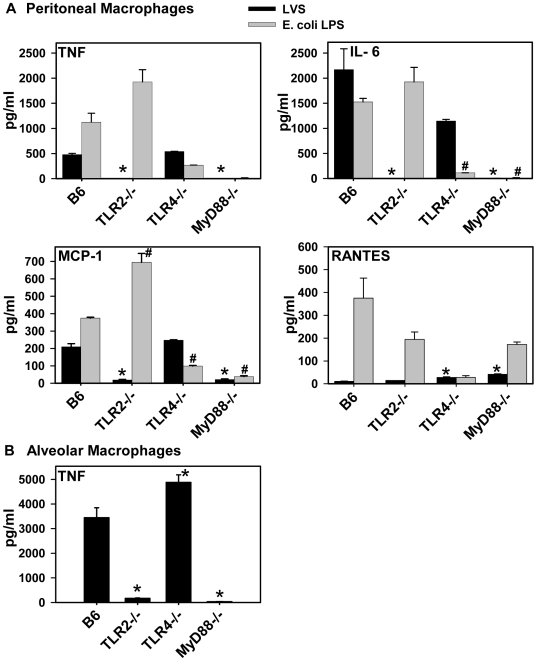
Methodology/principal findings: C57BL/6 (B6) control mice and TLR- or MyD88-deficient mice were infected intranasally (i.n.) or intradermally (i.d.) with F. tularensis LVS or with F. tularensis subsp. novicida. B6 mice survived >21 days following infection with LVS by both routes and survival of TLR1(-/-), TLR4(-/-), and TLR6(-/-) mice infected i.n. with LVS was equivalent to controls. Survival of TLR2(-/-) and MyD88(-/-) mice, however, was significantly reduced compared to B6 mice, regardless of the route of infection or the subspecies of F. tularensis. TLR2(-/-) and MyD88(-/-) mice also showed increased bacterial burdens in lungs, liver, and spleen compared to controls following i.n. infection. Primary macrophages from MyD88(-/-) and TLR2(-/-) mice were significantly impaired in the ability to secrete TNF and other pro-inflammatory cytokines upon ex vivo infection with LVS. TNF expression was also impaired in vivo as demonstrated by analysis of bronchoalveolar lavage fluid and by in situ immunofluorescent staining.
Conclusions/significance: We conclude from these studies that TLR2 and MyD88, but not TLR4, play critical roles in the innate immune response to F. tularensis infection regardless of the route of infection or the subspecies. Moreover, signaling through TLR2 does not depend exclusively on TLR1 or TLR6 during F. tularensis LVS infection.
Conflict of interest statement
Figures




References
-
- Bosio CM, Dow SW. Francisella tularensis induces aberrant activation of pulmonary dendritic cells. J Immunol. 2005;175:6792–6801. - PubMed
-
- Ben Nasr A, Haithcoat J, Masterson JE, Gunn JS, Eaves-Pyles T, et al. Critical role for serum opsonins and complement receptors CR3 (CD11b/CD18) and CR4 (CD11c/CD18) in phagocytosis of Francisella tularensis by human dendritic cells (DC): uptake of Francisella leads to activation of immature DC and intracellular survival of the bacteria. J Leukoc Biol. 2006;80:774–786. - PubMed
Publication types
MeSH terms
Substances
Grants and funding
LinkOut - more resources
Full Text Sources
Molecular Biology Databases
