


Synergy between repellents and organophosphates on bed nets: efficacy and behavioural response of natural free-flying An. gambiae mosquitoes
- PMID: 19936249
- PMCID: PMC2775911
- DOI: 10.1371/journal.pone.0007896
Synergy between repellents and organophosphates on bed nets: efficacy and behavioural response of natural free-flying An. gambiae mosquitoes
Abstract
Background: Chemicals are used on bed nets in order to prevent infected bites and to kill aggressive malaria vectors. Because pyrethroid resistance has become widespread in the main malaria vectors, research for alternative active ingredients becomes urgent. Mixing a repellent and a non-pyrethroid insecticide seemed to be a promising tool as mixtures in the laboratory showed the same features as pyrethroids.
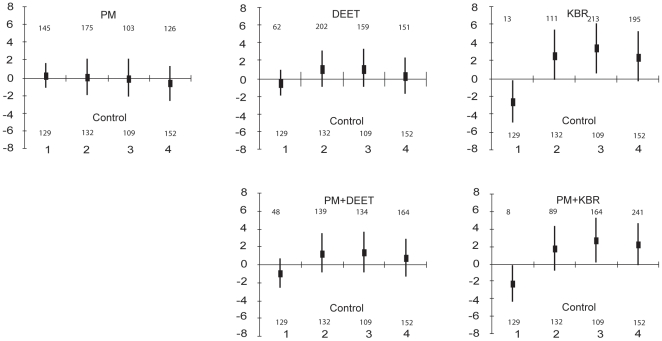
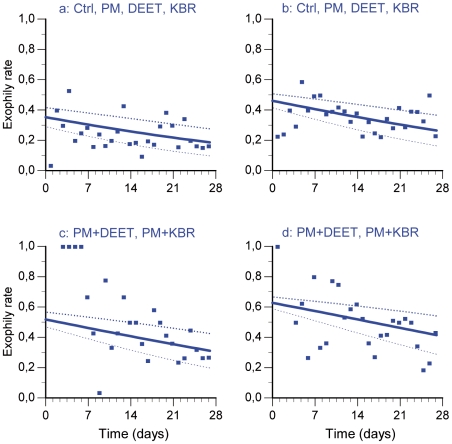
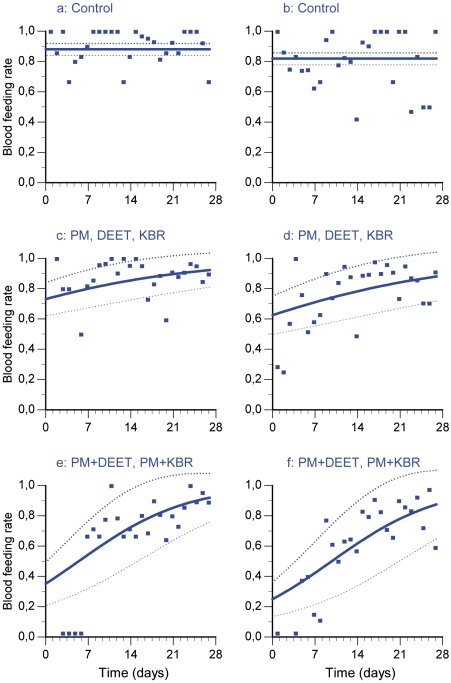
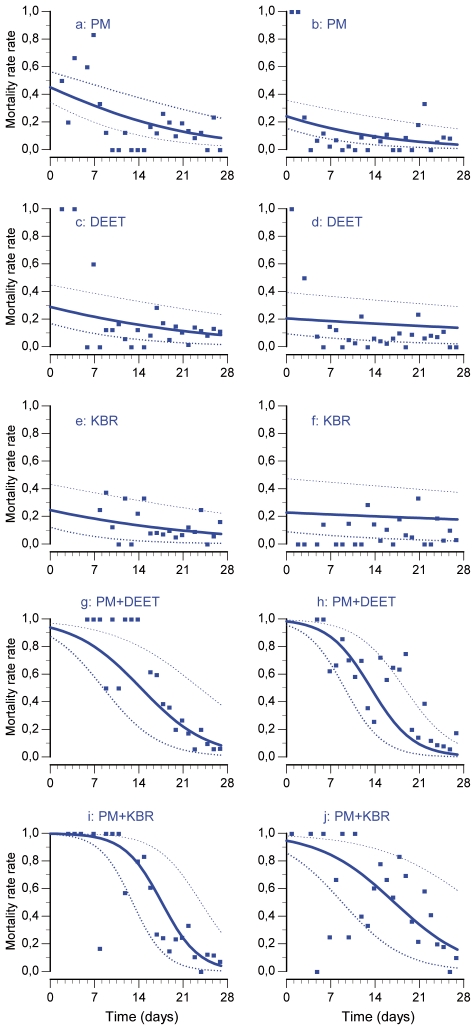
Methodology/principal findings: We present here the results of two trials run against free-flying Anopheles gambiae populations comparing the effects of two insect repellents (either DEET or KBR 3023, also known as icaridin) and an organophosphate insecticide at low-doses (pirimiphos-methyl, PM) used alone and in combination on bed nets. We showed that mixtures of PM and the repellents induced higher exophily, blood feeding inhibition and mortality among wild susceptible and resistant malaria vectors than compounds used alone. Nevertheless the synergistic interactions are only involved in the high mortality induced by the two mixtures.
Conclusion: These field trials argue in favour of the strategy of mixing repellent and organophosphate on bed nets to better control resistant malaria vectors.
Conflict of interest statement
Figures
References
-
- Peters W. Plasmodium: resistance to antimalarial drugs. Ann Parasitol Hum Comp. 1990;65(Suppl 1):103–106. - PubMed
-
- WHO. The world malaria report 2005. 2005. Geneva, World Health Organzation: Available: http://rbm.who.int/wmr2005/
-
- Greenwood BM, Bojang K, Whitty CJ, Targett GA. Malaria. Lancet. 2005;365:1487–1498. - PubMed
-
- Costantini C, Gibson G, Sagnon N, Della Torre A, Brady J, et al. Mosquito responses to carbon dioxide in a west African Sudan savanna village. Med Vet Entomol. 1996;10:220–227. - PubMed
-
- Costantini C, Sagnon NF, della Torre A, Diallo M, Brady J, et al. Odor-mediated host preferences of West African mosquitoes, with particular reference to malaria vectors. Am J Trop Med Hyg. 1998;58:56–63. - PubMed
Publication types
MeSH terms
Substances
LinkOut - more resources
Full Text Sources
