


Administration of Mycobacterium leprae rHsp65 aggravates experimental autoimmune uveitis in mice
- PMID: 19936251
- PMCID: PMC2775913
- DOI: 10.1371/journal.pone.0007912
Administration of Mycobacterium leprae rHsp65 aggravates experimental autoimmune uveitis in mice
Abstract
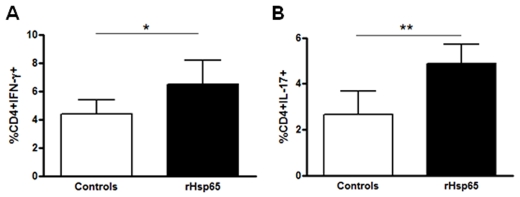
The 60 kDa heat shock protein family, Hsp60, constitutes an abundant and highly conserved class of molecules that are highly expressed in chronic-inflammatory and autoimmune processes. Experimental autoimmune uveitis [EAU] is a T cell mediated intraocular inflammatory disease that resembles human uveitis. Mycobacterial and homologous Hsp60 peptides induces uveitis in rats, however their participation in aggravating the disease is poorly known. We here evaluate the effects of the Mycobacterium leprae Hsp65 in the development/progression of EAU and the autoimmune response against the eye through the induction of the endogenous disequilibrium by enhancing the entropy of the immunobiological system with the addition of homologous Hsp. B10.RIII mice were immunized subcutaneously with interphotoreceptor retinoid-binding protein [IRBP], followed by intraperitoneally inoculation of M. leprae recombinant Hsp65 [rHsp65]. We evaluated the proliferative response, cytokine production and the percentage of CD4(+)IL-17(+), CD4(+)IFN-gamma(+) and CD4(+)Foxp3(+) cells ex vivo, by flow cytometry. Disease severity was determined by eye histological examination and serum levels of anti-IRBP and anti-Hsp60/65 measured by ELISA. EAU scores increased in the Hsp65 group and were associated with an expansion of CD4(+)IFN-gamma(+) and CD4(+)IL-17(+) T cells, corroborating with higher levels of IFN-gamma. Our data indicate that rHsp65 is one of the managers with a significant impact over the immune response during autoimmunity, skewing it to a pathogenic state, promoting both Th1 and Th17 commitment. It seems comprehensible that the specificity and primary function of Hsp60 molecules can be considered as a potential pathogenic factor acting as a whistleblower announcing chronic-inflammatory diseases progression.
Conflict of interest statement
Figures




References
-
- Whitcup SM, Nussenblatt RB. Immunologic mechanisms of uveitis. New targets for immunomodulation. Arch Ophthalmol. 1997;115:520–525. - PubMed
-
- Caspi RR, Roberge FG, Chan CC, Wiggert B, Chader GJ, et al. A new model of autoimmune disease. Experimental autoimmune uveoretinitis induced in mice with two different retinal antigens. J Immunol. 1988;140:1490–1495. - PubMed
-
- Mochizuki M, Kuwabara T, McAllister C, Nussenblatt RB, Gery I. Adoptive transfer of experimental autoimmune uveoretinitis in rats. Immunopathogenic mechanisms and histologic features. Invest Ophthalmol Vis Sci. 1985;26:1–9. - PubMed
-
- Rizzo LV, Silver P, Wiggert B, Hakim F, Gazzinelli RT, et al. Establishment and characterization of a murine CD4+ T cell line and clone that induce experimental autoimmune uveoretinitis in B10.A mice. J Immunol. 1996;156:1654–1660. - PubMed
-
- Thole JE, Hindersson P, de Bruyn J, Cremers F, van der Zee J, et al. Antigenic relatedness of a strongly immunogenic 65 kDA mycobacterial protein antigen with a similarly sized ubiquitous bacterial common antigen. Microb Pathog. 1988;4:71–83. - PubMed
Publication types
MeSH terms
Substances
LinkOut - more resources
Full Text Sources
Medical
Research Materials
Miscellaneous
