


Development of multilayered cell-hydrogel composites using an acoustic focusing technique
- PMID: 19938043
- PMCID: PMC2854877
- DOI: 10.1002/btpr.332
Development of multilayered cell-hydrogel composites using an acoustic focusing technique
Abstract
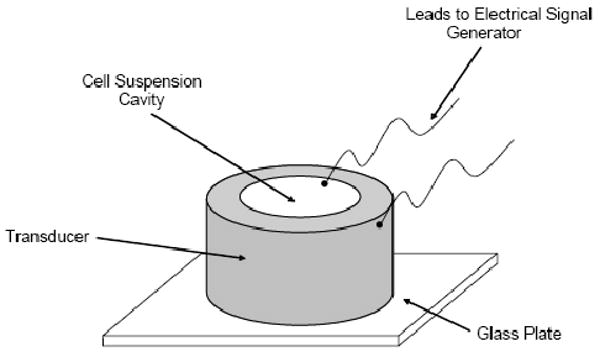
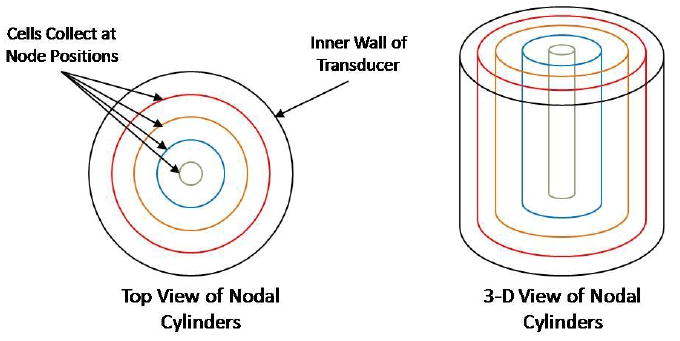
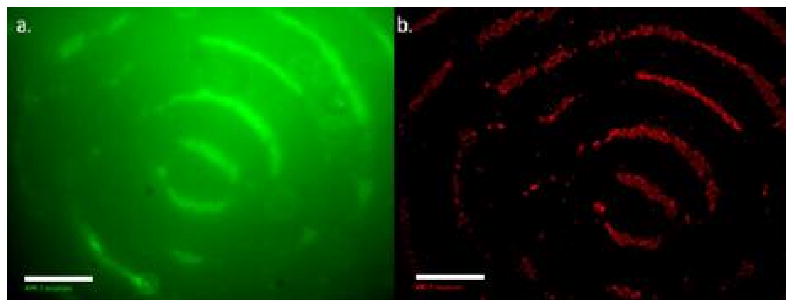
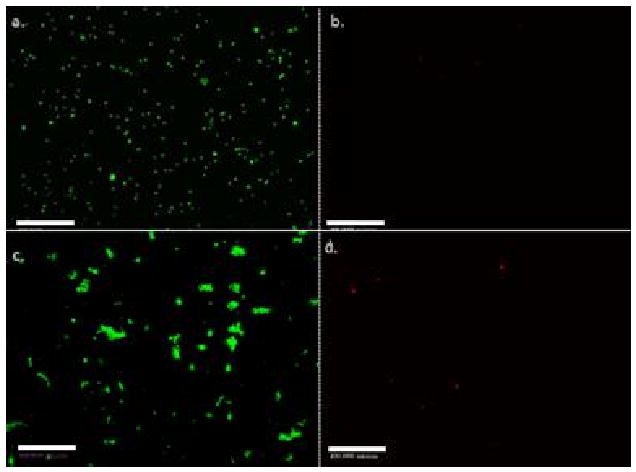
Multilayered composites, composed of mammalian cells arranged in a hydrogel, have been prepared using an acoustic focusing technique. Acoustic focusing is a simple, nonchemical technique that allows for the fast arrangement of cells in matrices where the control of cell geometry is beneficial. Breast cancer cells (MDA-MB231) were dispersed in a 30 wt % solution of poly(ethylene glycol) diacrylate (PEGDA) of molecular weight 400 at a density of 5 x 10(6) cells/mL of PEGDA solution. An ultrasonic field was used to organize the cells before polymerization of PEGDA. Disk-shaped hydrogel composites, typically 1 cm in diameter and 2-mm thick were prepared based on a PEGDA solution volume of 130 microL. At an acoustic frequency of 2.32 MHz, composites having cells positioned within concentric cylindrical shells interspersed with zones of cell-free hydrogel were produced. The cells were located in annuli approximately 80-microm thick and about 300 microm apart. The structure and viability of the cells within these constructs were studied using a fluorescent LIVE/DEAD assay. The viability of the cells was on the order of 50%. For the conditions used in this study, cell death was primarily attributed to exposure of cells to the PEGDA solution prior to polymerization, rather than adverse effects of polymerization or the sound field itself.
Figures
References
-
- Gupta S, Feke DL, Manas-Zloczower I. Fractionation of mixed particulate solids according to compressibility using ultrasonic standing wave fields. Chemical Engineering Science. 1995;50(20):3275–3284.
-
- Pangu G, Feke DL. Droplet transport and coalescence kinetics in emulsions subjected to acoustic fields. Ultrasonics. 2007;46(4):289–302. - PubMed
-
- Saito M, et al. Fabrication of polymer composite with periodic structure by the use of ultrasonic waves. Journal of Applied Physics. 1998;83(7):3490–3494.
-
- Hawkes JJ, et al. Ultrasonic deposition of cells on a surface. Biosensors and Bioelectronics. 2004;19(9):1021–1028. - PubMed
-
- Gherardini L, et al. A study of the spatial organization of microbial cells in a gel matrix subjected to treatment with ultrasound standing waves. Bioseparation. 2001;10(4):153–162. - PubMed
Publication types
MeSH terms
Substances
Grants and funding
LinkOut - more resources
Full Text Sources
