


Comparative Study
doi: 10.1021/pr900816a.
Comparison of database search strategies for high precursor mass accuracy MS/MS data
Affiliations
- PMID: 19938873
- PMCID: PMC2818881
- DOI: 10.1021/pr900816a
Item in Clipboard
Comparative Study
Comparison of database search strategies for high precursor mass accuracy MS/MS data
J Proteome Res.
.
Abstract
In shotgun proteomics, the analysis of tandem mass spectrometry data from peptides can benefit greatly from high mass accuracy measurements. In this study, we have evaluated two database search strategies which use high mass accuracy measurements of the peptide precursor ion. Our results indicate that peptide identifications are improved when spectra are searched with a wide mass tolerance window and precursor mass is used as a filter to discard incorrect matches. Database searches with a peptide data set constrained to peptides within a narrow mass window resulted in fewer peptide identifications but a significantly faster database search time.
Figures

Illustrations of two peptide database search methods using accurate precursor mass measurements. A) The peptide list used for database searching is constrained to a narrow mass tolerance window. B) The mass tolerance used to limit the peptide list, is set to a large value. After database searching, peptide results that have a mass difference greater than a narrow mass tolerance window are given an XCorr value of 0.

Results of different search methods on peptide spectrum matches. The number of peptide spectrum matches from the target database search are plotted versus false discovery rates. False discovery rates are calculated as described in Materials and Methods. A) The results from narrowing the mass tolerance for peptides used in database searching. B) The results for the database search of the Bullseye dataset with wide mass tolerances followed by filtering the results with a narrow mass tolerance window.
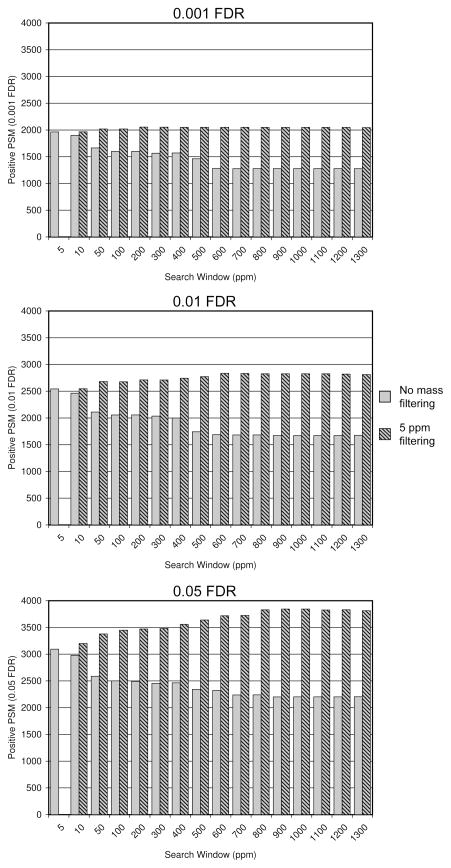
The number of peptide spectrum matches obtained from database searches using mass tolerances from 5 ppm to 1,300 ppm are shown at an FDR thresholds of 0.001, 0.01 and 0.05. The sensitivity improvement obtained when post-search filtering is used is dependent on the FDR threshold and the mass tolerance used during database searches.
References
-
- Geer LY, Markey SP, Kowalak JA, Wagner L, Xu M, Maynard DM, Yang X, Shi W, Bryant SH. Open Mass Spectrometry Search Algorithm. Journal of Proteome Research. 2004;3(5):958–964. - PubMed
-
- Craig R, Beavis RC. TANDEM: matching proteins with tandem mass spectra. Bioinformatics. 2004;20(9):1466–1467. - PubMed
-
- Eng JK, McCormack AL, Yates JR. An approach to correlate tandem mass spectral data of peptides with amino acid sequences in a protein database. Journal of the American Society for Mass Spectrometry. 1994;5(11):976–989. - PubMed
Publication types
MeSH terms
Substances
Grants and funding
LinkOut - more resources
Full Text Sources
Other Literature Sources
