


Cancer risk among infertile women with androgen excess or menstrual disorders (including polycystic ovary syndrome)
- PMID: 19939368
- PMCID: PMC2888728
- DOI: 10.1016/j.fertnstert.2009.10.012
Cancer risk among infertile women with androgen excess or menstrual disorders (including polycystic ovary syndrome)
Abstract
Objective: To define relationships of androgen excesses to cancer risk.
Design: Retrospective cohort study.
Setting: Five large infertility practices.
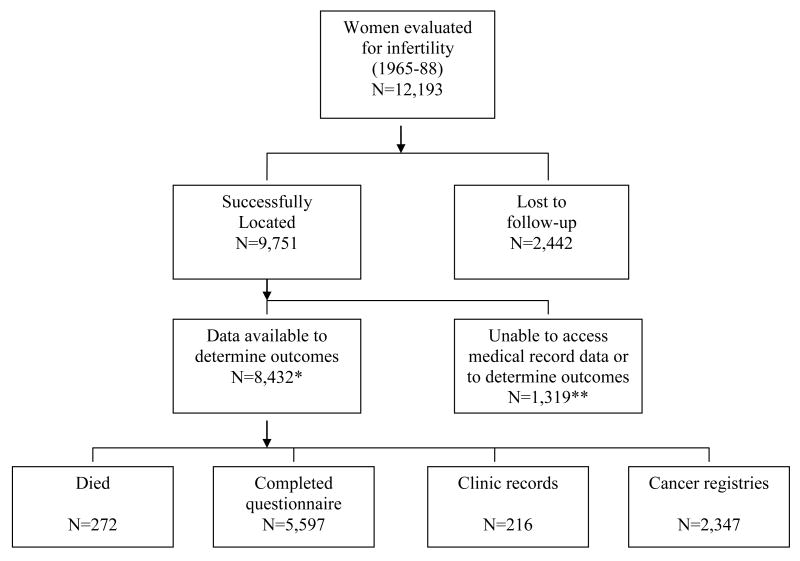
Patient(s): Among 12,193 women evaluated for infertility during 1965-1988 and traced for cancer incidence through 1999, 2,560 had androgen excess or menstrual disorders; among these, 412 met established criteria for polycystic ovary syndrome.
Intervention(s): None.
Main outcome measure(s): Cancer incidence. Derivation of standardized incidence ratios (SIRs) and 95% confidence intervals (CIs) for cancer risk comparisons with the general population and rate ratios (RRs) for comparisons with other infertility patients.
Result(s): Androgen excess/menstrual disorder patients showed significant SIRs for breast (1.31; 95% CI, 1.05-1.62) and uterine (2.02; 95% CI, 1.13-3.34) cancers and melanoma (1.96; 95% CI, 1.12-3.18). Significant associations for breast and uterine cancers were restricted to primary infertility patients (respective SIRs of 1.53 and 3.48). After adjustment for other cancer predictors, the only excess risk was for uterine cancer among primary infertility patients. Compared with women with secondary infertility and no androgen excess/menstrual disorder, those with primary infertility and a disorder had an RR of 1.88 (95% CI, 0.82-4.32). Cancer risks among the women with polycystic ovary syndrome or androgen excess disorders appeared to be similar to those in the more comprehensive group.
Conclusion(s): Previous findings linking androgen excess disorders to elevated uterine cancer risks might largely reflect underlying risk profiles.
Published by Elsevier Inc.
Figures
References
-
- Eliassen AH, Hankinson SE. Endogenous hormone levels and risk of breast, endometrial and ovarian cancers: prospective studies. Adv Exp Med Biol. 2008;630:148–165. - PubMed
-
- Azziz R, Woods KS, Reyna R, Key TJ, Knochenhauer ES, Yildiz BO. The prevalence and features of the polycystic ovary syndrome in an unselected population. J Clin Endocrinol Metab. 2004;89(6):2745–2749. - PubMed
-
- Knochenhauer ES, Key TJ, Kahsar-Miller M, Waggoner W, Boots LR, Azziz R. Prevalence of the polycystic ovary syndrome in unselected black and white women of the southeastern United States: a prospective study. J Clin Endocrinol Metab. 1998;83(9):3078–3082. - PubMed
-
- Legro RS, Myers E. Surrogate end-points or primary outcomes in clinical trials in women with polycystic ovary syndrome? Hum Reprod. 2004;19(8):1697–1704. - PubMed
-
- Revised 2003 consensus on diagnostic criteria and long-term health risks related to polycystic ovary syndrome (PCOS) Hum Reprod. 2004;19(1):41–47. - PubMed
Publication types
MeSH terms
Grants and funding
LinkOut - more resources
Full Text Sources
Medical
Miscellaneous
