


Gender-related dissociation in outcomes in chronic heart failure: reduced mortality but similar hospitalization in women
- PMID: 19939481
- PMCID: PMC2888923
- DOI: 10.1016/j.ijcard.2009.10.019
Gender-related dissociation in outcomes in chronic heart failure: reduced mortality but similar hospitalization in women
Abstract
Background: The impact of gender on major natural history endpoints in heart failure (HF) has not been examined in a propensity-matched study.
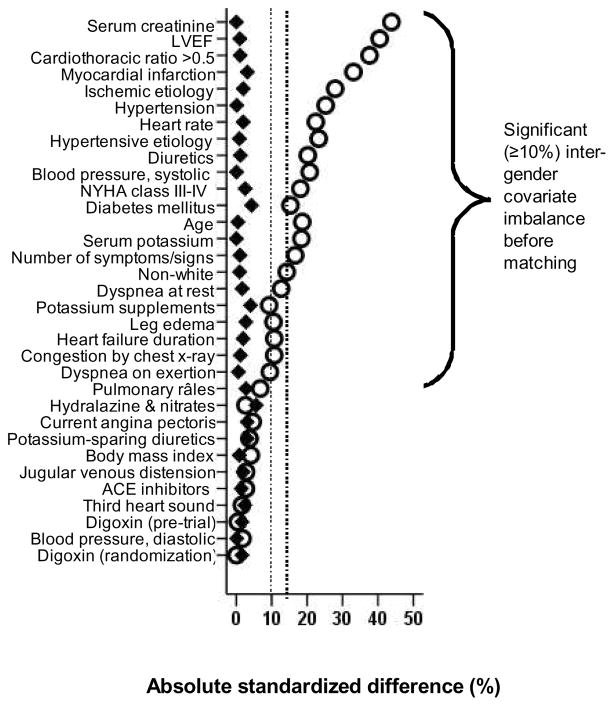
Methods: Of the 7788 chronic systolic and diastolic HF patients in the Digitalis Investigation Group trial 1926 were women. Propensity scores for female gender were used to assemble a cohort of 1669 pairs of men and women who were well-balanced on 32 measured baseline characteristics. Matched hazard ratios (HR) and 95% confidence intervals (CI) for outcomes associated with female gender were calculated using stratified Cox regression models.
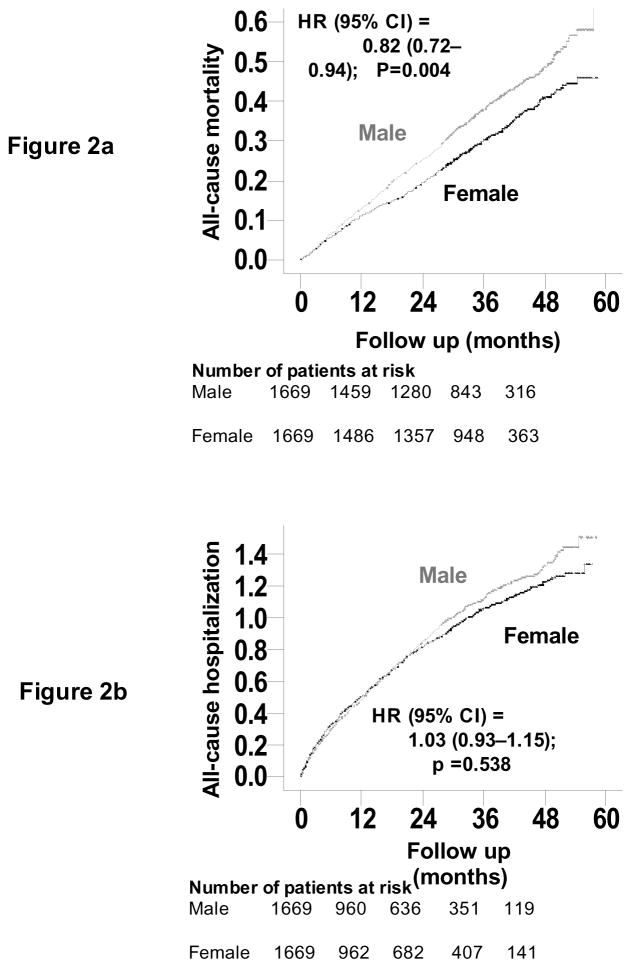
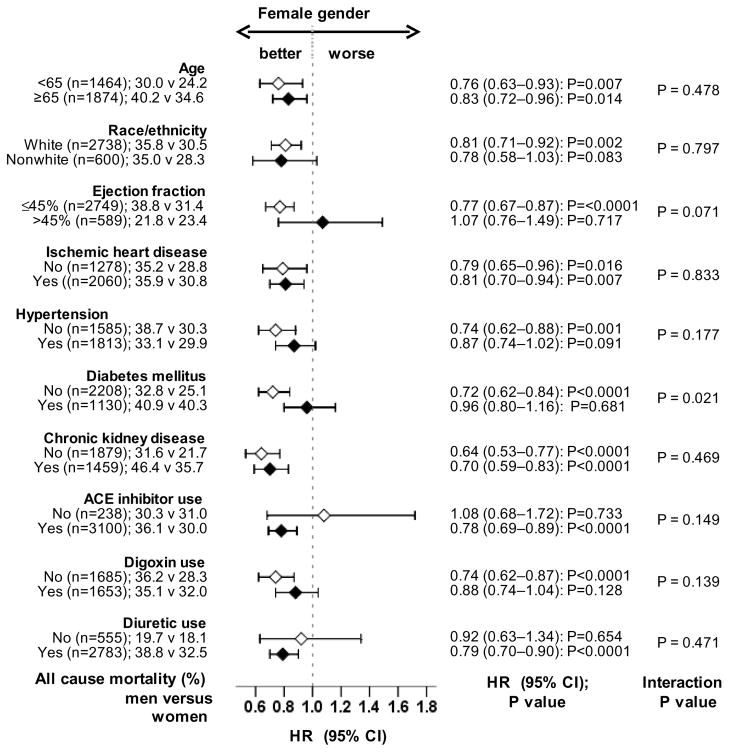
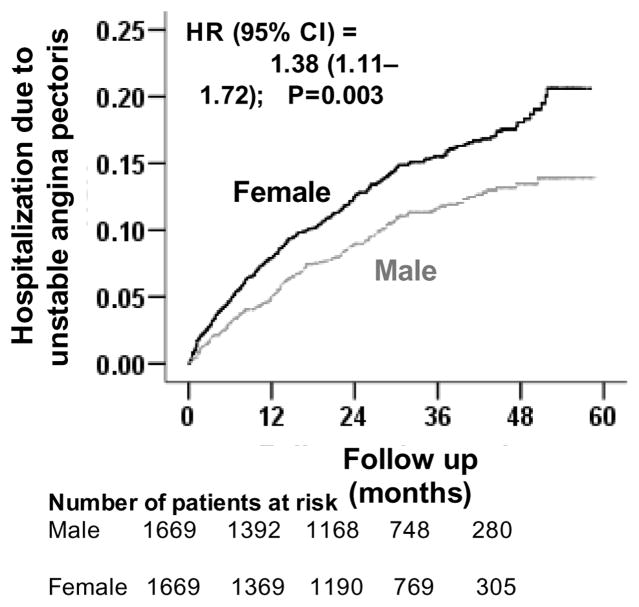
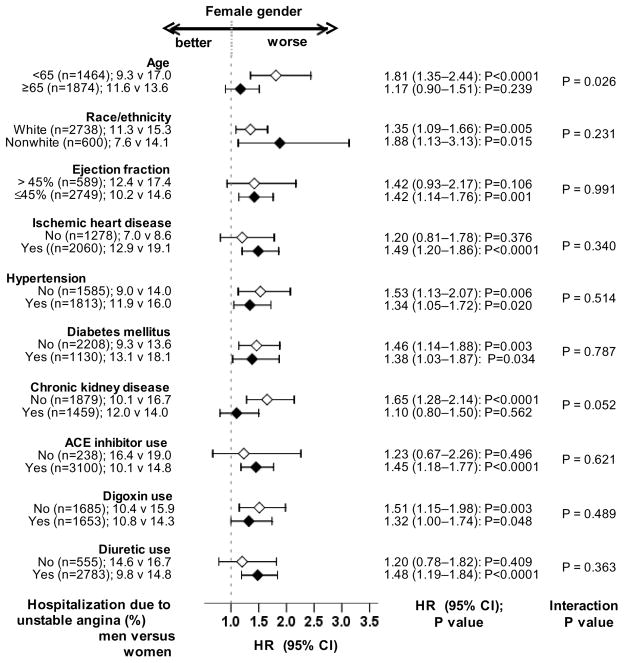
Results: All-cause mortality occurred in 36% (rate, 1256/10,000 person-years) and 30% (rate, 1008/10,000 person-years) of matched men and women respectively during 5 years of follow up (HR when women were compared with men, 0.82, 95% CI, 0.72-0.94, P=0.004). Female gender was also associated with reduced cardiovascular mortality (matched HR, 0.85; 95% CI, 0.73-0.99, P=0.037) and a trend toward reduced non-cardiovascular mortality (matched HR, 0.73; 95% CI, 0.53-1.00; P=0.053). All-cause hospitalization occurred in 67% (rate, 4003/10,000 person-years) and 65% (rate, 3762/10,000 person-years) matched male and female patients respectively (HR for women, 1.03, 95% CI, 0.93-1.15, P=0.538). Female gender was not associated with cardiovascular or HF hospitalization but was associated with hospitalization due to unstable angina pectoris (matched HR, 1.38; 95%CI, 1.11-1.72; P=0.003) and stroke (matched HR, 0.65; 95%CI, 0.46-0.92; P=0.014).
Conclusions: In patients with chronic HF, female gender has a significant independent association with improved survival but has no association with all-cause, cardiovascular, or HF hospitalizations.
Published by Elsevier Ireland Ltd.
Figures
References
-
- Schocken DD, Arrieta MI, Leaverton PE, Ross EA. Prevalence and mortality rate of congestive heart failure in the United States. J Am Coll Cardiol. 1992;20:301–6. - PubMed
-
- Ho KK, Anderson KM, Kannel WB, Grossman W, Levy D. Survival after the onset of congestive heart failure in Framingham Heart Study subjects. Circulation. 1993;88:107–15. - PubMed
-
- Adams KF, Jr, Sueta CA, Gheorghiade M, et al. Gender differences in survival in advanced heart failure. Insights from the FIRST study. Circulation. 1999;99:1816–21. - PubMed
-
- Simon T, Mary-Krause M, Funck-Brentano C, Jaillon P. Sex differences in the prognosis of congestive heart failure: results from the Cardiac Insufficiency Bisoprolol Study (CIBIS II) Circulation. 2001;103:375–80. - PubMed
-
- Alla F, Al-Hindi AY, Lee CR, Schwartz TA, Patterson JH, Adams KF., Jr Relation of sex to morbidity and mortality in patients with heart failure and reduced or preserved left ventricular ejection fraction. Am Heart J. 2007;153:1074–80. - PubMed
Publication types
MeSH terms
Grants and funding
LinkOut - more resources
Full Text Sources
Medical
Research Materials
Miscellaneous
