


Typology of club drug use among young adults recruited using time-space sampling
- PMID: 19939585
- PMCID: PMC2821995
- DOI: 10.1016/j.drugalcdep.2009.09.014
Typology of club drug use among young adults recruited using time-space sampling
Abstract
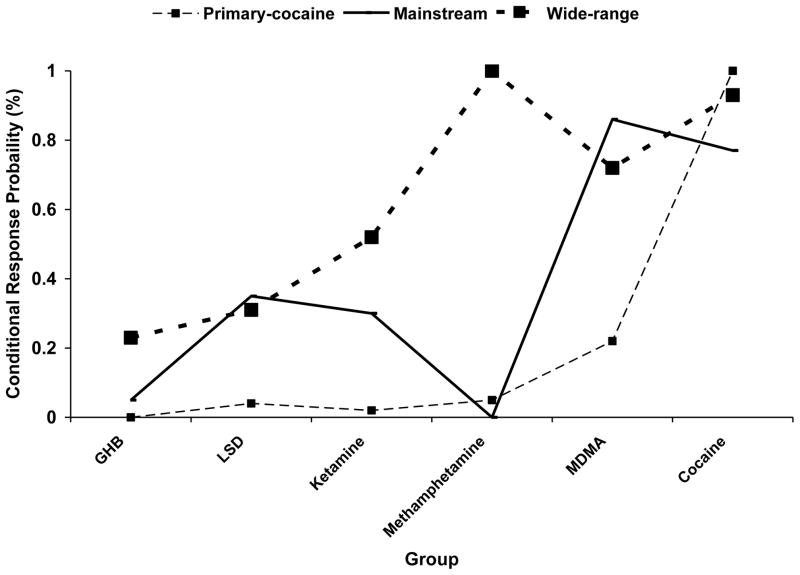
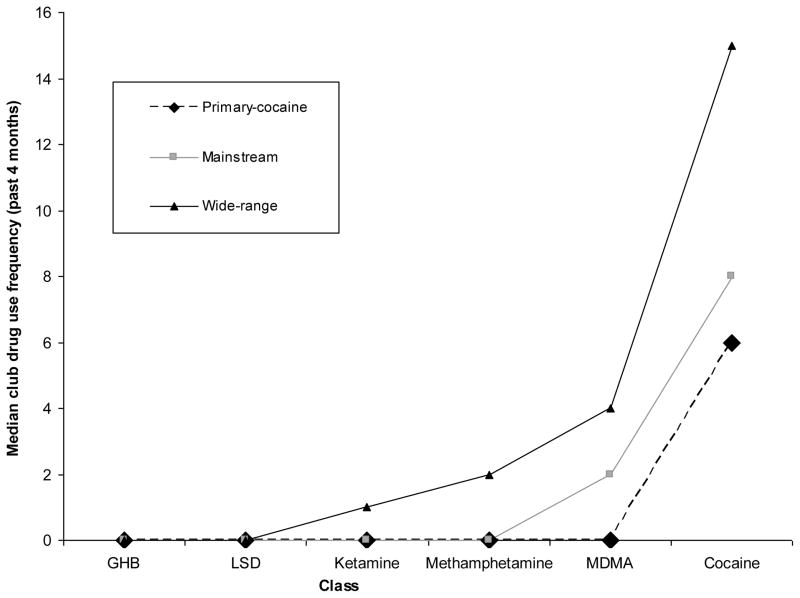
The present study examined patterns of recent club drug use among 400 young adults (18-29) recruited using time-space sampling in NYC. Subjects had used at least one of six club drugs (methylenedioxymethamphetamine (MDMA), ketamine, gamma-hydroxybutyrate (GHB), cocaine, methamphetamine, and D-lysergic acid diethylamide (LSD)) within the prior 3 months. We used latent class analysis (LCA) to estimate latent groups based on patterns of recent club drug use and examined differences in demographic and psychological variables by class. A 3-class model fit the data best. Patterns were: Primary cocaine users (42% of sample), Mainstream users (44% of sample), and Wide-range users (14% of sample). Those most likely to be Primary cocaine users were significantly less likely to be heterosexual males and had higher educational attainment than the other two classes. Those most likely to be Wide-range users were less likely to be heterosexual females, more likely to be gay/bisexual males, dependent on club drugs, had significantly greater drug and sexual sensation seeking, and were more likely to use when experiencing physical discomfort or pleasant times with others compared to the other two groups. Findings highlight the utility of using person-centered approaches to understand patterns of substance use, as well as highlight several patterns of club drug use among young adults.
Copyright 2009 Elsevier Ireland Ltd. All rights reserved.
Conflict of interest statement
Figures
References
-
- Akaike H. In: Petrov BN, Csaki F, editors. Information theory and an extension of the maximum likelihood principle; Second International Symposium in Information Theory; Akademiai, Kiado, Budapest. 1973. pp. 267–281.
-
- Akram G, Galt M. A profile of harm reduction practices and co-use of illicit and licit drugs amongst users of dance drugs. Drugs: Education, Prevention, & Policy. 1999;6:215–225.
-
- Beatty RL, Geckle MO, Huggins J, Kapner C, Lewis K, Sandstrom DJ. Gay men, lesbians, and bisexuals. In: McCrady BS, Epstein EE, editors. Addictions: A Comprehensive Guidebook. Oxford University Press; New York: 1999. pp. 542–551.
-
- Boyd CJ, McCabe SE, d’Arcy H. Ecstasy use among college undergraduates: Gender, race, and sexual identity. J Subst Abuse Treat. 2003;24:209–215. - PubMed
-
- Boys A, Marsden J, Griffiths P, Fountain J, Stillwell G, Strang J. Substance use among young people: The relationship between perceived functions and intentions. Addiction. 1999;94:1043–1050. - PubMed
Publication types
MeSH terms
Substances
Grants and funding
LinkOut - more resources
Full Text Sources
Medical
Research Materials
