


Time of feeding and the intrinsic circadian clock drive rhythms in hepatic gene expression
- PMID: 19940241
- PMCID: PMC2795502
- DOI: 10.1073/pnas.0909591106
Time of feeding and the intrinsic circadian clock drive rhythms in hepatic gene expression
Abstract
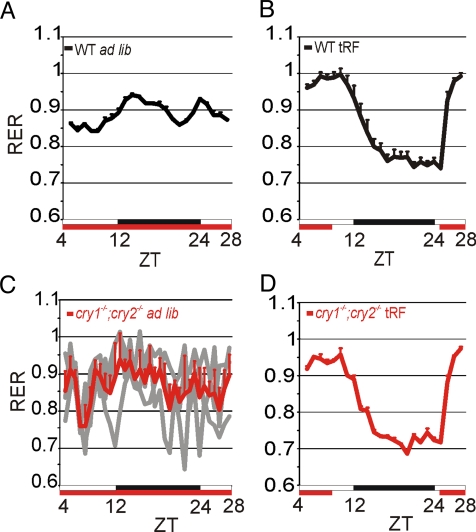
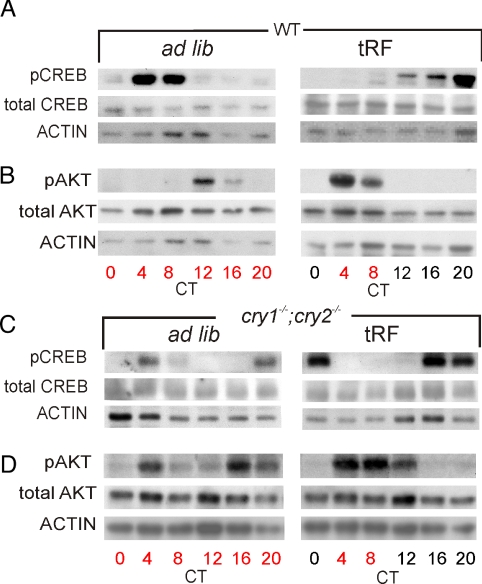
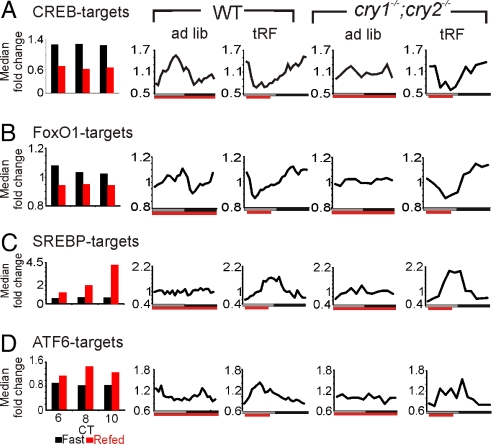
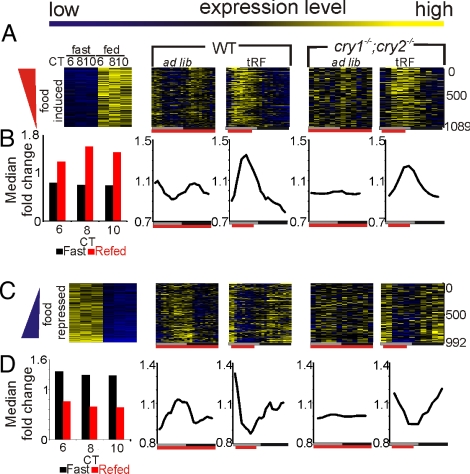
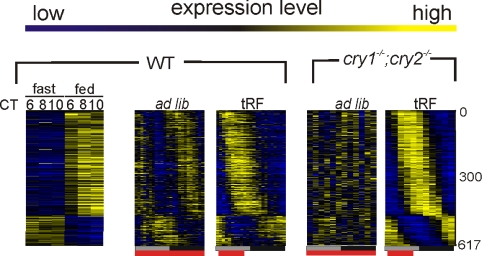
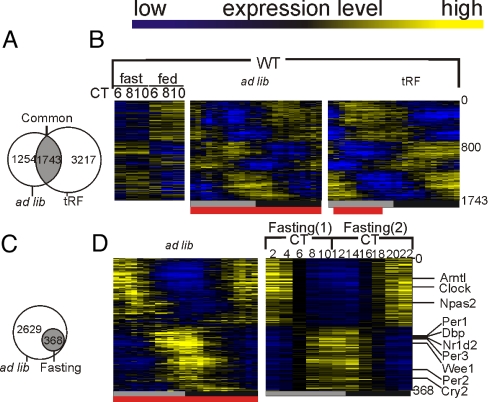
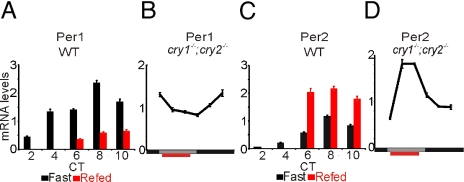
In mammals, the circadian oscillator generates approximately 24-h rhythms in feeding behavior, even under constant environmental conditions. Livers of mice held under constant darkness exhibit circadian rhythm in abundance in up to 15% of expressed transcripts. Therefore, oscillations in hepatic transcripts could be driven by rhythmic food intake or sustained by the hepatic circadian oscillator, or a combination of both. To address this question, we used distinct feeding and fasting paradigms on wild-type (WT) and circadian clock-deficient mice. We monitored temporal patterns of feeding and hepatic transcription. Both food availability and the temporal pattern of feeding determined the repertoire, phase, and amplitude of the circadian transcriptome in WT liver. In the absence of feeding, only a small subset of transcripts continued to express circadian patterns. Conversely, temporally restricted feeding restored rhythmic transcription of hundreds of genes in oscillator-deficient mouse liver. Our findings show that both temporal pattern of food intake and the circadian clock drive rhythmic transcription, thereby highlighting temporal regulation of hepatic transcription as an emergent property of the circadian system.
Conflict of interest statement
The authors declare no conflict of interest.
Figures
References
-
- Lowrey PL, Takahashi JS. Genetics of the mammalian circadian system: Photic entrainment, circadian pacemaker mechanisms, and posttranslational regulation. Annu Rev Genet. 2000;34:533–562. - PubMed
-
- Reppert SM, Weaver DR. Coordination of circadian timing in mammals. Nature. 2002;418:935–941. - PubMed
-
- Stokkan KA, Yamazaki S, Tei H, Sakaki Y, Menaker M. Entrainment of the circadian clock in the liver by feeding. Science. 2001;291:490–493. - PubMed
Publication types
MeSH terms
Substances
Associated data
- Actions
Grants and funding
LinkOut - more resources
Full Text Sources
Other Literature Sources
Molecular Biology Databases
