


Long-range synchronization and local desynchronization of alpha oscillations during visual short-term memory retention in children
- PMID: 19943040
- PMCID: PMC2840055
- DOI: 10.1007/s00221-009-2086-9
Long-range synchronization and local desynchronization of alpha oscillations during visual short-term memory retention in children
Abstract
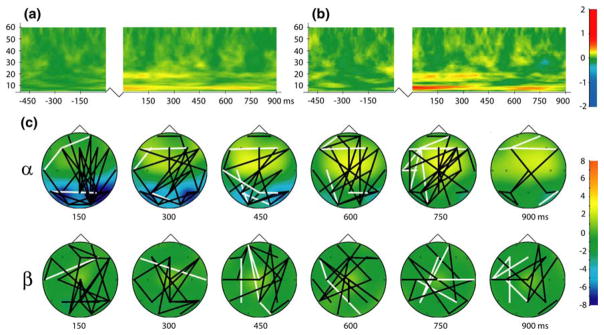
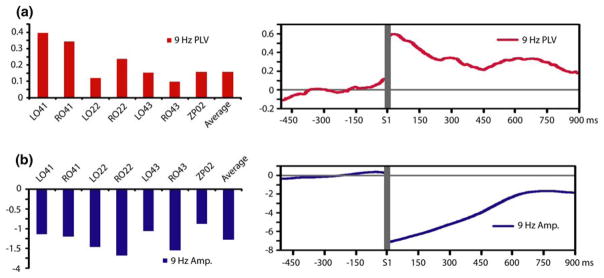
Local alpha-band synchronization has been associated with both cortical idling and active inhibition. Recent evidence, however, suggests that long-range alpha synchronization increases functional coupling between cortical regions. We demonstrate increased long-range alpha and beta band phase synchronization during short-term memory retention in children 6-10 years of age. Furthermore, whereas alpha-band synchronization between posterior cortex and other regions is increased during retention, local alpha-band synchronization over posterior cortex is reduced. This constitutes a functional dissociation for alpha synchronization across local and long-range cortical scales. We interpret long-range synchronization as reflecting functional integration within a network of frontal and visual cortical regions. Local desynchronization of alpha rhythms over posterior cortex, conversely, likely arises because of increased engagement of visual cortex during retention.
Conflict of interest statement
Figures
References
-
- Busch NA, Herrmann CS. Object-load and feature-load modulate EEG in a short-term memory task. Neuroreport. 2003;14(13):1721–1724. - PubMed
-
- Doesburg SM, Ward LM. Synchronization between sources: emerging methods for understanding large-scale functional networks in the human Brain. In: Perez-Velazquez J-L, Wennberg R, editors. Coordinated activity in the human brain: measurements and relevance to brain function and behavior. Springer; New York: 2009. pp. 25–42.
-
- Doesburg SM, Green JJ, McDonald JJ, Ward LM. From local inhibition to long-range integration: a functional dissociation of alpha-band synchronization across cortical scales in visuospatial attention. Brain Res. 2009;1303:97–110. - PubMed
-
- Foxe JJ, Simpson GV, Ahlfors SP. Parietal-occipital 10 Hz activity reflects anticipatory state of visual attention mechanisms. Neuroreport. 1998;9(17):3929–3933. - PubMed
Publication types
MeSH terms
Grants and funding
LinkOut - more resources
Full Text Sources
