


Septins enforce morphogenetic events during sexual reproduction and contribute to virulence of Cryptococcus neoformans
- PMID: 19943902
- PMCID: PMC3699866
- DOI: 10.1111/j.1365-2958.2009.06983.x
Septins enforce morphogenetic events during sexual reproduction and contribute to virulence of Cryptococcus neoformans
Abstract
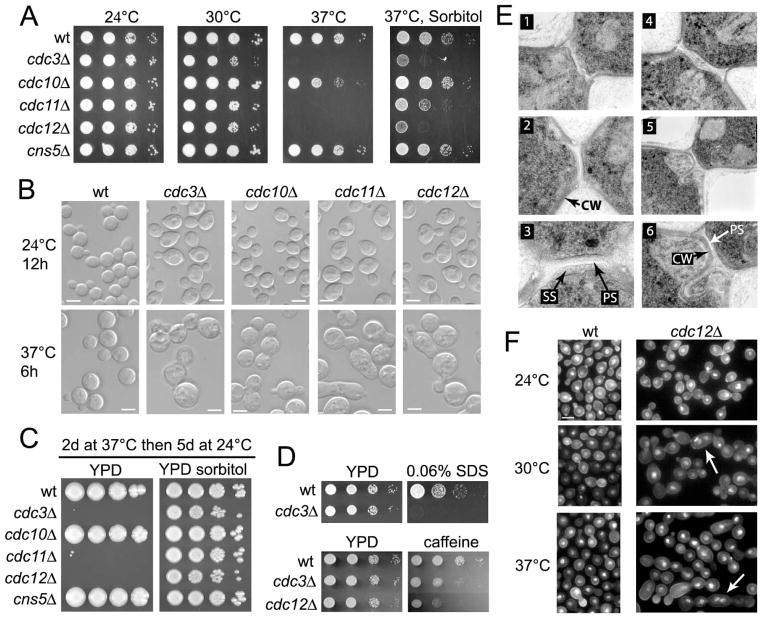
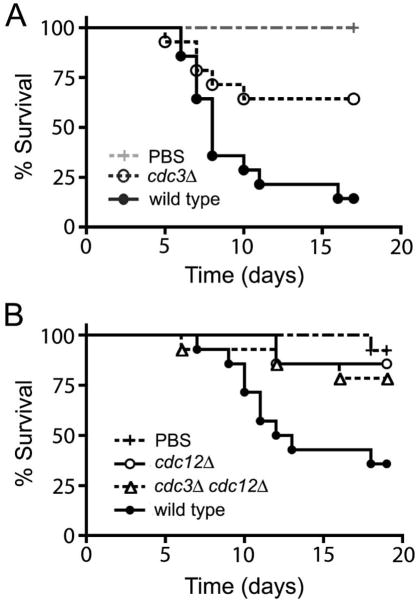
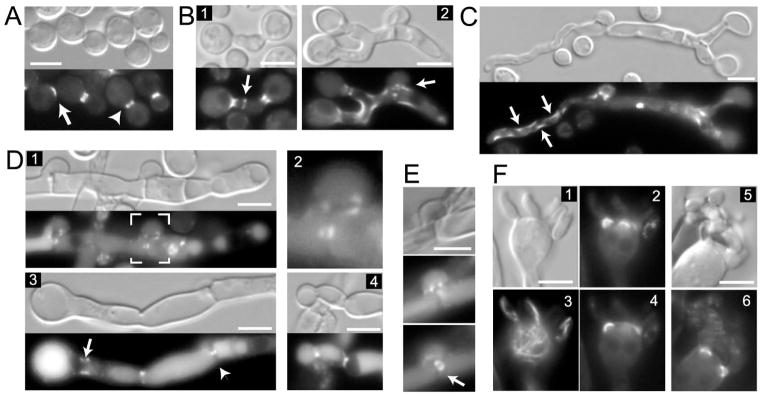
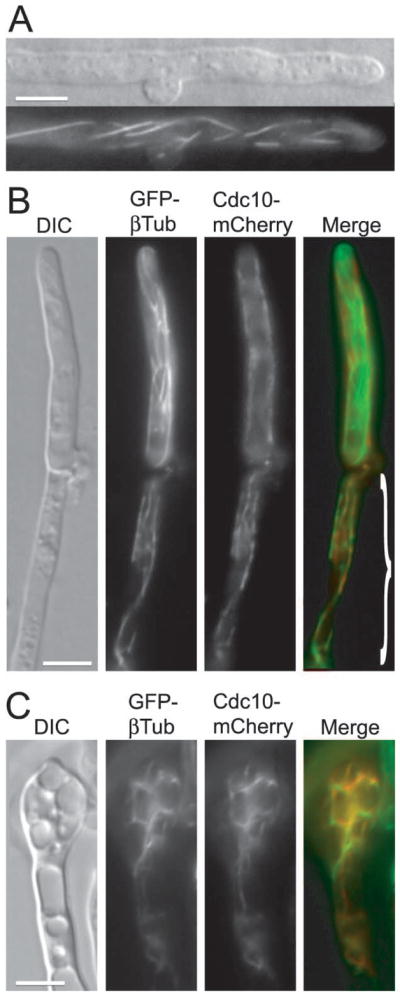
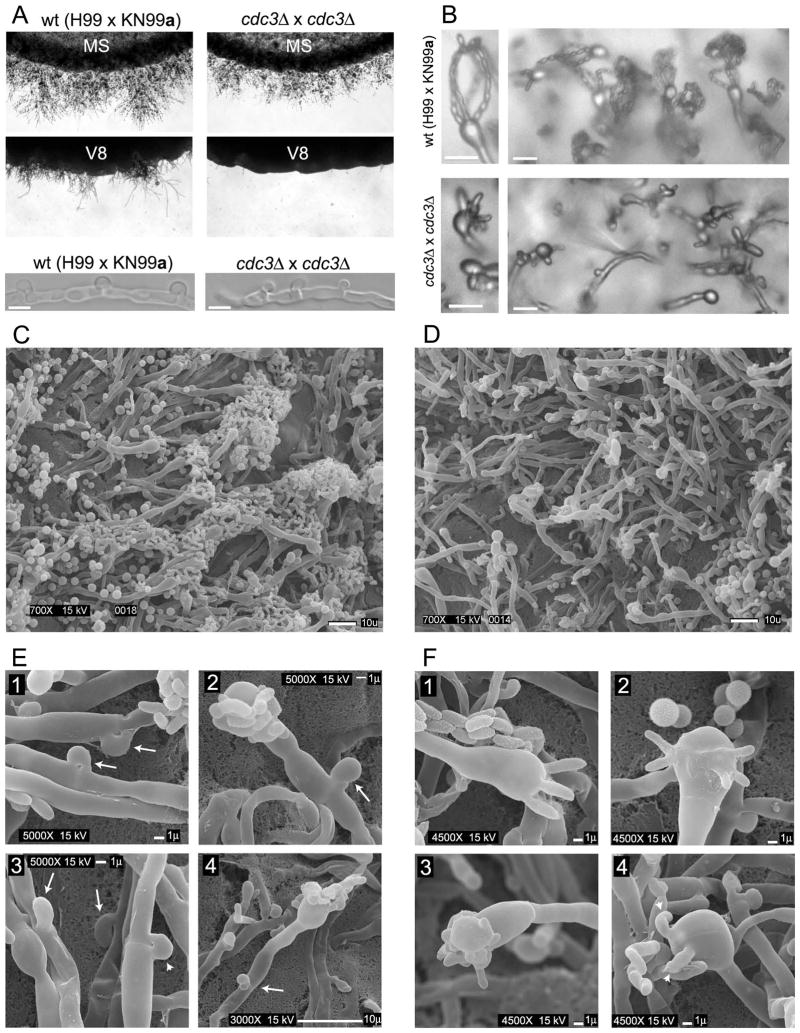
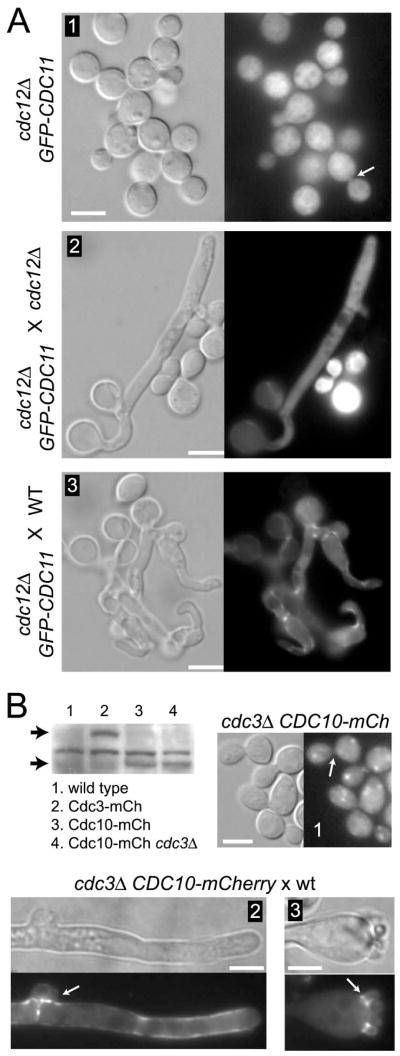
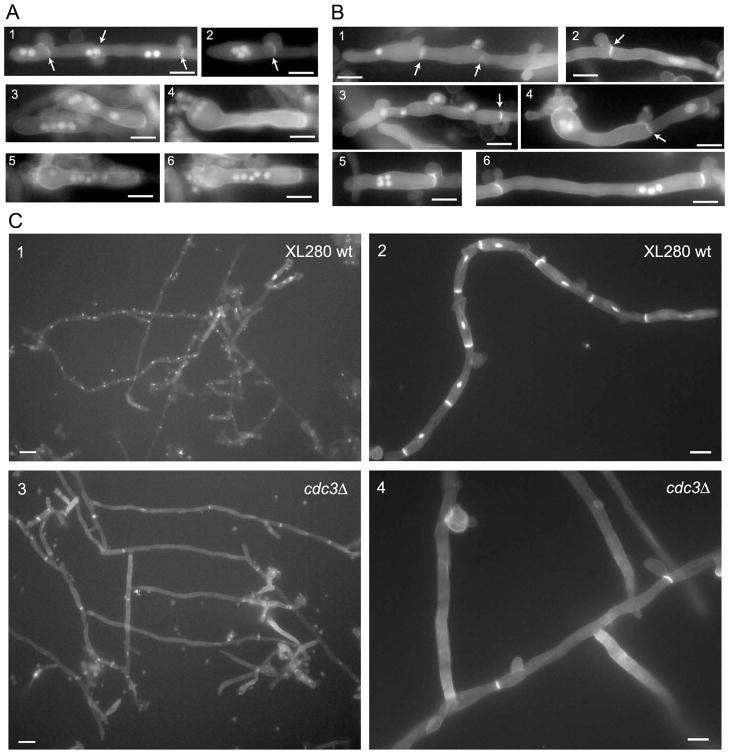
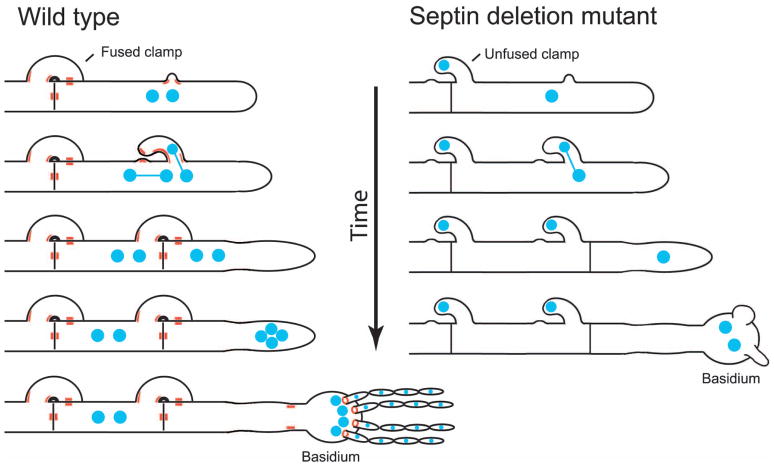
Septins are conserved, cytoskeletal GTPases that contribute to cytokinesis, exocytosis, cell surface organization and vesicle fusion by mechanisms that are poorly understood. Roles of septins in morphogenesis and virulence of a human pathogen and basidiomycetous yeast Cryptococcus neoformans were investigated. In contrast to a well-established paradigm in S. cerevisiae, Cdc3 and Cdc12 septin homologues are dispensable for growth in C. neoformans yeast cells at 24 degrees C but are essential at 37 degrees C. In a bilateral cross between septin mutants, cells fuse but the resulting hyphae exhibit morphological abnormalities, including lack of properly fused specialized clamp cells and failure to produce spores. Interestingly, post-mating hyphae of the septin mutants have a defect in nuclear distribution. Thus, septins are essential for the development of spores, clamp cell fusion and also play a specific role in nuclear dynamics in hyphae. In the post-mating hyphae the septins localize to discrete sites in clamp connections, to the septa and the bases of the initial emerging spores. Strains lacking CDC3 or CDC12 exhibit significantly reduced virulence in a Galleria mellonella model of infection. Thus, C. neoformans septins are vital to morphology of the hyphae and contribute to virulence.
Figures
Similar articles
-
Quantitative analysis of septin Cdc10 & Cdc3-associated proteome during stress response in the fungal pathogen Cryptococcus neoformans.PLoS One. 2024 Dec 17;19(12):e0313444. doi: 10.1371/journal.pone.0313444. eCollection 2024. PLoS One. 2024. PMID: 39689097 Free PMC article.
-
Registered report protocol: Quantitative analysis of septin Cdc10-associated proteome in Cryptococcus neoformans.PLoS One. 2020 Dec 14;15(12):e0242381. doi: 10.1371/journal.pone.0242381. eCollection 2020. PLoS One. 2020. Update in: PLoS One. 2024 Dec 17;19(12):e0313444. doi: 10.1371/journal.pone.0313444. PMID: 33315917 Free PMC article. Updated.
-
Role of the anillin-like protein in growth of Cryptococcus neoformans at human host temperature.Fungal Genet Biol. 2022 May;160:103697. doi: 10.1016/j.fgb.2022.103697. Epub 2022 Apr 23. Fungal Genet Biol. 2022. PMID: 35472450
-
[Research progresses on septin family].Yi Chuan. 2008 Sep;30(9):1097-107. doi: 10.3724/sp.j.1005.2008.01097. Yi Chuan. 2008. PMID: 18779165 Review. Chinese.
-
Profiling a killer, the development of Cryptococcus neoformans.FEMS Microbiol Rev. 2012 Jan;36(1):78-94. doi: 10.1111/j.1574-6976.2011.00286.x. Epub 2011 Jul 4. FEMS Microbiol Rev. 2012. PMID: 21658085 Free PMC article. Review.
Cited by
-
The Aspergillus fumigatus septins play pleiotropic roles in septation, conidiation, and cell wall stress, but are dispensable for virulence.Fungal Genet Biol. 2015 Aug;81:41-51. doi: 10.1016/j.fgb.2015.05.014. Epub 2015 Jun 5. Fungal Genet Biol. 2015. PMID: 26051489 Free PMC article.
-
Calcineurin Targets Involved in Stress Survival and Fungal Virulence.PLoS Pathog. 2016 Sep 9;12(9):e1005873. doi: 10.1371/journal.ppat.1005873. eCollection 2016 Sep. PLoS Pathog. 2016. PMID: 27611567 Free PMC article.
-
A Fungal Arrestin Protein Contributes to Cell Cycle Progression and Pathogenesis.mBio. 2019 Nov 19;10(6):e02682-19. doi: 10.1128/mBio.02682-19. mBio. 2019. PMID: 31744923 Free PMC article.
-
Sad1 Spatiotemporally Regulates Kinetochore Clustering To Ensure High-Fidelity Chromosome Segregation in the Human Fungal Pathogen Cryptococcus neoformans.mSphere. 2018 Jul 5;3(4):e00190-18. doi: 10.1128/mSphere.00190-18. mSphere. 2018. PMID: 29976642 Free PMC article.
-
Fungal morphogenesis.Cold Spring Harb Perspect Med. 2014 Nov 3;5(2):a019679. doi: 10.1101/cshperspect.a019679. Cold Spring Harb Perspect Med. 2014. PMID: 25367976 Free PMC article. Review.
References
-
- Badalyan SM, Polak E, Hermann R, Aebi M, Kues U. Role of peg formation in clamp cell fusion of homobasidiomycete fungi. J Basic Microbiol. 2004;44:167–177. - PubMed
Publication types
MeSH terms
Substances
Grants and funding
LinkOut - more resources
Full Text Sources
Molecular Biology Databases
