


Structure-toxicity relationship of phenolic analogs as anti-melanoma agents: an enzyme directed prodrug approach
- PMID: 19944085
- PMCID: PMC2821678
- DOI: 10.1016/j.cbi.2009.11.020
Structure-toxicity relationship of phenolic analogs as anti-melanoma agents: an enzyme directed prodrug approach
Abstract
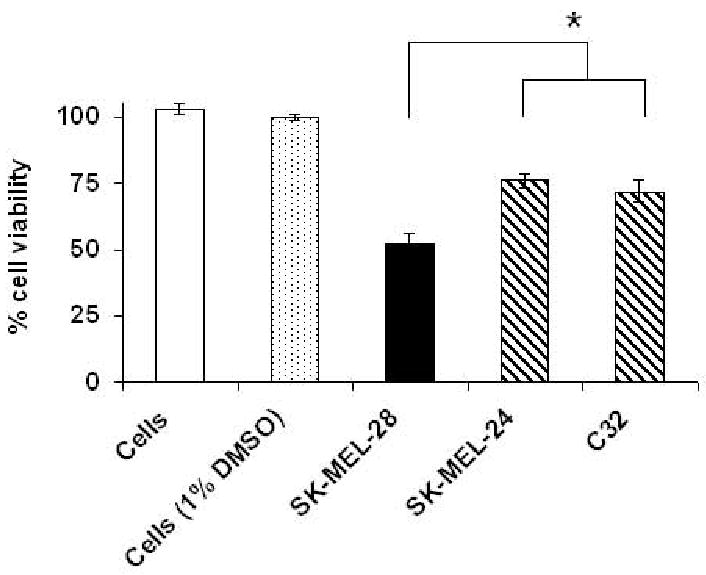
The aim of this study was to identify a phenolic prodrug compound that is minimally metabolized by rat liver microsomes, but yet could form quinone reactive intermediates in melanoma cells as a result of its bioactivation by tyrosinase. In current work, we investigated 24 phenolic compounds for their metabolism by tyrosinase, rat liver microsomes and their toxicity towards murine B16-F0 and human SK-MEL-28 melanoma cells. A linear correlation was found between toxicities of phenolic analogs towards SK-MEL-28 and B16-F0 melanoma cells, suggesting similar mechanisms of toxicity in both cell lines. 4-HEB was identified as the lead compound. 4-HEB (IC(50) 48h, 75muM) showed selective toxicity towards five melanocytic melanoma cell lines SK-MEL-28, SK-MEL-5, MeWo, B16-F0 and B16-F10, which express functional tyrosinase, compared to four non-melanoma cells lines SW-620, Saos-2, PC3 and BJ cells and two amelanotic SK-MEL-24, C32 cells, which do not express functional tyrosinase. 4-HEB caused significant intracellular GSH depletion, ROS formation, and showed significantly less toxicity to tyrosinase specific shRNA transfected SK-MEL-28 cells. Our findings suggest that presence of a phenolic group in 4-HEB is critical for its selective toxicity towards melanoma cells.
Published by Elsevier Ireland Ltd.
Conflict of interest statement
Figures



References
-
- Ries LAG, Eisner MP, Kosary CL, Hankey BF, Miller BA, Clegg L, Mariotto A, Feuer EJ, Edwards BK, editors. SEER Cancer Statistics Review, 1975-2001. National Cancer Institute; Bethesda, MD: 2004. http://seer.cancer.gov/csr/1975_2001/
-
- Anderson CM, Buzaid AC, Legha SS. Systemic treatments for advanced cutaneous melanoma. Oncology (Williston Park) 1995;9(11):1149–1158. discussion 1163-1164, 1167-1168. - PubMed
-
- Riley PA. Hydroxyanisole depigmentation: In-vitro studies. J Pathol. 1969;97(2):193–206. - PubMed
-
- Ojima I. Guided molecular missiles for tumor-targeting chemotherapy--case studies using the second-generation taxoids as warheads. Acc Chem Res. 2008;41(1):108–119. - PubMed
-
- Vielkind U, Schlage W, Anders F. Melanogenesis in genetically determined pigment cell tumors of platyfish and platyfish-swordtail hybrids: correlation between tyrosine activity and degree of malignancy. Cancer Res Clin Oncol. 1977;90(3):285–299. - PubMed
Publication types
MeSH terms
Substances
Grants and funding
LinkOut - more resources
Full Text Sources
Medical
Miscellaneous
