


Cephalic phase pancreatic polypeptide responses to liquid and solid stimuli in humans
- PMID: 19944113
- PMCID: PMC2834473
- DOI: 10.1016/j.physbeh.2009.11.009
Cephalic phase pancreatic polypeptide responses to liquid and solid stimuli in humans
Abstract
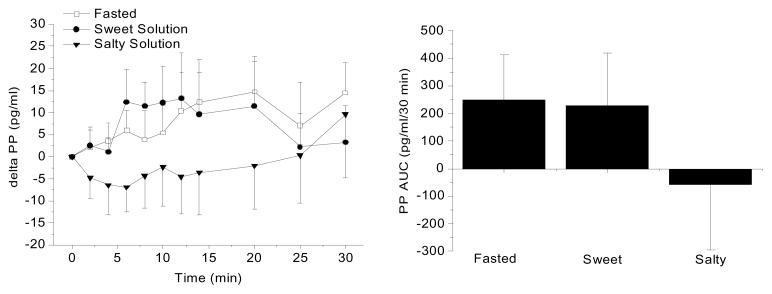
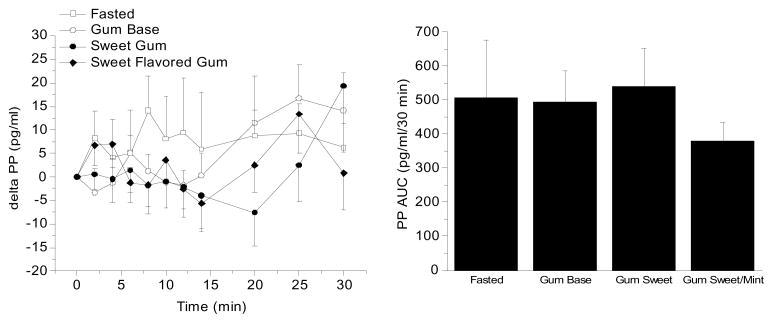
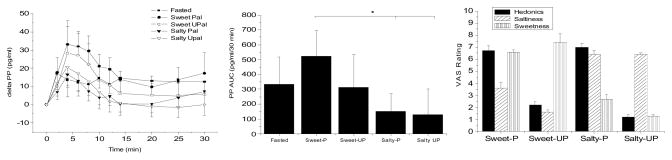
The hormone, pancreatic polypeptide (PP) is postulated to be involved in body weight regulation. PP release is dependent on vagal activation and is a marker of vagal efferent activity. Because vagal activity plays a role in glucose homeostasis, elucidating the conditions of activation has important implications for nutrient metabolism. In humans, modified sham-feeding is known to elicit vagally-mediated hormonal responses. We present results of 3 studies in which healthy human subjects tasted various stimuli including sweet and salty liquids, unflavored and flavored gum and mixed nutrient foods flavored with either sweet or salt and rendered palatable or unpalatable. We examined the effects of these stimuli on PP levels relative to fasting. We found that liquids flavored with either glucose or salt, did not elicit an increase in PP levels greater than fasting. Similarly, chewing gum, whether unflavored or flavored with a non-nutritive sweetener or the sweetener paired with a mint flavor, did not significantly increase PP levels. In contrast, when subjects tasted mixed nutrient foods, these reliably elicited increases in PP levels at 4 min post-stimulus (sweet palatable, p<0.002; sweet unpalatable, p<0.001; salty, palatable, p<0.05, salty unpalatable, p<0.05). The magnitude of release was influenced by the flavor, i.e. a sweet palatable stimulus (320.1+/-93.7 pg/ml/30 min) elicited the greatest increase in PP compared with a salty palatable stimulus (142.4+/-88.7 pg/ml/30 min; p<0.05). These data suggest that liquids and chewing gum do not provide adequate stimulation for vagal efferent activation in humans and that mixed nutrient foods are the optimal stimuli.
Copyright (c) 2009 Elsevier Inc. All rights reserved.
Figures
References
-
- Katsuura G, Asakawa A, Inui A. Roles of pancreatic polypeptide in regulation of food intake. Peptides. 2002;23:323–329. - PubMed
-
- Schwartz TW. Pancreatic polypeptide: a hormone under vagal control. Gastroenterology. 1983;85:1411–1425. - PubMed
-
- Batterham RL, Le Roux CW, Cohen MA, Oark AJ, Ellis EM, Patterson M, Frost GS, Ghatei MA, Bloom SR. Pancreatic polypeptide reduces appetite and food intake in humans. J C E M. 2003;88:3989–3992. - PubMed
-
- Kojima S, Ueno N, Asakawa A, Sagiyama K, Naruo T, Mizuno S, Inui A. A role for pancreatic polypeptide in feeding and body weight regulation. Peptides. 2007;28:459–463. - PubMed
-
- Asakawa A, Inui A, Yuzuriha H, Ueno N, Katsuura G, Fujimiya M, Fujino MA, Niijima A, Meguid MM, Kasuga M. Characterization of the effects of pancreatic polypeptide in the regulation of energy balance. Gastroenterology. 2003;124:1325–1336. - PubMed
Publication types
MeSH terms
Substances
Grants and funding
LinkOut - more resources
Full Text Sources
Miscellaneous
