


Review
doi: 10.1016/j.cmet.2009.10.011.
Hyperinsulinism and diabetes: genetic dissection of beta cell metabolism-excitation coupling in mice
Affiliations
- PMID: 19945402
- PMCID: PMC3245718
- DOI: 10.1016/j.cmet.2009.10.011
Item in Clipboard
Review
Hyperinsulinism and diabetes: genetic dissection of beta cell metabolism-excitation coupling in mice
Cell Metab.
2009 Dec.
Abstract
The role of metabolism-excitation coupling in insulin secretion has long been apparent, but in recent years, in parallel with studies of human hyperinsulinism and diabetes, genetic manipulation of proteins involved in glucose transport, metabolism, and excitability in mice has brought the central importance of this pathway into sharp relief. We focus on these animal studies and how they provide important insights into not only metabolic and electrical regulation of insulin secretion, but also downstream consequences of alterations in this pathway and the etiology and treatment of insulin-secretion diseases in humans.
Figures
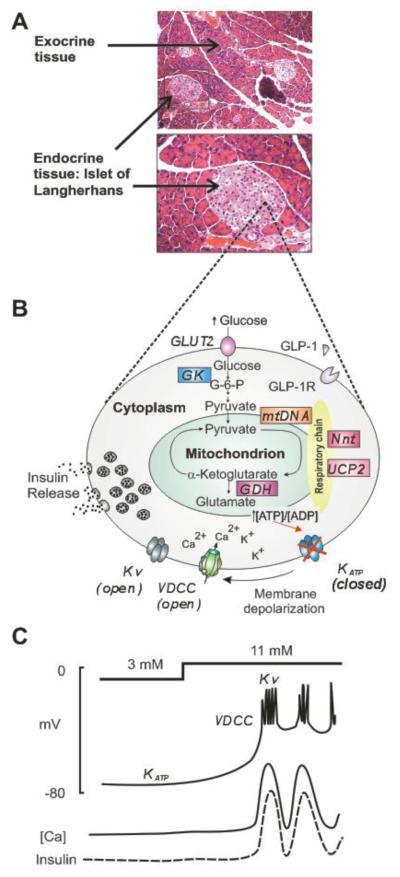
A) Hematoxylin-eosin stained paraffin section of mouse pancreas. The pancreas is composed of exocrine tissue and endocrine tissue (Islet of Langerhans). Islets contain different cell types, including the insulin-secreting β-cells. Arrows point to exocrine and endocrine tissue. B) Schematic illustration of the β-cell glucose-stimulated insulin secretion pathway. Glucose entering the β-cell through glucose transporters (GLUT2) is phosphorylated by glucokinase (GK) and metabolized by glycolysis (Cytoplasm) and tricarboxylic acid (TCA) cycle (mitochondria). A rise in the [ATP]:[ADP] ratio resulting from oxidative metabolism inhibits the ATP-sensitive K+ channels (KATP) at the cell surface, causing membrane depolarization and opening of voltage-dependent Ca2+-channels (VDCC). This results in a rise of intracellular [Ca2+] which stimulates insulin secretion. Voltage-dependent outward K+ channel (Kv) are involved in membrane repolarization and cessation of insulin secretion. Factors that impair ATP production or downstream signaling are expected to suppress GSIS. Several genes that directly or indirectly alter ATP production and therefore underlie a diabetic or hypeinsulinemic phenotype when mutated (humans and/or mouse models) are shown in color: glucokinase (GK), nicotinamide nucleotide transhydrogenase (Nnt), uncoupling protein 2 (UCP2), mitochondrial DNA mutations (mtDNA) and glutamate dehydrogenase (GDH). Mutations that may indirectly affect channel activity are also shown in color. C) Schematic illustration of the electrical activity of β-cells and the temporal response to elevated glucose. In low (3 mM) glucose, the membrane is hyperpolarized due to KATP activity, intracellular Ca ([Ca]) is low and insulin is not secreted. When glucose is elevated to stimulatory levels (11 mM), KATP channels close, and the membrane depolarizes due to L-type VDCC activity. Bursts of APs, involving both VDCC and Kv channels, result in slowly elevated [Ca], which in turn triggers insulin secretion.
References
-
- Aguilar-Bryan L, Bryan J, Nakazaki M. Of mice and men: K(ATP) channels and insulin secretion. Recent Prog Horm Res. 2001;56:47–68. - PubMed
-
- Araki E, Lipes MA, Patti ME, Bruning JC, Haag B, 3rd, Johnson RS, Kahn CR. Alternative pathway of insulin signalling in mice with targeted disruption of the IRS-1 gene. Nature. 1994;372:186–190. - PubMed
-
- Arkblad EL, Tuck S, Pestov NB, Dmitriev RI, Kostina MB, Stenvall J, Tranberg M, Rydstrom J. A Caenorhabditis elegans mutant lacking functional nicotinamide nucleotide transhydrogenase displays increased sensitivity to oxidative stress. Free Radical Biology & Medicine. 2005;38:1518–1525. - PubMed
-
- Arsenijevic D. Disruption of the uncoupling protein-2 gene in mice reveals a role in immunity and reactive oxygen species production.[see comment] Nat Genet. 2000;26:435–439. - PubMed
-
- Ashcroft FM. From molecule to malady. Nature. 2006;440:440–447. - PubMed
Publication types
MeSH terms
Substances
Grants and funding
LinkOut - more resources
Full Text Sources
Medical
Molecular Biology Databases
