


doi: 10.1016/j.ceb.2009.10.007.
Epub 2009 Nov 27.
mTOR and cancer: many loops in one pathway
Affiliations
- PMID: 19945836
- PMCID: PMC2854285
- DOI: 10.1016/j.ceb.2009.10.007
Item in Clipboard
mTOR and cancer: many loops in one pathway
Curr Opin Cell Biol.
2010 Apr.
Abstract
The mammalian target of rapamycin (mTOR) is a master regulator of cell growth and division that responds to a variety of stimuli, including nutrient, energy, and growth factors. In the last years, a significant number of pieces have been added to the puzzle of how mTOR coordinates and executes its functions. Extensive research on mTOR has also uncovered a complex network of regulatory loops that impact the therapeutic approaches aimed at targeting mTOR.
Copyright 2009 Elsevier Ltd. All rights reserved.
Figures
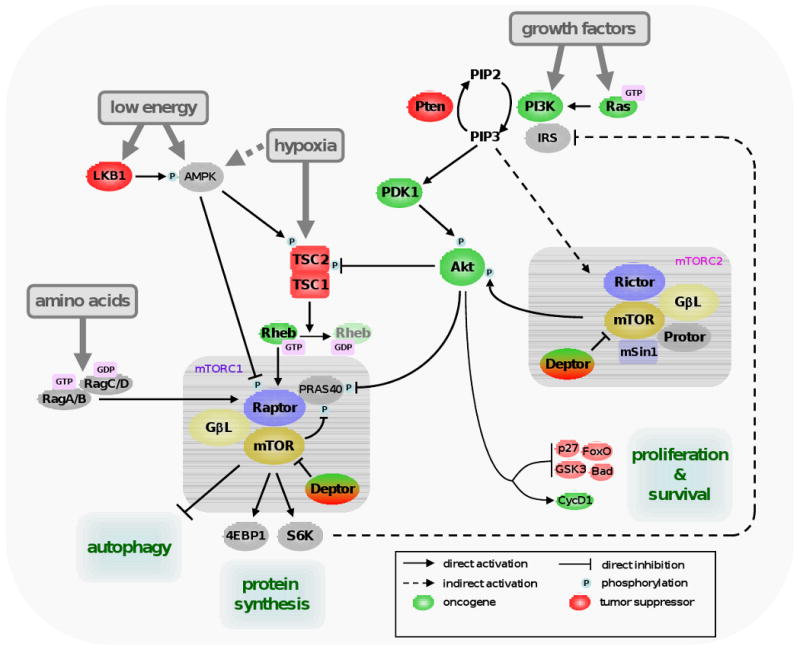
One branch of mTORC1 activation is mediated by the class I phosphoinositide-3 kinase (PI3K), Akt (also known as Pkb) and the tuberous sclerosis complex (TSC). TSC is formed by TSC1 and TSC2, and inhibits a direct activator of mTORC1, the GTPase Ras-homolog enriched in brain (Rheb) by hydrolyzing its GTP into GDP [52]. TSC2 is activated by phosphorylation by AMP-activated protein kinase (AMPK) [53], which is directly activated by a high AMP vs. ATP ratio. AMPK also directly phosphorylates and inactivates Raptor, so it inhibits mTORC1 by TSC-dependent and -independent manners [54]. The activity of AMPK is regulated by phosphorylation by the tumor suppressor LKB1. This protein, like TSC1/2, was found mutated in the germline of patients with different hamartomatous syndromes [55,56]. Akt is a serine/threonine kinase and an important player in regulating mTORC1 activity. Akt positively regulates mTORC1 by acting at different levels. First, Akt inactivates TSC1/2 by phosphorylating TSC2 [57]. Second, Akt inhibits Pras40, negative regulator of mTORC1 that counteracts Rheb function [6,7]. Akt is activated by PI3K, which responds to a variety of growth factors. When activated by insulin or insulin-like growth factors (IGFs), as well as other growth factors, class I PI3K catalyzes the formation of the lipidic second messenger phosphoinositide 3,4,5 tri-phosphate (PIP3) from the bi-phosphate form PIP2. PIP3 triggers the relocation of Akt to the inner surface of the plasma membrane, where it is activated by phosphoinositide-dependent kinase 1 (PDK1) and transduces the signal as described above. Opposing Akt function is the tumor suppressor Phosphatase and Tensin homolog deleted on chromosome ten (Pten), a lipid phosphatase that converts of PIP3 to PIP2, thus shutting off signaling from PI3K. Pten deficiency causes a series of hamartomatous syndromes collectively classified as PTEN hamartoma tumour syndrome (reviewed in [58]). Amino acids activate mTORC1 by an independent route mediated by the Rag family of proteins. The activation of mTORC2 is not well-understood, but this complex directly activates Akt (and Akt-related kinases) by phosphorylation. Akt, in addition, regulates many proteins involved in cell survival and cell cycle progression.
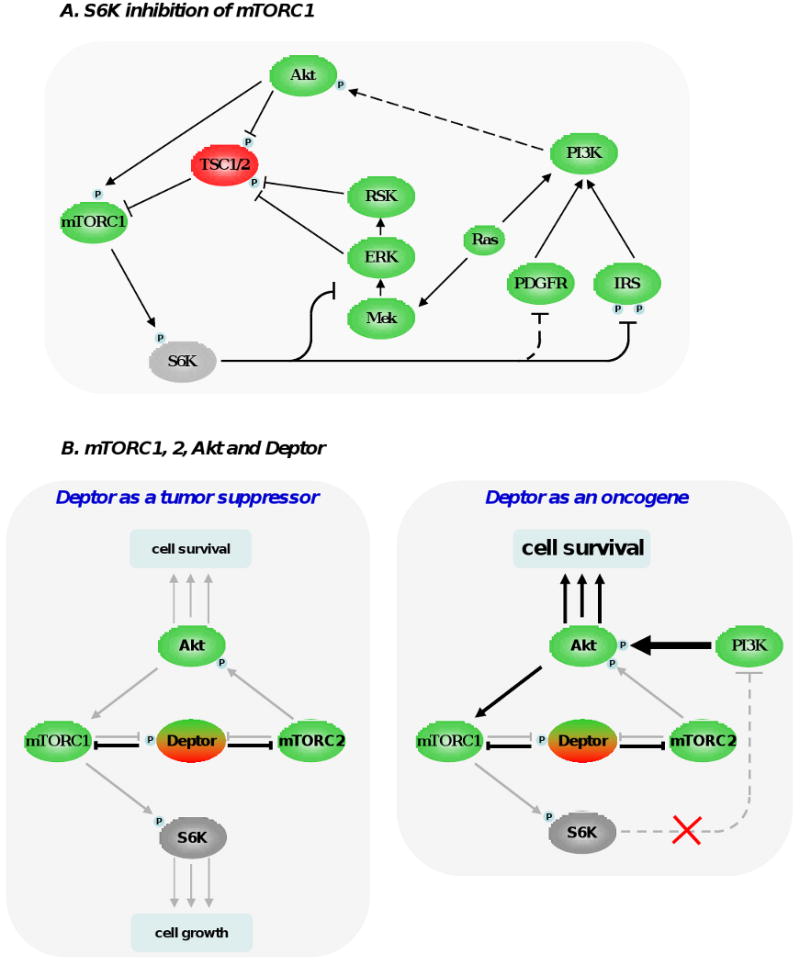
(A) S6K1 phosphorylation by mTORC1 triggers a number of feedback loops that negatively impact on PI3K signaling. S6K1 directly phosphorylates insulin receptor substrate 1 (IRS-1) at multiple sites, which leads a significant attenuation of insulin and and insulin-like growth factor effect at the cell membrane. S6K1 also inhibits PDGFR and the MEK/ERK signaling pathway through a not fully-understood mechanism. These 3 inhibitory loops ultimately dampen PI3K, Akt and mTORC1 activation and have likely evolved as a cellular response to buffer aberrant or excessive PI3K activity. (B) Deptor can have oncogenic and tumor suppressive properties. By blocking mTORC1 and mTORC2, Deptor inhibits protein synthesis, cell size increase and the proliferative and survival effects of Akt. However, under certain conditions, inhibition of mTORC1 by Deptor relieves the feedback inhibition from S6K1 to PI3K, boosting Akt activity. (C) The 2 most important tumor suppressors, namely Pten and p53, cooperate in the inhibition of mTORC1. p53 transactivates many negative regulators of mTORC1 (TSC2, AMPKβ1, Sestrin 1 and 2), which oppose Akt activity. Akt favors degradation of p53 by phosphorylating and stabilizing MDM2. Importantly, Pten and AMPK directly stabilize p53. Collectively, these interactions imply the existence of a coordinate regulation of mTOR signaling pathway by energy, nutrients, growth factors, oncogenic stress and DNA integrity.
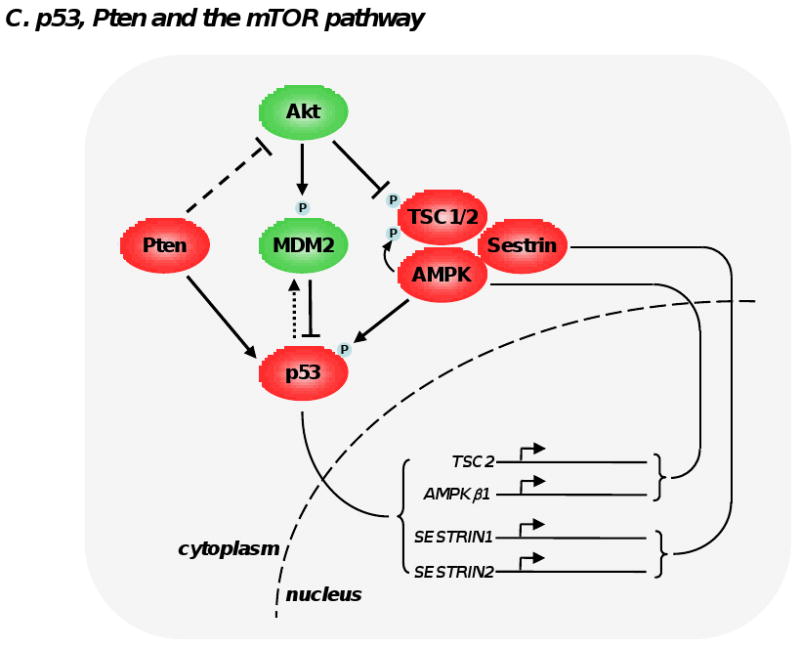
(A) S6K1 phosphorylation by mTORC1 triggers a number of feedback loops that negatively impact on PI3K signaling. S6K1 directly phosphorylates insulin receptor substrate 1 (IRS-1) at multiple sites, which leads a significant attenuation of insulin and and insulin-like growth factor effect at the cell membrane. S6K1 also inhibits PDGFR and the MEK/ERK signaling pathway through a not fully-understood mechanism. These 3 inhibitory loops ultimately dampen PI3K, Akt and mTORC1 activation and have likely evolved as a cellular response to buffer aberrant or excessive PI3K activity. (B) Deptor can have oncogenic and tumor suppressive properties. By blocking mTORC1 and mTORC2, Deptor inhibits protein synthesis, cell size increase and the proliferative and survival effects of Akt. However, under certain conditions, inhibition of mTORC1 by Deptor relieves the feedback inhibition from S6K1 to PI3K, boosting Akt activity. (C) The 2 most important tumor suppressors, namely Pten and p53, cooperate in the inhibition of mTORC1. p53 transactivates many negative regulators of mTORC1 (TSC2, AMPKβ1, Sestrin 1 and 2), which oppose Akt activity. Akt favors degradation of p53 by phosphorylating and stabilizing MDM2. Importantly, Pten and AMPK directly stabilize p53. Collectively, these interactions imply the existence of a coordinate regulation of mTOR signaling pathway by energy, nutrients, growth factors, oncogenic stress and DNA integrity.
References
-
- Hara K, Maruki Y, Long X, Yoshino K, Oshiro N, Hidayat S, Tokunaga C, Avruch J, Yonezawa K. Raptor, a binding partner of target of rapamycin (TOR), mediates TOR action. Cell. 2002;110:177–189. - PubMed
-
- Kim DH, Sarbassov DD, Ali SM, King JE, Latek RR, Erdjument-Bromage H, Tempst P, Sabatini DM. mTOR interacts with raptor to form a nutrient-sensitive complex that signals to the cell growth machinery. Cell. 2002;110:163–175. - PubMed
-
- Kim DH, Sarbassov DD, Ali SM, Latek RR, Guntur KV, Erdjument-Bromage H, Tempst P, Sabatini DM. GbetaL, a positive regulator of the rapamycin-sensitive pathway required for the nutrient-sensitive interaction between raptor and mTOR. Mol Cell. 2003;11:895–904. - PubMed
-
- Loewith R, Jacinto E, Wullschleger S, Lorberg A, Crespo JL, Bonenfant D, Oppliger W, Jenoe P, Hall MN. Two TOR complexes, only one of which is rapamycin sensitive, have distinct roles in cell growth control. Mol Cell. 2002;10:457–468. - PubMed
-
- Peterson TR, Laplante M, Thoreen CC, Sancak Y, Kang SA, Kuehl WM, Gray NS, Sabatini DM. DEPTOR is an mTOR inhibitor frequently overexpressed in multiple myeloma cells and required for their survival. Cell. 2009;137:873–886. (") In this report, Deptor, a negative regulator of mTORC1 and 2, is identified. mTOR and Deptor inhibit each other, and interestingly, Deptor overexpression indirectly leads to Akt hyperactivation. - PMC - PubMed
Publication types
MeSH terms
Substances
Grants and funding
LinkOut - more resources
Full Text Sources
Other Literature Sources
Miscellaneous
