


Progesterone decreases tyrosine hydroxylase phosphorylation state and increases protein phosphatase 2A activity in the stalk-median eminence on proestrous afternoon
- PMID: 19945993
- PMCID: PMC2808445
- DOI: 10.1677/JOE-09-0335
Progesterone decreases tyrosine hydroxylase phosphorylation state and increases protein phosphatase 2A activity in the stalk-median eminence on proestrous afternoon
Abstract
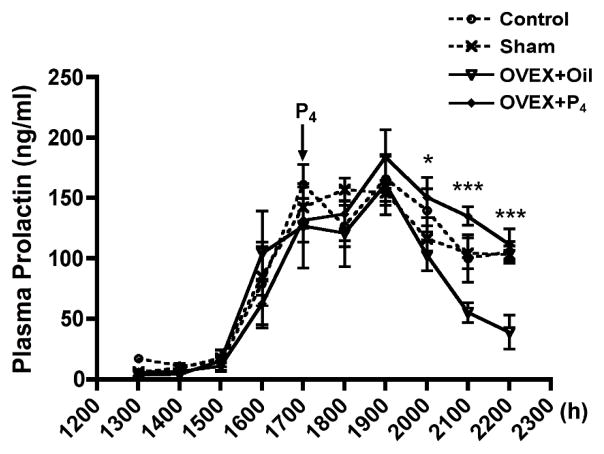
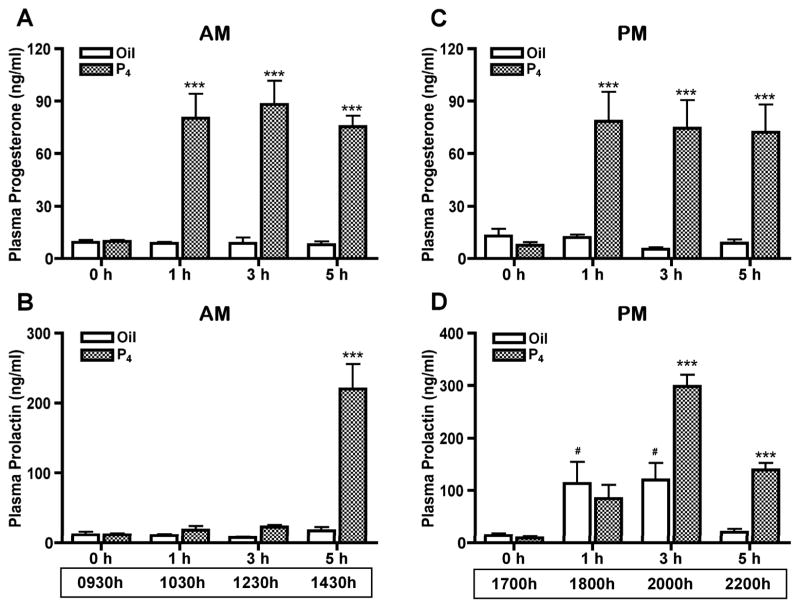
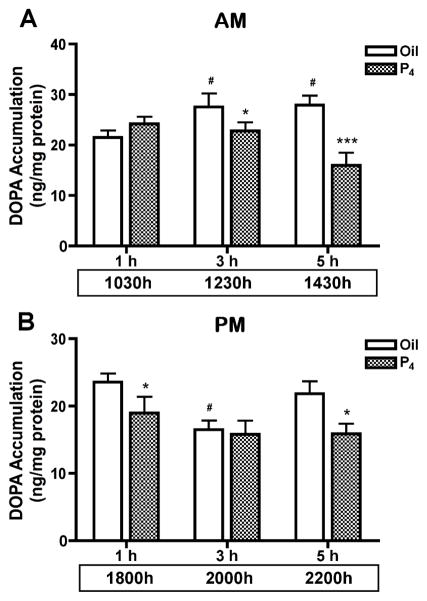
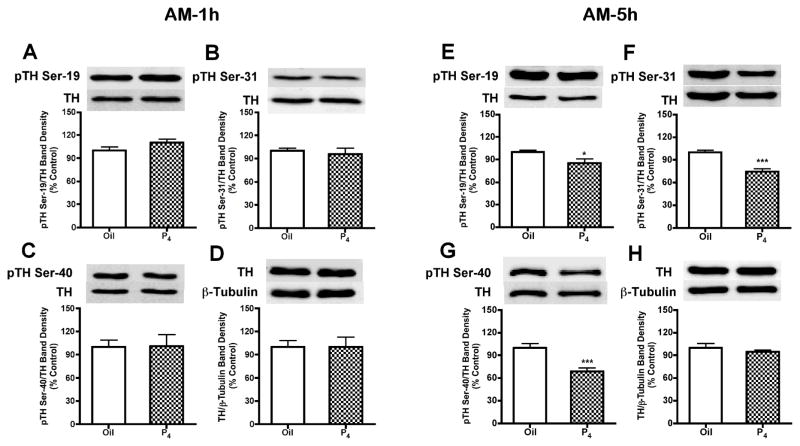
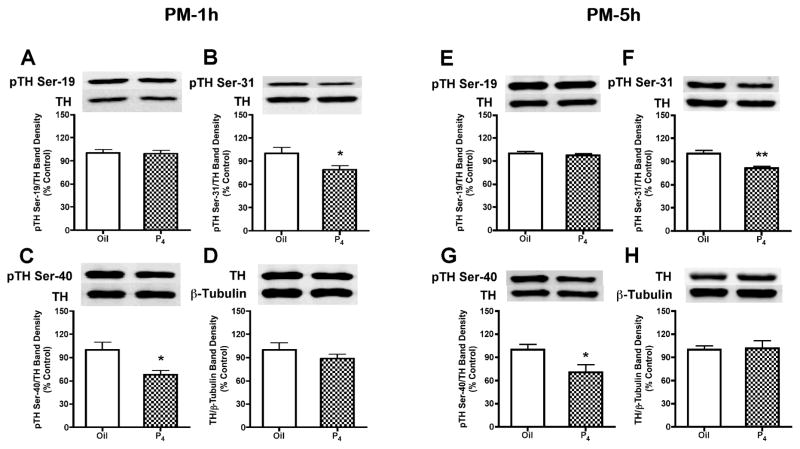
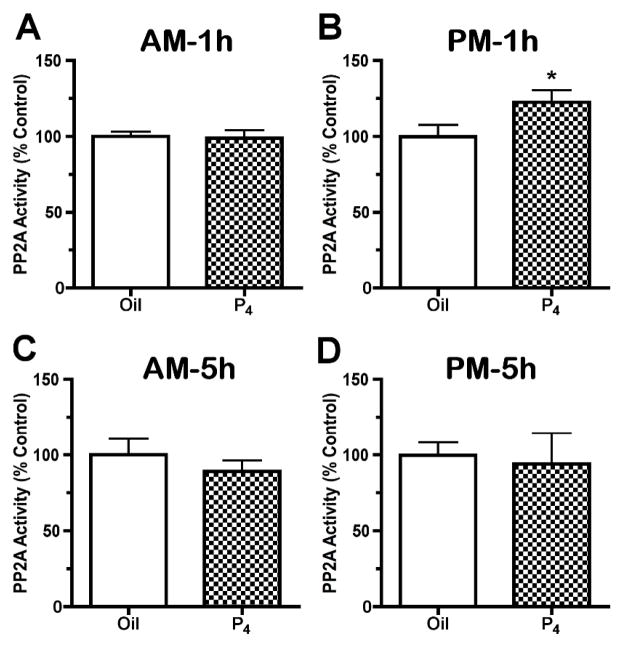
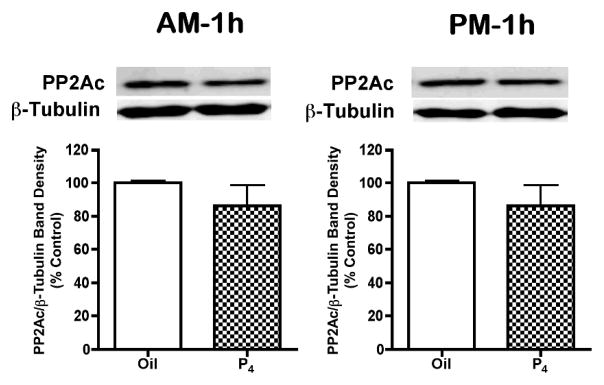
The progesterone (P(4)) rise on proestrous afternoon is associated with dephosphorylation of tyrosine hydroxylase (TH) and reduced TH activity in the stalk-median eminence (SME), which contributes to the proestrous prolactin surge in rats. In the present study, we investigated the time course for P(4) effect on TH activity and phosphorylation state, as well as cAMP levels and protein phosphatase 2A (PP2A) activity and quantity, in the SME on proestrous morning and afternoon. P(4) (7.5 mg/kg, s.c.) treatment on proestrous afternoon decreased TH activity and TH phosphorylation state at Ser-31 and Ser-40 within 1 h, whereas morning administration of P(4) had no 1 h effect on TH. PP2A activity in the SME was enhanced after P(4) treatment for 1 h on proestrous afternoon without a change in PP2A catalytic subunit quantity, whereas P(4) treatment had no effect on PP2A activity or quantity on proestrous morning. cAMP levels in the SME were unchanged with 1 h P(4) treatment. At 5 h after P(4) treatment, TH activity and phosphorylation state declined coincident with an increase in plasma prolactin in both P(4)-treated morning and afternoon groups. PP2A activity in the SME was unchanged in 5 h P(4)-treated rat. Our data suggest that P(4) action on tuberoinfundibular dopaminergic (TIDA) neurons involves at least two components. A more rapid (1 h) P(4) effect engaged only on proestrous afternoon likely involves the activation of PP2A. The longer P(4) action on TIDA neurons is evident on both the morning and afternoon of proestrus and may involve a common, as yet unidentified, mechanism.
Figures
References
-
- Arbogast LA, Ben-Jonathan N. Tyrosine hydroxylase in the stalk-median eminence and posterior pituitary is inactivated only during the plateau phase of the preovulatory prolactin surge. Endocrinology. 1989;125:667–674. - PubMed
-
- Arbogast LA, Ben-Jonathan N. The preovulatory prolactin surge is prolonged by a progesterone-dependent dopaminergic mechanism. Endocrinology. 1990;126:246–252. - PubMed
-
- Arbogast LA, Voogt JL. Hyperprolactinemia increases and hypoprolactinemia decreases tyrosine hydroxylase messenger ribonucleic acid levels in the arcuate nuclei, but not the substantia nigra or zona incerta. Endocrinology. 1991;128:997–1005. - PubMed
-
- Arbogast LA, Voogt JL. Progesterone suppresses tyrosine hydroxylase messenger ribonucleic acid levels in the arcuate nucleus on proestrus. Endocrinology. 1994;135:343–350. - PubMed
-
- Arbogast LA, Voogt JL. Progesterone induces dephosphorylation and inactivation of tyrosine hydroxylase in rat hypothalamic dopaminergic neurons. Neuroendocrinology. 2002;75:273–281. - PubMed
Publication types
MeSH terms
Substances
Grants and funding
LinkOut - more resources
Full Text Sources
