Quality of life three years after diagnosis of localised prostate cancer: population based cohort study
- PMID: 19945997
- PMCID: PMC2784818
- DOI: 10.1136/bmj.b4817
Quality of life three years after diagnosis of localised prostate cancer: population based cohort study
Abstract
Objective: To quantify the risk and severity of negative effects of treatment for localised prostate cancer on long term quality of life.
Design: Population based, prospective cohort study with follow-up over three years.
Setting: New South Wales, Australia.
Participants: Men with localised prostate cancer were eligible if aged less than 70 years, diagnosed between October 2000 and October 2002, and notified to the New South Wales central cancer registry. Controls were randomly selected from the New South Wales electoral roll and matched to cases by age and postcode.
Main outcome measures: General health specific and disease specific function up to three years after diagnosis, according to the 12 item short form health survey and the University of California, Los Angeles prostate cancer index.
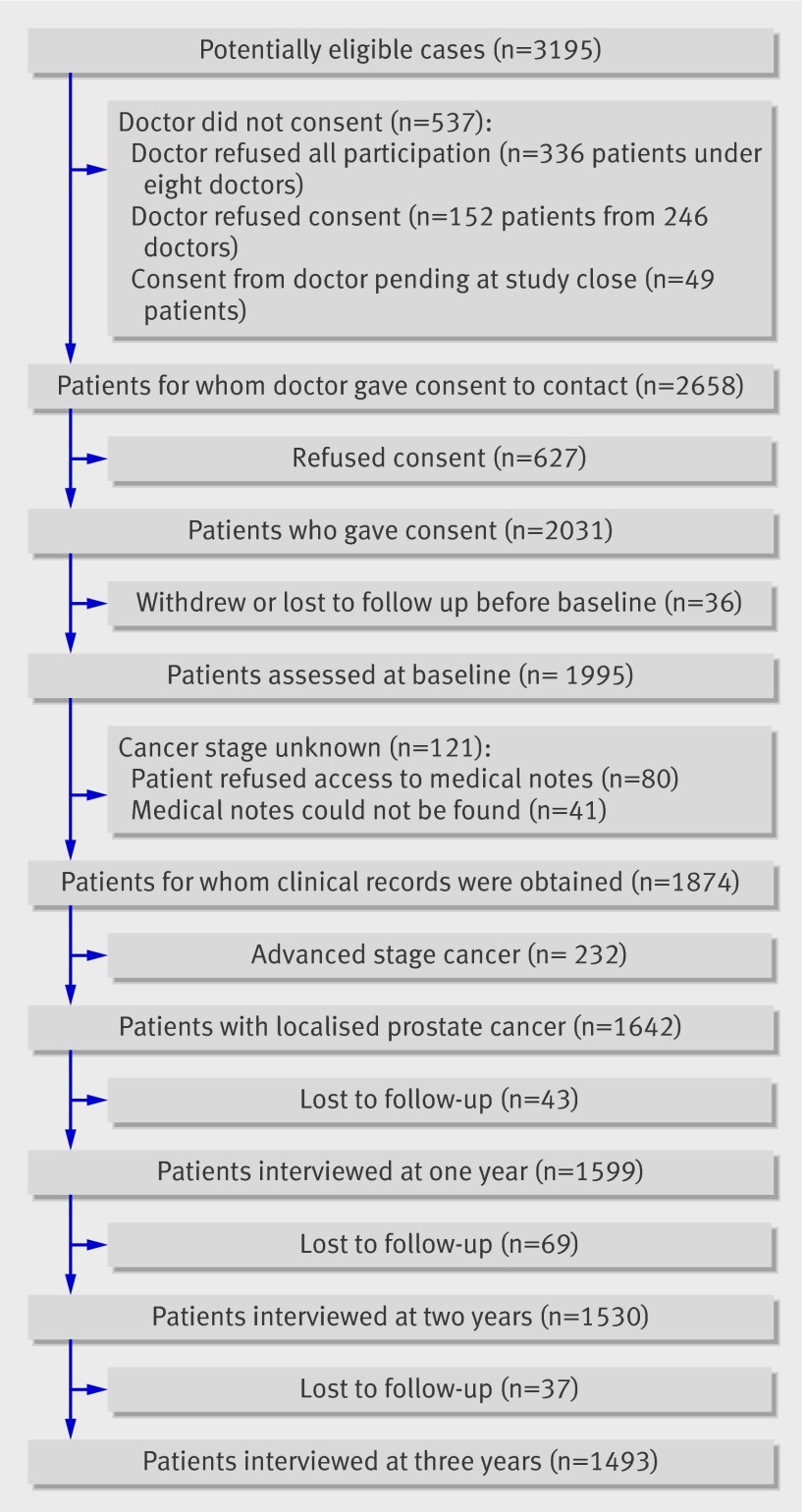
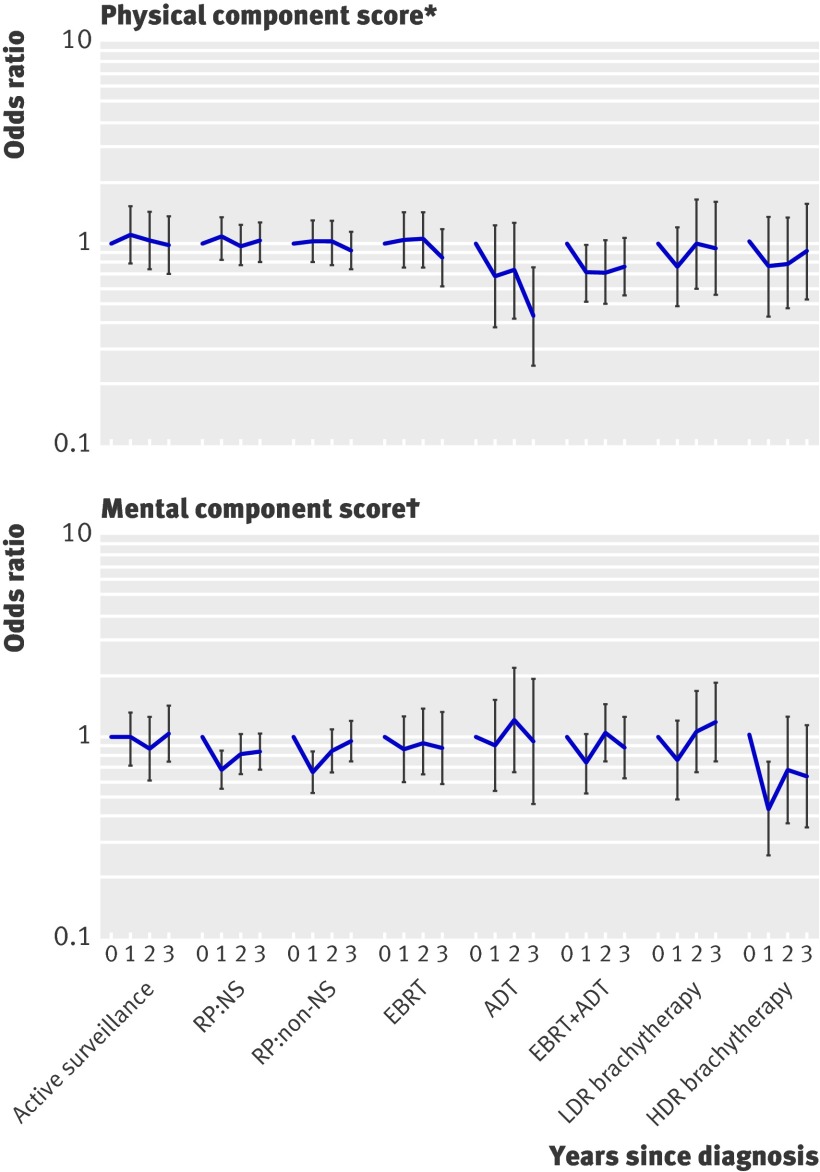
Results: 1642 (64%) cases and 495 (63%) eligible and contacted controls took part in the study. After adjustment for confounders, all active treatment groups had low odds of having better sexual function than controls, in particular men on androgen deprivation therapy (adjusted odds ratio (OR) 0.02, 95% CI 0.01 to 0.07). Men treated surgically reported the worst urinary function (adjusted OR 0.17, 95% CI 0.13 to 0.22). Bowel function was poorest in cases who had external beam radiotherapy (adjusted OR 0.44, 95% CI 0.30 to 0.64). General physical and mental health scores were similar across treatment groups, but poorest in men who had androgen deprivation therapy.
Conclusions: The various treatments for localised prostate cancer each have persistent effects on quality of life. Sexual dysfunction three years after diagnosis was common in all treatment groups, whereas poor urinary function was less common. Bowel function was most compromised in those who had external beam radiotherapy. Men with prostate cancer and the clinicians who treat them should be aware of the effects of treatment on quality of life, and weigh them up against the patient's age and the risk of progression of prostate cancer if untreated to make informed decisions about treatment.
Conflict of interest statement
Competing interests: None declared.
Figures

Comment in
-
Life after prostate cancer. Time to evaluate focal therapy.BMJ. 2010 Feb 23;340:c1057. doi: 10.1136/bmj.c1057. BMJ. 2010. PMID: 20179109 No abstract available.
-
[Patient quality of life three years after diagnosis of localized prostate cancer].Praxis (Bern 1994). 2010 Apr 14;99(8):503-4. doi: 10.1024/1661-8157/a000125. Praxis (Bern 1994). 2010. PMID: 20391358 German. No abstract available.
References
-
- Tracey EA, Baker D, Chen W, Stavrou E, Bishop J. Cancer in New South Wales: incidence, mortality and prevalence, 2005. Cancer Institute New South Wales, 2007.
-
- Ries LAG, Melbert D, Krapcho M, Mariotto A, Miller BA, Feuer EJ, et al. SEER cancer statistics review, 1975-2004. National Cancer Institute, 2007.
-
- Wilt TJ, MacDonald R, Rutks I, Shamliyan TA, Taylor BC, Kane RL. Systematic review: comparative effectiveness and harms of treatments for clinically localized prostate cancer. Ann Intern Med 2008;148:435-48. - PubMed
-
- Smith DP, Supramaniam R, King MT, Ward J, Berry M, Armstrong BK. Age, health, and education determine supportive care needs of men younger than 70 years with prostate cancer. J Clin Oncol 2007;25:2560-6. - PubMed
-
- Australian Cancer Network Working Party, National Health and Medical Research Council (NHMRC). Clinical practice guidelines: evidence-based information and recommendations of localised prostate cancer. AusInfo Government Info Bookshops, Commonwealth of Australia, 2002.
Publication types
MeSH terms
Substances
LinkOut - more resources
Full Text Sources
Medical