


Single-cell analysis reveals oligoclonality among 'low-count' monoclonal B-cell lymphocytosis
- PMID: 19946263
- PMCID: PMC2806490
- DOI: 10.1038/leu.2009.192
Single-cell analysis reveals oligoclonality among 'low-count' monoclonal B-cell lymphocytosis
Abstract
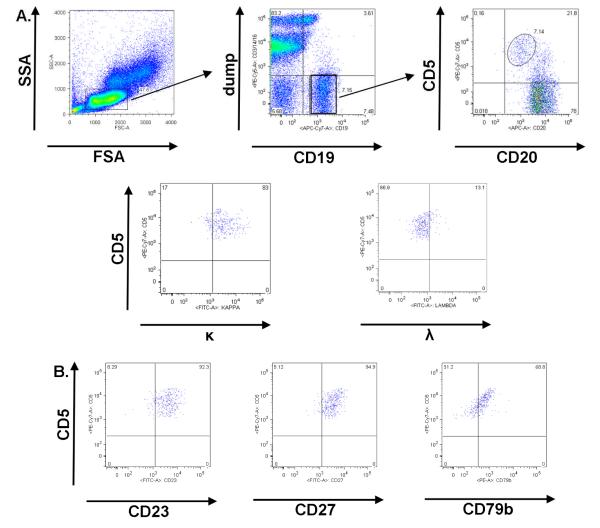
Monoclonal B-cell lymphocytosis (MBL) is a preclinical hematologic syndrome characterized by small accumulations of CD5(+) B lymphocytes. Most MBL share phenotypic characteristics with chronic lymphocytic leukemia (CLL). Although some MBL progress to CLL, most MBL have apparently limited potential for progression to CLL, particularly those MBL with normal absolute B-cell counts ('low-count' MBL). Most CLL are monoclonal and it is not known whether MBL are monoclonal or oligoclonal; this is important because it is unclear whether MBL represent indolent CLL or represent a distinct premalignant precursor before the development of CLL. We used flow cytometry analysis and sorting to determine immunophenotypic characteristics, clonality and molecular features of MBL from familial CLL kindreds. Single-cell analysis indicated four of six low-count MBL consisted of two or more unrelated clones; the other two MBL were monoclonal. 87% of low-count MBL clones had mutated immunoglobulin genes, and no immunoglobulin heavy-chain rearrangements of V(H) family 1 were observed. Some MBL were diversified, clonally related populations with evidence of antigen drive. We conclude that although low-count MBL share many phenotypic characteristics with CLL, many MBL are oligoclonal. This supports a model for step-wise development of MBL into CLL.
Figures

References
-
- Chiorazzi N, Rai KR, Ferrarini M. Chronic lymphocytic leukemia. N Engl J Med. 2005 Feb 24;352(8):804–815. - PubMed
-
- Dighiero G, Hamblin TJ. Chronic lymphocytic leukaemia. Lancet. 2008 Mar 22;371(9617):1017–1029. - PubMed
-
- Goldin LR, Pfeiffer RM, Li X, Hemminki K. Familial risk of lymphoproliferative tumors in families of patients with chronic lymphocytic leukemia: results from the Swedish Family-Cancer Database. Blood. 2004 Sep 15;104(6):1850–1854. - PubMed
-
- Geiger KD, Klein U, Brauninger A, Berger S, Leder K, Rajewsky K, et al. CD5-positive B cells in healthy elderly humans are a polyclonal B cell population. Eur J Immunol. 2000 Oct;30(10):2918–2923. - PubMed
Publication types
MeSH terms
Substances
Grants and funding
LinkOut - more resources
Full Text Sources
Miscellaneous
