


The progressive increase of food waste in America and its environmental impact
- PMID: 19946359
- PMCID: PMC2775916
- DOI: 10.1371/journal.pone.0007940
The progressive increase of food waste in America and its environmental impact
Abstract
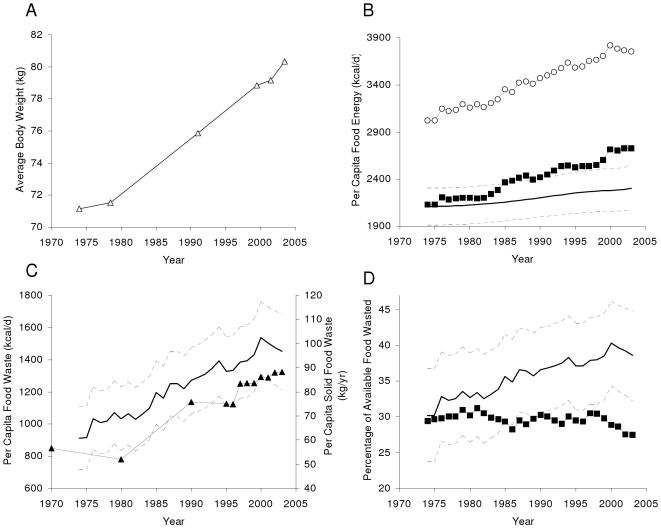
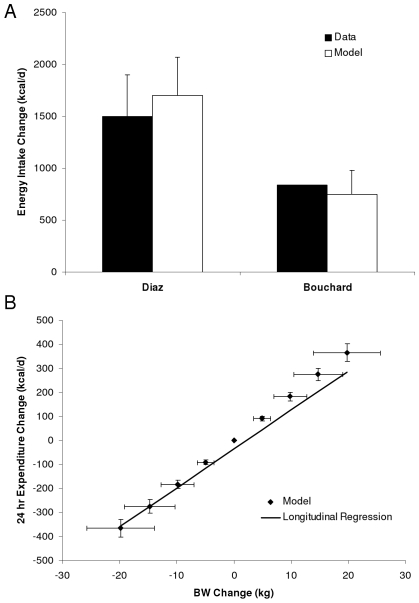
Food waste contributes to excess consumption of freshwater and fossil fuels which, along with methane and CO(2) emissions from decomposing food, impacts global climate change. Here, we calculate the energy content of nationwide food waste from the difference between the US food supply and the food consumed by the population. The latter was estimated using a validated mathematical model of metabolism relating body weight to the amount of food eaten. We found that US per capita food waste has progressively increased by approximately 50% since 1974 reaching more than 1400 kcal per person per day or 150 trillion kcal per year. Food waste now accounts for more than one quarter of the total freshwater consumption and approximately 300 million barrels of oil per year.
Conflict of interest statement
Figures
References
-
- von Braun J, Ahmed A, Asenso-Okyere K, Fan S, Gulati A, et al. Washington D.C.: International Food Policy Research Institute; 2008. High food prices: The what, who, and how of proposed policy actions.
-
- Wiggins S, Levy S. London: Overseas Development Institute; 2008. Rising food prices: Cause for concern.
-
- Griffin M, Sobal J, Lyson TA. An analysis of a community food waste stream. Agric Hum Values. 2009;26:67–81.
-
- Kantor LS, Lipton K, Manchester A, Oliveira V. Estimating and addressing America's food losses. Food Review. 1997;20:2–12.
-
- Muth MK, Kosa KM, Nielsen SM, Karns SA. (2007) Exploratory research on estimation of consumer-level food loss conversion factors, Agreement No. 58-4000-6-0121, Final Report.
Publication types
MeSH terms
Substances
Grants and funding
LinkOut - more resources
Full Text Sources
