


Gender, mental health service use and objectively measured physical activity: Data from the National Health and Nutrition Examination Survey (NHANES 2003-2004)
- PMID: 19946571
- PMCID: PMC2782873
- DOI: 10.1016/j.mhpa.2008.05.001
Gender, mental health service use and objectively measured physical activity: Data from the National Health and Nutrition Examination Survey (NHANES 2003-2004)
Abstract
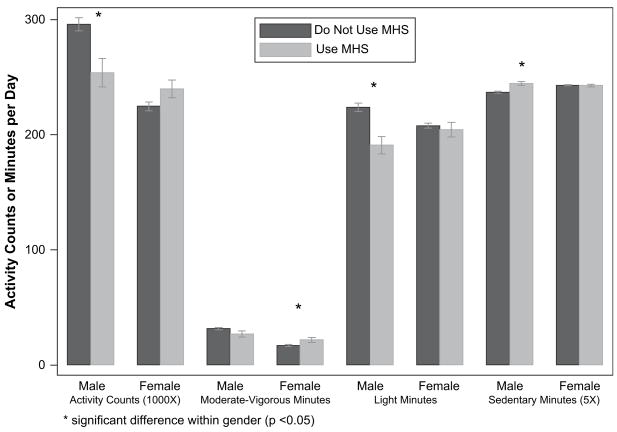
OBJECTIVE: To examine the relationship between physical activity levels measured objectively by accelerometry and the use of mental health services (MHS) in a representative sample of males and females. METHOD: NHANES 2003-2004 is a cross-sectional study of the civilian, non-institutionalized US adult population. Participants reported whether or not they had seen a mental health professional during the past 12 months. Three measures of daily physical activity (light minutes, moderate-vigorous minutes, and total activity counts) and sedentary minutes were determined by accelerometry. The relationship between physical activity and use of MHS was modeled with and without adjustments for potential socioeconomic and health confounders. RESULTS: Of the 1846 males and 1963 females included in this analysis, 7 and 8% reported seeing mental health professionals during the past 12 months, respectively. Men who used MHS were significantly less active than men who did not use MHS (227,700 versus 276,900 total activity counts, respectively, p < 0.05). Men who did not use MHS engaged in 38 min (95% CI 16.3, 59.0) more of light or moderate-vigorous physical activity per day than men who used MHS. Physical activity levels of women, regardless of MHS use, were significantly lower than men who did not use MHS. Differences in total physical activity between women who did and did not use MHS were small (1.3, 95% CI - 14.0, 11.4). CONCLUSION: Men and women who used MHS were relatively sedentary. Additional research is warranted to determine if increasing physical activity levels results in improved mental health in individuals who use MHS.
Figures
References
-
- Abu-Omar K, Rutten A, Lehtinen V. Mental health and physical activity in the European Union. Sozial- und Praventivmedizin. 2004;49(5):301–309. - PubMed
-
- Barker P, Epstein J, Hourani L, Gfroerer J, Clinton-Sherrod A, West N, et al. Patterns of mental health services utilization and substance use among adults, 2000 and 2001. [DHHS Publication No. SMA 04–3901, Analytic Series A-22] Rockville, MD: Substance Abuse and Mental Health Services Administration, Office of Applied Studies; 2004. < http://purl.access.gpo.gov/GPO/LPS68029>.
-
- Bassett DR, Jr, Ainsworth BE, Swartz AM, Strath SJ, O’Brien WL, King GA. Validity of four motion sensors in measuring moderate intensity physical activity. Medicine & Science in Sports & Exercise. 2000;32(Suppl 9):S471–480. - PubMed
-
- Bassett DR, Jr, Cureton AL, Ainsworth BE. Measurement of daily walking distance-questionnaire versus pedometer. Medicine & Science in Sports & Exercise. 2000;32(5):1018–1023. - PubMed
Grants and funding
LinkOut - more resources
Full Text Sources
Miscellaneous