


Open femoral hernia repair: one skin incision for all
- PMID: 19948016
- PMCID: PMC2789711
- DOI: 10.1186/1749-7922-4-44
Open femoral hernia repair: one skin incision for all
Abstract
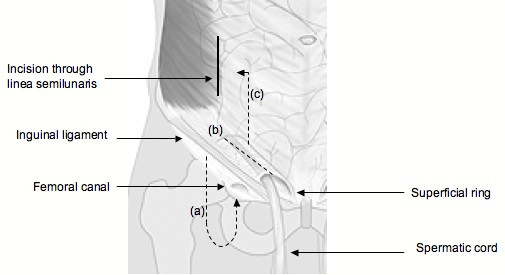
Background: Femoral hernias are relatively uncommon, however they are the most common incarcerated abdominal hernia, with strangulation of a viscus carrying significant mortality. Classically three approaches are described to open femoral hernia repair: Lockwood's infra-inguinal, Lotheissen's trans-inguinal and McEvedy's high approach. Each approach describes a separate skin incision and dissection to access the femoral sac. The decision as to which approach to adopt, predominantly dependent on the suspicion of finding strangulated bowel, is often a difficult one and in our opinion an unnecessary one.
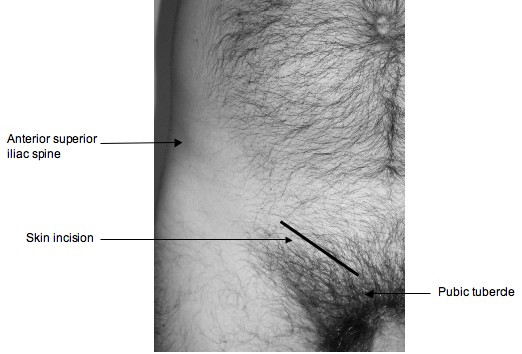
Methods: We propose a technique for open femoral hernia repair that involves a single skin incision 1 cm above the medial half of the inguinal ligament that allows all of the above approaches to the hernia sac depending on the operative findings. Thus the repair of simple femoral hernias can be performed from below the inguinal ligament. If found, inguinal hernias can be repaired. More importantly, resection of compromised bowel can be achieved by accessing the peritoneal cavity with division of the linea semilunaris 4 cm above the inguinal ligament. This avoids compromise of the inguinal canal, and with medial retraction of the rectus abdominis muscle enables access to the peritoneal cavity and compromised bowel.
Discussion: This simple technique minimises the preoperative debate as to which incision will allow the best approach to the femoral hernia sac, allow for alteration to a simple inguinal hernia repair if necessary, and more importantly obviate the need for further skin incisions if compromised bowel is encountered that requires resection.
Figures
References
LinkOut - more resources
Full Text Sources
