. 2009 Nov 30:10:565.
doi: 10.1186/1471-2164-10-565.

Eukaryotic transcriptomics in silico: optimizing cDNA-AFLP efficiency

Affiliations

Eukaryotic transcriptomics in silico: optimizing cDNA-AFLP efficiency

Kai N Stölting et al. BMC Genomics. .

Abstract

Background: Complementary-DNA based amplified fragment length polymorphism (cDNA-AFLP) is a commonly used tool for assessing the genetic regulation of traits through the correlation of trait expression with cDNA expression profiles. In spite of the frequent application of this method, studies on the optimization of the cDNA-AFLP assay design are rare and have typically been taxonomically restricted. Here, we model cDNA-AFLPs on all 92 eukaryotic species for which cDNA pools are currently available, using all combinations of eight restriction enzymes standard in cDNA-AFLP screens.

Results: In silco simulations reveal that cDNA pool coverage is largely determined by the choice of individual restriction enzymes and that, through the choice of optimal enzyme combinations, coverage can be increased from <40% to 75% without changing the underlying experimental design. We find evidence of phylogenetic signal in the coverage data, which is largely mediated by organismal GC content. There is nonetheless a high degree of consistency in cDNA pool coverage for particular enzyme combinations, indicating that our recommendations should be applicable to most eukaryotic systems. We also explore the relationship between the average observed fragment number per selective AFLP-PCR reaction and the size of the underlying cDNA pool, and show how AFLP experiments can be used to estimate the number of genes expressed in a target tissue.

Conclusion: The insights gained from in silico screening of cDNA-AFLPs from a broad sampling of eukaryotes provide a set of guidelines that should help to substantially increase the efficiency of future cDNA-AFLP experiments in eukaryotes. In silico simulations also suggest a novel use of cDNA-AFLP screens to determine the number of transcripts expressed in a target tissue, an application that should be invaluable as next-generation sequencing technologies are adapted for differential display.


Figures
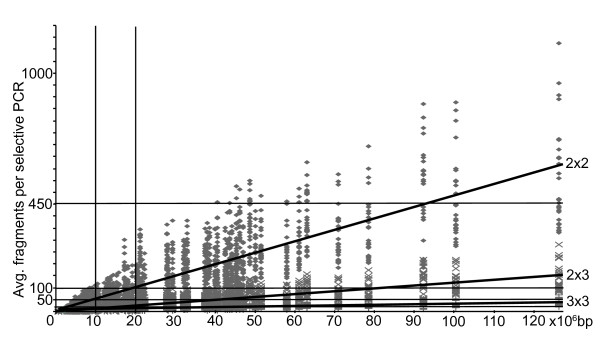
Figure 1
Figure 1
A positive relationship between cDNA pool size and the number of fragments per PCR. Linear regressions of average fragment numbers produced during in silico selective cDNA-AFLP PCRs against the absolute cDNA pool size in bp. Symbols indicate the average fragment numbers produced per enzyme combination and species for selective amplifications using 2 × 2 (diamonds), 2 × 3 (crosses) and 3 × 3 (pluses) selective base pairs, respectively. Duplicate species have been removed from this analysis. The numbers of selective base pairs used for each primer in the selective PCR are indicated, and regression lines have been added for each of the three amplification types. The correlation coefficient for each of the three datasets is 0.74. The production of fewer than 20 fragments per PCR minimizes the possibility of collisions [8], while up to 100 fragments per reaction are often desired when performing AFLP on genomic DNA [3]. A maximum of 450 fragments can be separated in the typical size range of AFLP screens (50-500 bp). Vertical reference lines indicate the total cDNA pool size range expected in a typical tissue expressing between 7500 and 15000 different cDNAs [24] assuming an average cDNA length of 1346 bp [12].
Figure 2
Figure 2
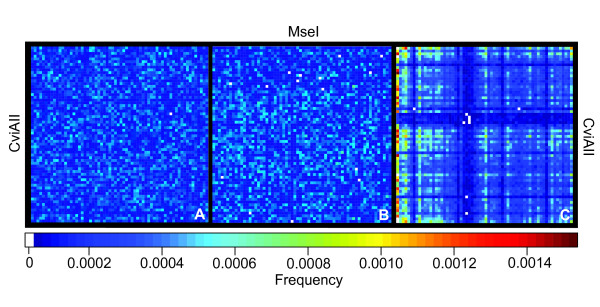
Empirical cDNA-AFLP data are highly structured. Patterning of cDNA-AFLP data. A and B: Patterning of complete arrays of selective PCR amplifications using CviAII and MseI restriction enzymes for (A) simulated random DNA, (B) simulated cDNA (following the standard eukaryotic codon table [25]), and (C) Homo sapiens cDNA. 10000 sequences of 1290 bp were simulated for both the DNA and cDNA datasets. Pixel intensity reflects the relative proportion of products obtained during selective in silico PCR. Pixels are ordered by selective base pairs: AAA (left, top) to TTT (bottom, right). White pixels indicate that no fragments were generated for this combination of selective base pairs.
Figure 3
Figure 3
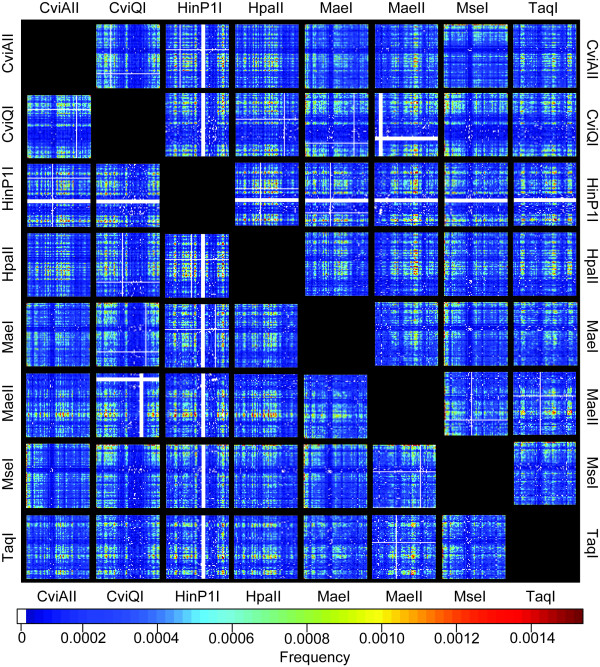
Characteristic cDNA-AFLP patterns are generated by individual restriction enzymes. Overview of the Homo sapiens selective cDNA-AFLP PCR arrays for all enzyme combinations tested here. The layout of arrays follows Figure 2. Note the consistent patterning of arrays, with characteristic ridges and trenches for enzyme combinations which contain the same enzyme. Arrays above the diagonal are mirror images of those below the diagonal. Selective primer combinations yielding no amplifications are highlighted in white. The pixel intensity indicates the relative proportion of fragments amplified in a given selective PCR combination.
Figure 4
Figure 4
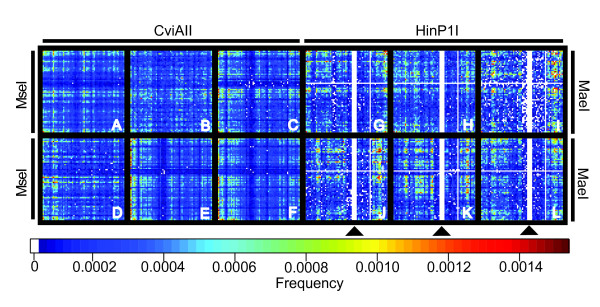
cDNA-AFLP patterning is consistent across all eukaryotes. Arrays of all possible cDNA-AFLP selective PCR combinations for the best (A-F) and worst (G-L) restriction enzyme combinations. Six species per enzyme combination are included. A-F restriction enzymes CviAII and MseI, G-L restriction enzymes HinP1I and MaeI. A/G Arabidopsis thaliana, B/H Drosophila melanogaster, C/I Gallus gallus, D/J Gasterosteus aculeatus, E/K Homo sapiens, F/L Xenopus laevis. Arrowheads pointing to white areas in the arrays indicate primer combinations with GCN-selective base pair motifs, which fail to produce any fragments in a cDNA-AFLP screen with these enzymes (see Discussion).

References

    1. Liang P, Pardee AB. Differential display of eukaryotic messenger-RNA by means of the polymerase chain-reaction. Science. 1992;257:967–971. doi: 10.1126/science.1354393. - DOI - PubMed
    1. Breyne P, Dreesen R, Cannoot B, Rombaut D, Vandepoele K, Rombauts S, Vanderhaeghen R, Inze D, Zabeau M. Quantitative cDNA-AFLP analysis for genome-wide expression studies. Mol Genet Genomics. 2003;269:173–179. - PubMed
    1. Vos P, Hogers R, Bleeker M, Reijans M, Vandelee T, Hornes M, Frijters A, Pot J, Peleman J, Kuiper M, Zabeau M. AFLP - A new technique for DNA-fingerprinting. Nucleic Acids Res. 1995;23:4407–4414. doi: 10.1093/nar/23.21.4407. - DOI - PMC - PubMed
    1. Meudt HM, Clarke AC. Almost forgotten or latest practice? AFLP applications, analyses and advances. Trends Plant Sci. 2007;12:106–117. doi: 10.1016/j.tplants.2007.02.001. - DOI - PubMed
    1. Koopman WJM, Gort G. Significance tests and weighted values for AFLP similarities, based on Arabidopsis in silico AFLP fragment length distributions. Genetics. 2004;167:1915–1928. doi: 10.1534/genetics.103.015693. - DOI - PMC - PubMed

Publication types

MeSH terms

Substances

LinkOut - more resources