


Helix/coil nucleation: a local response to global demands
- PMID: 19948130
- PMCID: PMC2784565
- DOI: 10.1016/j.bpj.2009.09.013
Helix/coil nucleation: a local response to global demands
Abstract
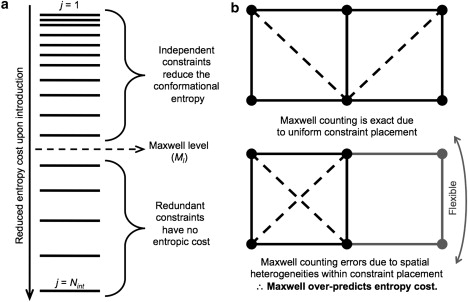
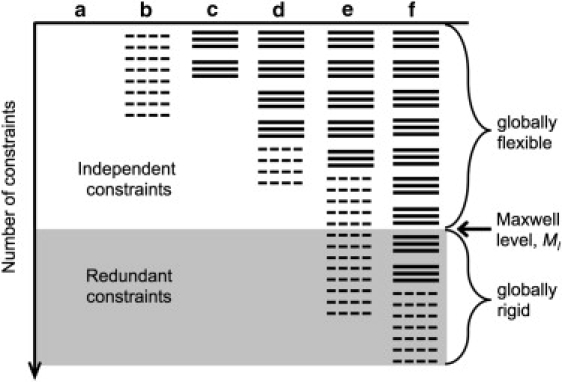
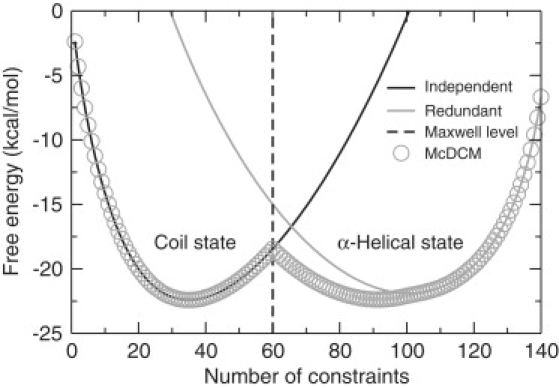
A complete description of protein structure and function must include a proper treatment of mechanisms that lead to cooperativity. The helix/coil transition serves as a simple example of a cooperative folding process, commonly described by a nucleation-propagation mechanism. The prevalent view is that coil structure must first form a short segment of helix in a localized region despite paying a free energy cost (nucleation). Afterward, helical structure propagates outward from the nucleation site. Both processes entail enthalpy-entropy compensation that derives from the loss in conformational entropy on helix formation with concomitant gain in favorable interactions. Nucleation-propagation models inherently assume that cooperativity arises from a sequential series of local events. An alternative distance constraint model asserts there is a direct link between available degrees of freedom and cooperativity through the nonadditivity in conformational entropy. That is, helix nucleation is a concerted manifestation of rigidity propagating through atomic structure. The link between network rigidity and nonadditivity of conformational entropy is shown in this study by solving the distance constraint model using a simple global constraint counting approximation. Cooperativity arises from competition between excess and deficiency in available degrees of freedom in the coil and helix states respectively.
Figures
References
-
- IUPAC . Blackwell Scientific Publications; Oxford: 1997. Compendium of Chemical Terminology.
-
- Miranker A.D., Dobson C.M. Collapse and cooperativity in protein folding. Curr. Opin. Struct. Biol. 1996;6:31–42. - PubMed
-
- Krusek J. Allostery and cooperativity in the interaction of drugs with ionic channel receptors. Physiol. Res. 2004;53:569–579. - PubMed
-
- Whitty A. Cooperativity and biological complexity. Nat. Chem. Biol. 2008;4:435–439. - PubMed
Publication types
MeSH terms
Substances
Grants and funding
LinkOut - more resources
Full Text Sources
