


doi: 10.1016/j.jviromet.2009.11.025.
Epub 2009 Dec 3.
Optimization of allele-specific PCR using patient-specific HIV consensus sequences for primer design
Affiliations
- PMID: 19948190
- PMCID: PMC4734888
- DOI: 10.1016/j.jviromet.2009.11.025
Item in Clipboard
Optimization of allele-specific PCR using patient-specific HIV consensus sequences for primer design
J Virol Methods.
2010 Mar.
Abstract
Allele-specific PCR based on subtype consensus sequences is a powerful technique for detecting low frequency drug resistant mutants in HIV-1 infected patients. However, this approach can be limited by genetic variation in the region complementary to the primers, leading to variability in allele detection. The goals of this study were to quantify this effect and then to improve assay performance.
Copyright (c) 2009 Elsevier B.V. All rights reserved.
Conflict of interest statement
The authors declare no competing interests
Figures
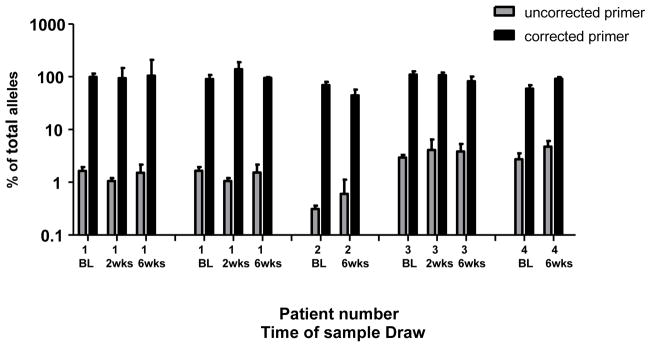
Comparison of allele-specific PCR efficiency of patient samples between primers based on HIV-1 subtype C consensus sequences and primers based on patient-specific HIV-1 consensus sequences at codon 103. The total amplification efficiency of patient samples 1–4 (Table 1) was calculated as the sum of the efficiencies of detection of the wild-type and mutant alleles. Shown are results using the uncorrected consensus primers (grey) and the corrected primers (black) with error bars representing standard deviations of triplicate observations for samples taken immediately before single-dose nevirapine (BL) and 2 and/or 6 weeks following treatment. Patient 1 has 2 data sets; the 1st are samples amplified with primers that match the HIV-1 sequence infecting patient 1, the 2nd are samples amplified with primers only corrected to match the sequence at codon 104 in patient 1.
References
-
- Ambrose Z, Palmer S, Boltz VF, Kearney M, Larsen K, Polacino P, Flanary L, Oswald K, Piatak M, Jr, Smedley J, Shao W, Bischofberger N, Maldarelli F, Kimata JT, Mellors JW, Hu SL, Coffin JM, Lifson JD, KewalRamani VN. Suppression of viremia and evolution of human immunodeficiency virus type 1 drug resistance in a macaque model for antiretroviral therapy. J Virol. 2007;81:12145–55. - PMC - PubMed
-
- Cha RS, Zarbl H, Keohavong P, Thilly WG. Mismatch amplification mutation assay (MAMA): application to the c-H-ras gene. PCR Methods Appl. 1992;2:14–20. - PubMed
-
- Coffin JM. HIV population dynamics in vivo: implications for genetic variation, pathogenesis, and therapy. Science. 1995;267:483–9. - PubMed
-
- De Clercq E. HIV resistance to reverse transcriptase inhibitors. Biochem Pharmacol. 1994;47:155–69. - PubMed
-
- Deeks SG. International perspectives on antiretroviral resistance. Nonnucleoside reverse transcriptase inhibitor resistance. J Acquir Immune Defic Syndr. 2001;26(Suppl 1):S25–33. - PubMed
Publication types
MeSH terms
Substances
Grants and funding
LinkOut - more resources
Full Text Sources
Medical
