


Tumor-stroma co-evolution in prostate cancer progression and metastasis
- PMID: 19948237
- PMCID: PMC3388105
- DOI: 10.1016/j.semcdb.2009.11.016
Tumor-stroma co-evolution in prostate cancer progression and metastasis
Abstract
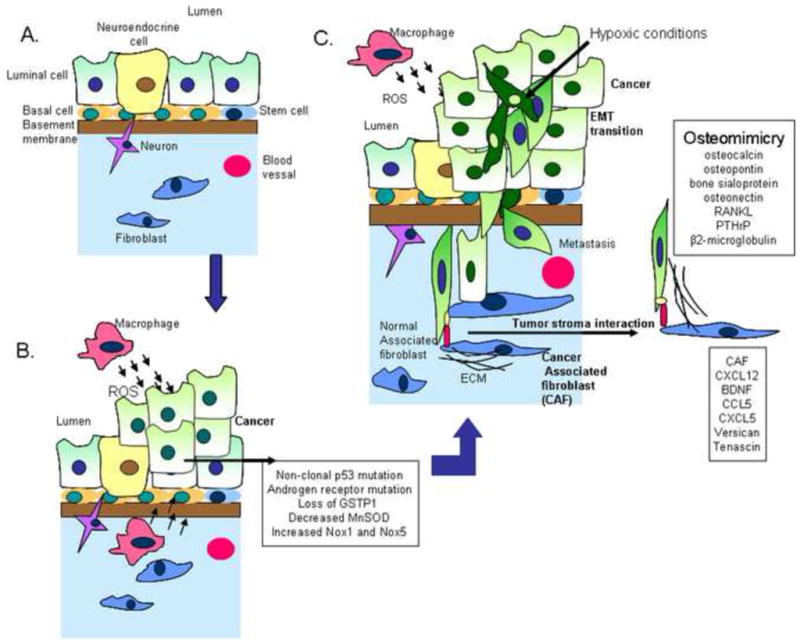
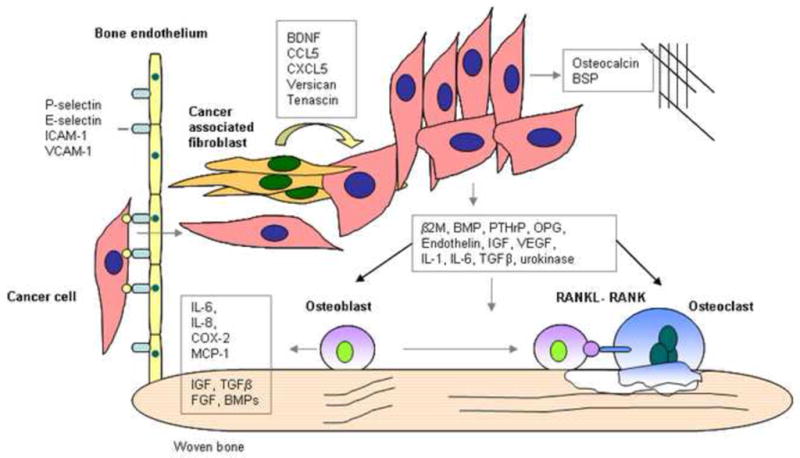
Cancer development is complex and involves several layers of interactions and pleotropic signaling mechanisms leading to progression. Cancer cells associate with resident stromal fibroblasts, smooth muscle cells, macrophages, endothelium, neurons and migrating cells at metastatic sites and phenotypically and genotypically activate them. These become an integral part of the cancer cell community through activated cell signaling mechanisms. During this process, the cancer cells and cells in the cancer microenvironment "co-evolve" in part due to oxidative stress, and acquire the ability to mimic other cell types (which can be termed osteomimicry, vasculomimicry, neuromimicry and stem cell mimicry), and undergo transition from epithelium to mesenchyme with definitive morphologic and behavioral modifications. In our laboratory, we demonstrated that prostate cancer cells co-evolve in their genotypic and phenotypic characters with stroma and acquire osteomimetic properties allowing them to proliferate and survive in the skeleton as bone metastasis. Several signaling interactions in the bone microenvironment, mediated by reactive oxygen species, soluble and membrane bound factors, such as superoxide, beta2-microglobulin and RANKL have been described. Targeting the signaling pathways in the cancer-associated stromal microenvironment in combination with known conventional therapeutic modalities could have a synergistic effect on cancer treatment. Since cancer cells are constantly interacting and acquiring adaptive and survival changes primarily directed by their microenvironment, it is imperative to delineate these interactions and co-target both cancer and stroma to improve the treatment and overall survival of cancer patients.
Copyright 2009 Elsevier Ltd. All rights reserved.
Figures
References
-
- Thalmann GN, Anezinis PE, Chang SM, Zhau HE, Kim EE, Hopwood VL, et al. Androgen-independent cancer progression bone metastasis in the LNCaP model of human prostate cancer. Cancer Res. 1994;54:2577–2581. - PubMed
-
- Rhee HW, Zhau HE, Pathak S, Multani AS, Pennanen S, Visakorpi T, et al. Permanent phenotypic and genotypic changes of prostate cancer cells cultured in a three-dimensional rotating-wall vessel. In Vitro Cell Dev Biol Anim. 2001;37:127–140. - PubMed
-
- De Marzo AM. The pathology of human prostatic atrophy and inflammation. In: Chung LWK, Simons JW, editors. Prostate Cancer: Biology, Genetics, and the New Therapeutics. 2. New Jersey: Humana Press; 2007. p. 34.
-
- Tsujimoto Y, Takayama H, Nonomura N, Okuyama A, Aozasa K. Postatrophic hyperplasia of the prostate in Japan: histologic and immunohistochemical features and p53 gene mutation analysis. Prostate. 2002;52:279–287. - PubMed
-
- Tsujimoto Y, Takakuwa T, Takayama H, Nishimura K, Okuyama A, Aozasa K, et al. In situ shortening of CAG repeat length within the androgen receptor gene in prostatic cancer and its possible precursors. Prostate. 2004;58:283–290. - PubMed
Publication types
MeSH terms
Substances
Grants and funding
LinkOut - more resources
Full Text Sources
Other Literature Sources
Medical
