Review
. 2009 Nov 30;187(5):589-96.
doi: 10.1083/jcb.200908138. Epub 2009 Nov 23.

Eukaryotic systems broaden the scope of synthetic biology

Affiliations
Review

Eukaryotic systems broaden the scope of synthetic biology

Karmella A Haynes et al. J Cell Biol. .

Abstract

Synthetic biology aims to engineer novel cellular functions by assembling well-characterized molecular parts (i.e., nucleic acids and proteins) into biological "devices" that exhibit predictable behavior. Recently, efforts in eukaryotic synthetic biology have sprung from foundational work in bacteria. Designing synthetic circuits to operate reliably in the context of differentiating and morphologically complex cells presents unique challenges and opportunities for progress in the field. This review surveys recent advances in eukaryotic synthetic biology and describes how synthetic systems can be linked to natural cellular processes in order to manipulate cell behavior and to foster new discoveries in cell biology research.


Figures
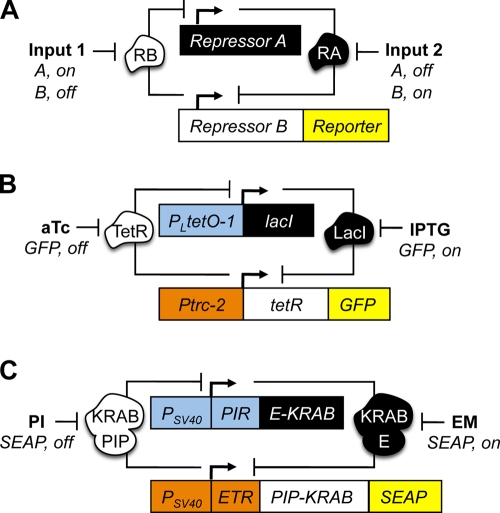
Figure 1.
Figure 1.
Synthetic genetic toggle switches. (A) A genetic toggle switch comprised of two genes (Repressor A and Repressor B) encoding repressor proteins (RA and RB) uses a mutual repression motif to achieve bistability. Transient exposure to Input 1 inhibits RB and switches the system’s stable state to Repressor A expression. Input 2 inhibits RA and activates Repressor B and a detectable output (Reporter). (B) Stable GFP output from a synthetic prokaryotic toggle switch is activated by isopropyl-β-d-thiogalactopyranoside (IPTG) and deactivated by anhydrotetracycline (aTc; Gardner et al., 2000). The LacI and TetR repressor proteins bind the Ptrc-2 and PLtetO-1 promoters, respectively. (C) In the mammalian toggle switch, secreted alkaline phosphatase (SEAP) output is activated erythromycin (EM) and deactivated by pristinamycin I (PI; Kramer et al., 2004). Repressor proteins, containing the KRAB (Kruppel-associated box) transcription repression domain fused with either the pristinamycin-induced transcription regulator protein (PIP) or the macrolide responsive MphR(A) protein (E) bind to promoters containing a simian virus 40 region (PSV40) and target sequences for PIP (PIR) or E (ETR).
Figure 2.
Figure 2.
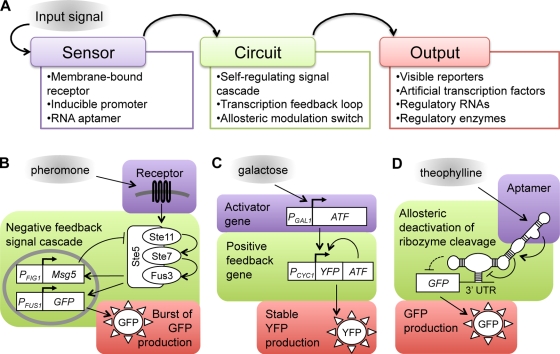
Three levels of modular functions within synthetic devices. (A) An input signal, such as a small molecule, ligand, or metabolite, is detected at the sensor level. The signal is then translated into a pattern of behavior at the circuit level. At the output level, reporter gene expression and/or effectors of downstream processes coincide with the behavior of the circuit. Each box lists examples of sensors, circuits, and outputs that are correspondingly shaded in B–D. (B) In a cell signaling–based device, pheromone input binds a receptor and triggers an engineered MAPK signal circuit that activates GFP expression and the negative regulator Msg5. Activation, negative feedback, then deactivation result in a burst of GFP output (Bashor et al., 2008). (C) In a transcription-based device, transient galactose input induces the expression of a PGAL1-driven ATF that initiates the stable transcription of a positive feedback gene and sustained YFP output (Ajo-Franklin et al., 2007). (D) Functions of a riboswitch are encoded within folded RNA domains. Theophylline input binds to the aptamer sensor region, causing a conformational change that is transduced down the molecule to disrupt ribozyme-mediated RNA cleavage and allow GFP expression (Win and Smolke 2007, 2008).
Figure 3.
Figure 3.
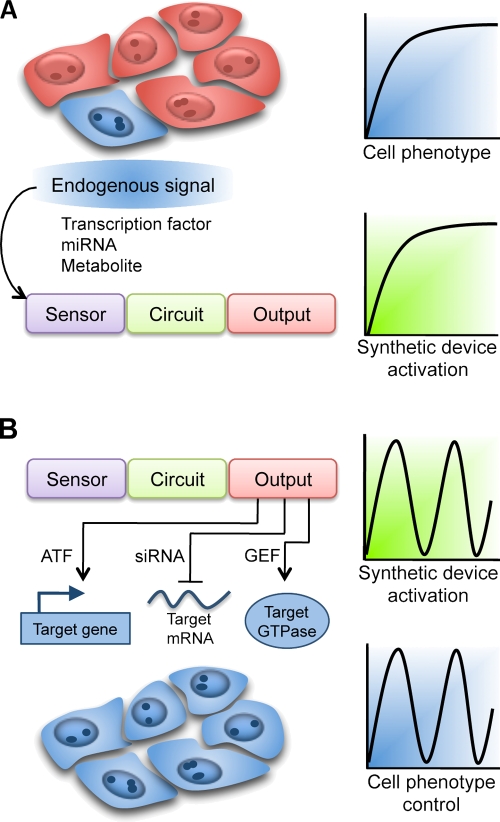
Interfacing synthetic circuits with biological functions. (A) Synthetic devices can be placed under the control of sensors that sense inputs such as transcription factors, metabolites (Table I), and potentially miRNAs. In a population of cells that carry the circuit, the cell (shaded blue) that expresses certain developmental or disease cues triggers activity of the circuit. (B) At the output level, synthetic devices can be interfaced with cell phenotypes by placing endogenous targets under the control of circuit outputs: transcription factors target endogenous genes, small RNA silencers target transcripts, and guanine nucleotide exchange factors target GTPase enzymes that regulate cytoskeletal morphology. Consequently, all cells (shaded blue) that are exposed to the input stimulus undergo a programmed change in phenotype.

References

    1. Ajo-Franklin C.M., Drubin D.A., Eskin J.A., Gee E.P., Landgraf D., Phillips I., Silver P.A. 2007. Rational design of memory in eukaryotic cells. Genes Dev. 21:2271–2276 10.1101/gad.1586107 - DOI - PMC - PubMed
    1. Anderson J.C., Clarke E.J., Arkin A.P., Voigt C.A. 2006. Environmentally controlled invasion of cancer cells by engineered bacteria. J. Mol. Biol. 355:619–627 10.1016/j.jmb.2005.10.076 - DOI - PubMed
    1. Andrianantoandro E., Basu S., Karig D.K., Weiss R. 2006. Synthetic biology: new engineering rules for an emerging discipline. Mol. Syst. Biol. 2:2006: 0028 10.1038/msb4100073 - DOI - PMC - PubMed
    1. Anthony J.R., Anthony L.C., Nowroozi F., Kwon G., Newman J.D., Keasling J.D. 2009. Optimization of the mevalonate-based isoprenoid biosynthetic pathway in Escherichia coli for production of the anti-malarial drug precursor amorpha-4,11-diene. Metab. Eng. 11:13–19 10.1016/j.ymben.2008.07.007 - DOI - PubMed
    1. Antunes M.S., Ha S.B., Tewari-Singh N., Morey K.J., Trofka A.M., Kugrens P., Deyholos M., Medford J.I. 2006. A synthetic de-greening gene circuit provides a reporting system that is remotely detectable and has a re-set capacity. Plant Biotechnol. J. 4:605–622 10.1111/j.1467-7652.2006.00205.x - DOI - PubMed

Publication types