. 2010 Jan;12(1):109-17.
doi: 10.2353/jmoldx.2010.090035. Epub 2009 Nov 30.

The effect of primer-template mismatches on the detection and quantification of nucleic acids using the 5' nuclease assay

Affiliations

The effect of primer-template mismatches on the detection and quantification of nucleic acids using the 5' nuclease assay

Ralph Stadhouders et al. J Mol Diagn. 2010 Jan.

Abstract

Real-time polymerase chain reaction (PCR) is the current method of choice for detection and quantification of nucleic acids, especially for molecular diagnostics. Complementarity between primers and template is often crucial for PCR applications, as mismatches can severely reduce priming efficiency. However, little quantitative data on the effect of these mismatches is available. We quantitatively investigated the effects of primer-template mismatches within the 3'-end primer region on real-time PCR using the 5'-nuclease assay. Our results show that single mismatches instigate a broad variety of effects, ranging from minor (<1.5 cycle threshold, eg, A-C, C-A, T-G, G-T) to severe impact (>7.0 cycle threshold, eg, A-A, G-A, A-G, C-C) on PCR amplification. A clear relationship between specific mismatch types, position, and impact was found, which remained consistent for DNA versus RNA amplifications and Taq/Moloney murine leukemia virus versus rTth based amplifications. The overall size of the impact among the various master mixes used differed substantially (up to sevenfold), and for certain master mixes a reverse or forward primer-specific impact was observed, emphasizing the importance of the experimental conditions used. Taken together these data suggest that mismatch impact follows a consistent pattern and enabled us to formulate several guidelines for predicting primer-template mismatch behavior when using specific 5-nuclease assay master mixes. Our study provides novel insight into mismatch behavior and should allow for more optimized development of real-time PCR assays involving primer-template mismatches.


Figures
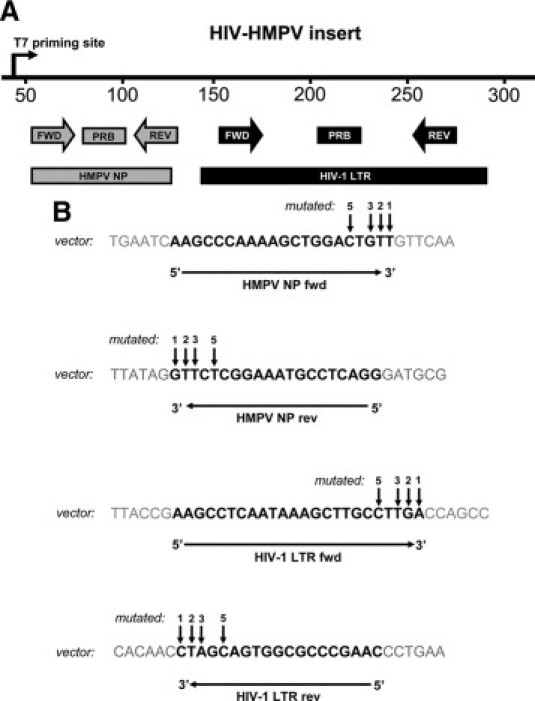
Figure 1
Figure 1
Oligonucleotides used to study the effects of 3′ end primer-template mismatches on nucleic acid detection and quantification with real-time Taqman PCR. Panel (A) represents a linear map of the HIV-HMPV insert, in which the location of both viral DNA sequences and corresponding primers and probes are depicted. Panel (B) shows the nucleotide sequences of the primers (black) as located in the vector. Arrows indicate the positions on the HIV-hMPVpGA4 vector that have been subjected to site-directed mutagenesis. fwd = forward primer, rev = reverse primer, PRB = probe.
Figure 2
Figure 2
Effects of primer-template mismatches on the quantification of nucleic acids using real-time Taqman PCR. Each panel represents the effects of one single mismatch (depicted as a primer-template mismatch) at different positions on the HIV-hMPVpGA4 construct. The position of the mismatch and the primer in which it is located are shown on the x axis, while the y axis shows the average increase in detected Ct-value as compared with the complementary situation. Amplifications were performed using the 2× Taqman Universal PCR Mastermix. Error bars represent the SD (n = 4). Differences in Ct-values were tested for statistical significance using a Student t-test. Significant values (*P < 0.05) are indicated nt = nucleotide, rev = reverse primer, fwd = forward primer.
Figure 3
Figure 3
Effects of primer-template mismatches on the quantification of nucleic acids using a Taq/MMLV-based real-time Taqman RT-PCR. Each panel represents the effects of the 12 individual mismatches (depicted as primer-template mismatches) per primer. The type and position of the individual mismatches are shown on the x axis, while the y axis shows the average increase in detected Ct-value as compared with the complementary situation. Amplifications were performed using the Taqman PCR Core Reagents Kit, combined with Multiscribe Reverse Transcriptase and RNase inhibitors. Error bars represent the SD (n = 4). Differences in Ct-values were tested for statistical significance using a Student t-test. Significant values (*P < 0.05) are indicated nt = nucleotide, REV = reverse primer, FWD = forward primer.
Figure 4
Figure 4
Effects of primer-template mismatches on the quantification of nucleic acids using rTth DNA polymerase-based real-time Taqman RT-PCR. Each panel represents the effects of the 12 individual mismatches (depicted as primer-template mismatches) per primer. The type and position of the individual mismatches are shown on the x axis, while the y axis shows the average increase in detected Ct-value as compared with the complementary situation. Amplifications were performed using the Taqman EZ RT-PCR Kit. Error bars represent the SD (n = 4). Differences in Ct-values were tested for statistical significance using a Student t-test. Significant values (P < 0.05) are indicated by an asterisk. nt = nucleotide, REV = reverse primer, FWD = forward primer.

References

    1. Valasek MA, Repa JJ. The power of real-time PCR. Adv Physiol Educ. 2005;29:151–159. - PubMed
    1. Ginzinger DG. Gene quantification using real-time quantitative PCR: an emerging technology hits the mainstream. Exp Hematol. 2002;30:503–512. - PubMed
    1. Lie YS, Petropoulos CJ. Advances in quantitative PCR technology: 5′ nuclease assays. Curr Opin Biotechnol. 1998;9:43–48. - PubMed
    1. Gibson NJ. The use of real-time PCR methods in DNA sequence variation analysis. Clin Chim Acta. 2006;363:32–47. - PubMed
    1. Mackay IM, Arden KE, Nitsche N. Real-time PCR in virology. Nucleic Acids Res. 2002;30:1292–1305. - PMC - PubMed
