. 2010 Feb;184(2):351-61.
doi: 10.1534/genetics.109.111393. Epub 2009 Nov 30.

FRQ-interacting RNA helicase mediates negative and positive feedback in the Neurospora circadian clock

Affiliations

FRQ-interacting RNA helicase mediates negative and positive feedback in the Neurospora circadian clock

Mi Shi et al. Genetics. 2010 Feb.

Abstract

The Neurospora circadian oscillator comprises FREQUENCY (FRQ) and its transcription activator, the White Collar Complex (WCC). Repression of WCC's transcriptional activity by FRQ via negative feedback is indispensable for clock function. An unbiased genetic screen that targeted mutants with defects in negative feedback regulation yielded a fully viable arrhythmic strain bearing a novel allele of FRQ-interacting RNA helicase (frh), an essential gene that encodes a putative exosome component protein. In the allele, frh(R806H), clock function is completely disturbed, while roles of FRQ-interacting RNA helicase (FRH) essential for viability are left intact. FRH(R806H) still interacts with FRQ, but interaction between the FRQ-FRH(R806H) complex (FFC) and WCC is severely affected. Phosphorylation of WC-1 is reduced in the mutant leading to constantly elevated WCC activity, which breaks the negative feedback loop. WCC levels are considerably reduced in the mutant, especially those of WC-1, consistent both with loss of positive feedback (FRQ-dependent WC-1 stabilization) and with a reduced level of the FRQ-mediated WCC phosphorylation that leads to high WCC activity accompanied by rapid transcription-associated turnover. FRH overexpression promotes WC-1 accumulation, confirming that FRH together with FRQ plays a role in WC-1 stabilization. Identification of a viable allele of frh, displaying virtually complete loss of both negative and positive circadian feedback, positions FRH as a core component of the central oscillator that is permissive for rhythmicity but appears not to modulate periodicity. Moreover, the results suggest that there are clock-specific roles for FRH that are distinct from the predicted essential exosome-associated functions for the protein.


Figures
F<sc>igure</sc> 1.—
Figure 1.—
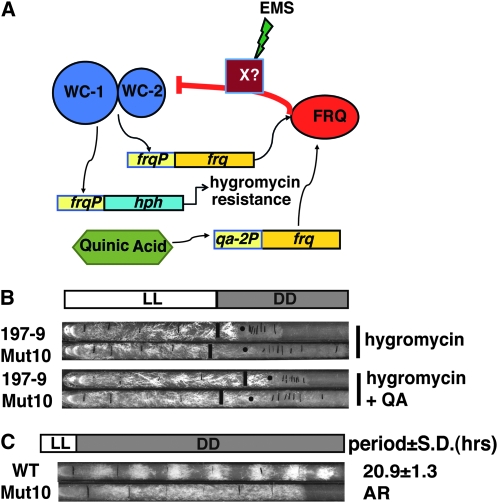
A genetic screen for mutants defective in circadian negative feedback. (A) Scheme of the genetic screen. Expression of the selectable marker, hph, is under control of the frq promoter (frqP); therefore it is repressed by negative feedback in the dark via FRQ inhibiting the WCC transcriptional activity. Mutants with defects in negative feedback were obtained after EMS mutagenesis through selection for resistance to hygromycin. Overexpression of FRQ by QA induction driven through the qa-2 promoter (qa-2P) was subsequently used to confirm that there was a break in the negative feedback loop connecting FRQ to the WCC. (B) Race tube assay with hygromycin selection. The mycelial growth front was marked with a thin black line each day. The thick solid black lines on race tubes represent light (LL) to dark (DD) transfer. The dots mark growth fronts 1 day after LD transfer. The original strain 197-9 that was subjected to EMS mutagenesis grew normally in light, reflecting light-induced WCC activity that activates the frqP. After LD transfer, the growth rate decreased dramatically, verifying that the WCC activity was inhibited by FRQ. In comparison with 197-9, the growth rate of Mut10 was faster in DD, suggesting that negative feedback was severely affected. Consistent with this, QA-induced FRQ could not restore the loss of negative feedback in Mut10, confirming that the strain contains a bona fide feedback mutation not at the frq locus. (C) Race tube assay in free running conditions. WT and Mut10 sibling strains were cultured in light and their clocks were assayed after transfer to DD. Mut10 is arrhythmic under free running conditions, although its growth rate is comparable to the WT sibling strain. Period length is shown from a regression analysis of n = 6 bands with a standard deviation (SD). AR, arrhythmic.
F<sc>igure</sc> 2.—
Figure 2.—
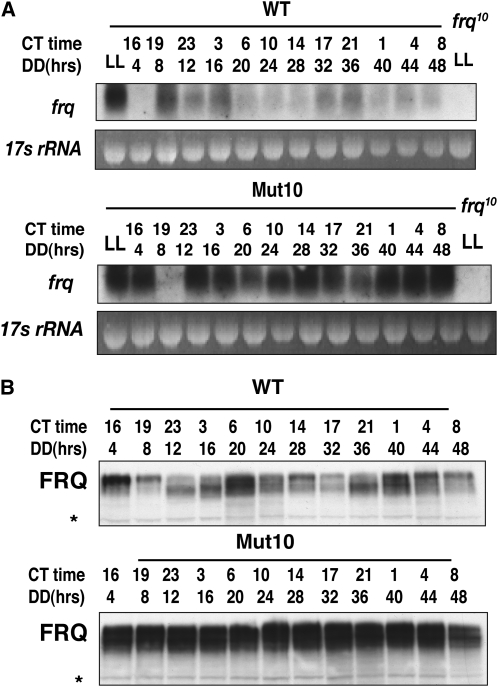
Loss of negative feedback in Mut10. (A) Northern analysis showing rhythmic frq expression in the molecular clock. RNA samples collected over 2 days from a WT strain (top) were subjected to a Northern analysis probing with frq. A normal circadian frq mRNA oscillation was observed with two peaks around time DD12 (12-hr culture in dark) and DD36, respectively. In Mut10 (bottom), frq mRNA was upregulated and displayed a random fluctuation representing unregulated and noncircadian WCC activity due to the loss of negative feedback. (B) Western analysis of FRQ. Samples were collected every 4 hr from cultures held in constant darkness (DD) as in A, and subjected to Western analysis with anti-FRQ antiserum. A WT strain (top) showed a circadian oscillation of FRQ protein level and FRQ phosphorylation. In comparison, Mut10 (bottom), having lost negative feedback, showed a constitutively high level of FRQ and the presence of all phospho-isoforms at all time points. Asterisks mark a nonspecific band.
F<sc>igure</sc> 3.—
Figure 3.—
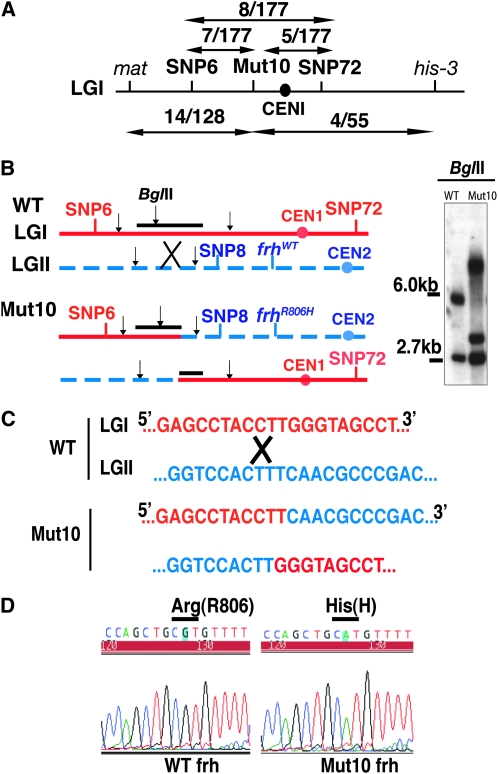
Genetic mapping of Mut10 reveals a translocation with a breakpoint linked to frh. (A) Genetic mapping analyzing progeny from a cross between Mut10 and WT showed linkage to traditional markers (mat and his-3) and newly identified SNP markers near the centromere region on linkage group I (LGI). The genetic distance is reported as the number of recombinants over the number of total progeny analyzed. SNP markers were named after their contig numbers in Neurospora genome (release 7) (http://www.broad.mit.edu/annotation/genome/neurospora). (B) Chromosomal translocation in Mut10. A diagram of the chromosomes in WT and Mut10 is shown (left). The red solid line and the blue dashed line represent chromosomes of LGI and LGII, respectively, from WT (top left) and Mut10 (bottom left). The thick black bar indicates a fragment amplified by oligos MS266 and MS254 (see materials and methods) from WT genomic DNA. The fragment flanks a BglII site (arrowhead) and was used as a probe in the Southern analysis (right); other BglII sites are also marked by arrows. The breakpoint of the chromosomal translocation is within the probe region, therefore the probe hybridizes to DNA from two chromosomes in Mut10, resulting in a different digestion pattern from WT as shown in the Southern analysis. See text and Figure S1 for details. (C) The translocation junction fragment was cloned by inverse PCR and sequencing of the junction region identified the exact translocation point between LGI (sequence in red) and LGII (sequence in blue). A thymidine nucleotide was lost as a result of the translocation event. (D) Sequencing of the frh locus in Mut10 revealed a G-to-A mutation leading to an arginine-to-histidine change (R806H).
F<sc>igure</sc> 4.—
Figure 4.—
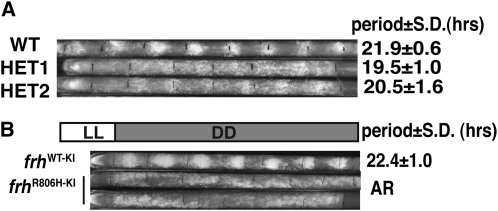
frhR806H knock-in phenocopies Mut10. (A) Analysis of forced heterokaryons between WT and Mut10. HET1 (heterokaryon of Mut10; pan-2 and inl) and HET2 (heterokaryon of Mut10; inl and pan-2) showed weak rhythmic conidiation on race tubes with a strong conidiation background. The phenotype is between wild type and Mut10, suggesting that Mut10 is codominant with WT. Period is shown by regression analysis of n = 6–7 conidial bands on the race tube. (B) Race tube assay of frh knock-in strains (see Figure S2 for details). The frhWT-KI (SM52) strain, bearing a normal copy of frh with bar as a selectable marker, showed a normal circadian rhythm in free running conditions. In comparison, two separate frhR806H-KI strains (SM53 and SM54) showed arrhythmicity, which phenocopied Mut10 and frhR806H.
F<sc>igure</sc> 5.—
Figure 5.—
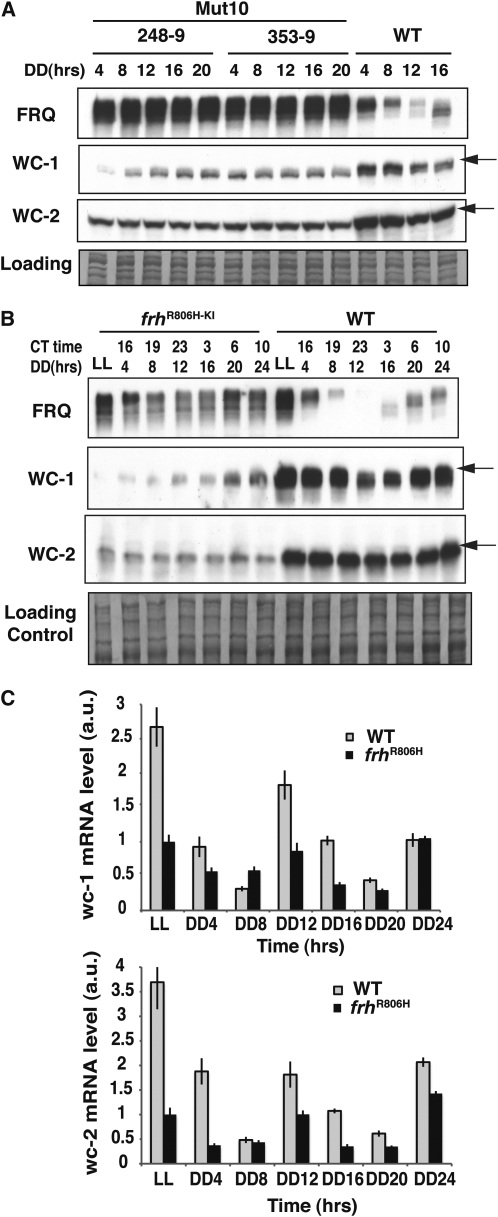
Loss of positive feedback in Mut10 and frhR806H. (A) Circadian time course samples of WT and Mut10 were subjected to Western analysis and blotted with FRQ, WC-1, and WC-2 antisera. The progeny 248-9 and 353-9 are from two successive generations of backcrosses between Mut10 and WT; both strains are arrhythmic. While FRQ levels were elevated in Mut10, WC-1 and WC-2 levels in such strains were much lower than in WT, suggesting that the high FRQ level could not maintain the WCC level, because the positive feedback loop of FRQ promoting WCC expression was disrupted in the mutant (see text for details). Arrowheads point to bands corresponding to hyperphosphorylated WC-1 or WC-2, representing inactive WCC (Schafmeier et al. 2005). Both White Collar proteins were hypophosphorylated in Mut10, consistent with loss of negative feedback that leads to upregulated WCC activity. (B) frhR806H-KI strains phenocopy Mut10 at the molecular level, showing defects in negative feedback leading to high expression of FRQ and defects in positive feedback leading to reduced expression of the WCC. Arrowheads point at hyperphosphorylated WCC. (C) Real-time PCR analysis of mRNA levels in samples collected over 1 day in darkness or after 24 hr in light. wc-1 (top) and wc-2 (bottom) mRNA levels were in general reduced in frhR806H compared to WT. (Error bar ± SD, n = 3 PCR repeats.)
F<sc>igure</sc> 6.—
Figure 6.—
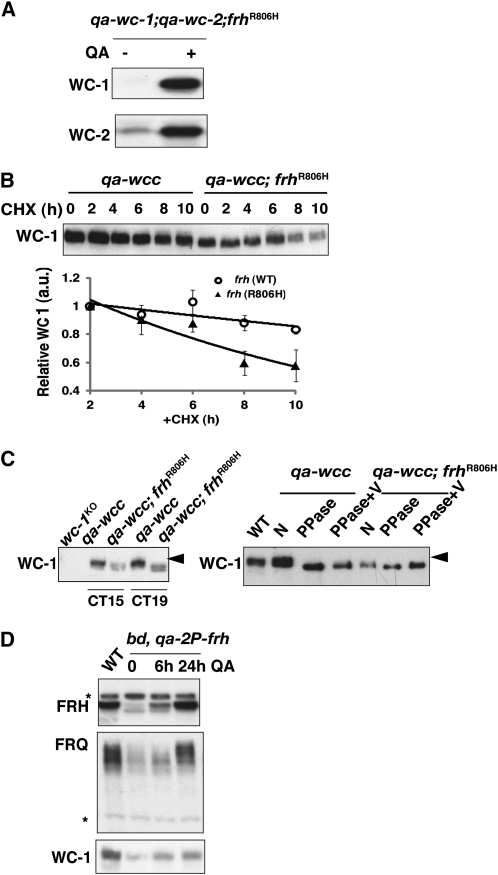
Reduced WC-1 phosphorylation and stability in frhR806H suggest a role for FRH in positive feedback. (A) WCC induction in frhR806H. The qa-wc-1; qa-wc-2; frhR806H strain was cultured in 2% glucose (−QA condition) and then moved to 0.1% glucose with 0.01 m QA (+QA condition) and grown for 8 hr. Extracts were made and subjected to Western analysis and the result showed that WC-1 and WC-2 could be induced by QA. (B) Reduced WC-1 stability in frhR806H. WC-1 and WC-2 were induced in WT and frhR806H by QA for 12 hr before QA was washed away and CHX was added. Time course samples collected after QA release were subjected to Western analysis and the change in WC-1 levels as determined by densitometry is plotted as a function of time. WC-1 was less stable in frhR806H than in WT, suggesting that FRHR806H had a defect in maintaining WC-1 stability and FRH has a role in post-translation regulation of WC-1. WC-2 was stable in frhR806H. (C) Defects in WC-1 phosphorylation in frhR806H. (Left) WCC was induced in WT and frhR806H, and samples were cultured in dark and extracted at subjective dusk time. WC-1 in frhR806H shows faster mobility, consistent with hypophosphorylation. (Right) WC-1 is normally phosphorylated under these conditions and can be dephosphorylated by λ-PPase and this dephosphorylation can be inhibited by sodium vanadate. Samples from CT15 (DD4) were analyzed: N signifies no addition to the reaction mix; PPase, addition of phosphatase; PPase+V, addition of both PPase and the PPase-inhibitor vanadate. (D) FRH regulates FRQ and WC-1 expression. qa-frhKI strains were initially cultured in 2% glucose media for 48 hr (0 QA) and then moved into 0.1% glucose media with 0.01 m QA for induction. Time course samples (6 hr and 24 hr) were collected and extracts were subjected to Western analysis. FRH is inducible by QA in qa-frhKI. Induction of FRH leads to increases in FRQ and WC-1 expression. The experiment shown is representative; variability in the kinetics of FRH, FRQ, and WC-1 induction was noted, but not in the presence of induction.
F<sc>igure</sc> 7.—
Figure 7.—
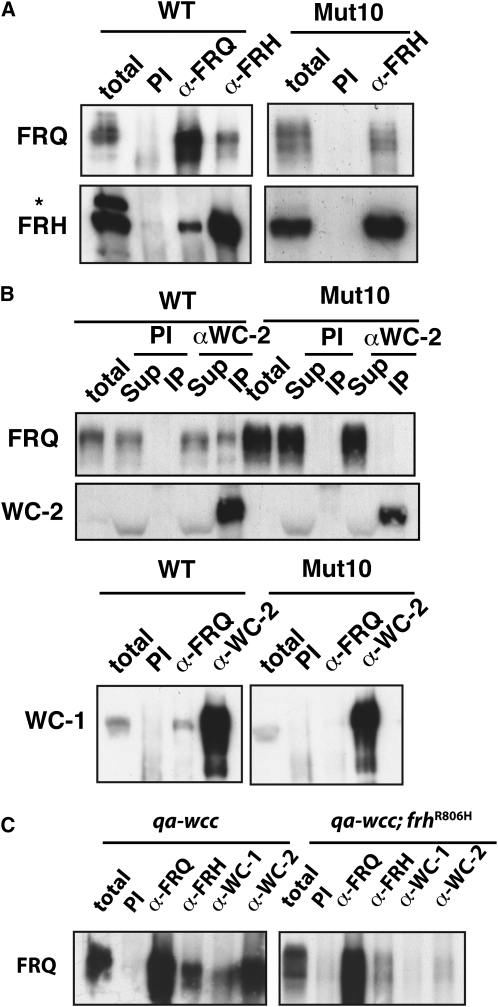
The point mutation in FRHR806H has no effect on FRQ and FRH interaction, but abrogates interaction between FRQ, FRH, and the White Collar Complex. (A) Co-immunoprecipitation assay. FRQ and FRH form the FRQ–FRH complex (FFC) in WT, shown by reciprocal co-IP using α-FRQ and α-FRH. Similarly, the complex formation is intact in Mut10 as well, where α-FRH co-immunoprecipitates FRQ from extracts made from Mut10 strains. PI, pre-immune serum. (B) Reciprocal co-immunoprecipitation assay using α-WC-2 and α-FRQ shows that the FFC and the WCC interact in extracts from WT but not Mut10 cultures. (Top left) IP with α-WC-2 pulls down WC-2 and FRQ. (Bottom left) WC-1 is detected in the immunoprecipitates from WT extracts treated with α-FRQ or α-WC-2. In contrast, in extracts made from Mut10, α-WC-2 did not pull down FRQ (top right), neither did α-FRQ pull down WC-1 (bottom right). However in Mut10 extracts, α-WC-2 does pull down WC-1 (bottom right), indicating that the WCC is intact in Mut10. (C) Co-immunoprecipitation assay in strains where WCC is induced shows that interaction between the FRQ/FRH complex and the WCC is reduced in frhR806H. (Left) In WT, IP with α-WC-1 or α-WC-2 pulls down FRQ. (Right) In frhR806H, α-WC-1 or α-WC-2 pulls down some FRQ protein, but the level is reduced in comparison with WT, arguing the interaction between FFC and WCC is reduced in mutant.

References

    1. Aronson, B. D., K. A. Johnson, J. J. Loros and J. C. Dunlap, 1994. Negative feedback defining a circadian clock: autoregulation of the clock gene frequency. Science 263 1578–1584. - PubMed
    1. Bell-Pedersen, D., V. M. Cassone, D. J. Earnest, S. S. Golden, P. E. Hardin et al., 2005. Circadian rhythms from multiple oscillators: lessons from diverse organisms. Nat. Rev. Genet. 6 544–556. - PMC - PubMed
    1. Belden, W. J., L. F. Larronodo, A. C. Froehlich, M. Shi, C. H. Chen, et al., 2007. The band mutation in Neurospora crassa is a dominant allele of ras-1 implicating RAS signaling in circadian output. Genes Dev. 21 1494–1505. - PMC - PubMed
    1. Brunner, M., and K. Kaldi, 2008. Interlocked feedback loops of the circadian clock of Neurospora crassa. Mol. Microbiol. 68 255–262. - PubMed
    1. Cheng, P., Q. He, Q. He, L. Wang and Y. Liu, 2005. Regulation of the Neurospora circadian clock by an RNA helicase. Genes Dev. 19 234–241. - PMC - PubMed

Publication types

MeSH terms