


The effects of differential reinforcement of unprompted responding on the skill acquisition of children with autism
- PMID: 19949520
- PMCID: PMC2695336
- DOI: 10.1901/jaba.2009.42-327
The effects of differential reinforcement of unprompted responding on the skill acquisition of children with autism
Abstract
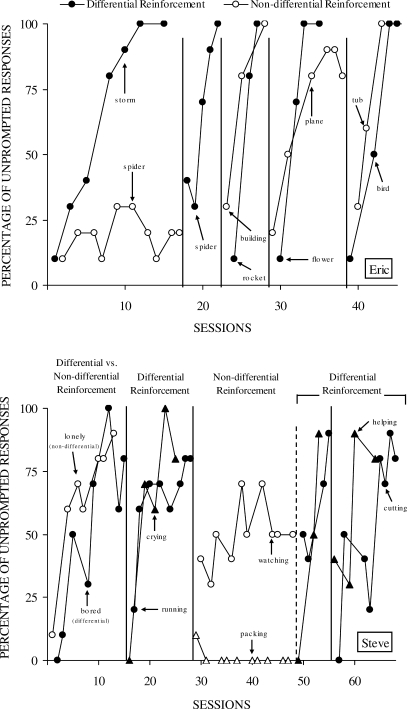
The recommendation to reserve the most potent reinforcers for unprompted responses during acquisition programming has little published empirical support for its purported benefits (e.g., rapid acquisition, decreased errors, and decreased prompt dependence). The purpose of the current investigation was to compare the delivery of high-quality reinforcers exclusively following unprompted responses (differential reinforcement) with the delivery of high-quality reinforcers following both prompted and unprompted responses (nondifferential reinforcement) on the skill acquisition of 2 children with autism. Results indicated that both were effective teaching procedures, although the differential reinforcement procedure was more reliable in producing skill acquisition. These preliminary findings suggest that the differential reinforcement of unprompted responses may be the most appropriate default approach to teaching children with autism.
Keywords: autism; differential reinforcement; skill acquisition.
Figures
References
-
- Anderson S.R, Taras M, O'Malley-Cannon B. Teaching new skills to young children with autism. In: Maurice C, Green G, Luce S, editors. Behavioral intervention for young children with autism: A manual for parents and professionals. Austin, TX: Pro-Ed; 1996. pp. 181–193.
-
- Lovaas I.O, Freitas L, Nelson K, Whalen C. The establishment of imitation and its use for the development of complex behavior in schizophrenic children. Behaviour Research and Therapy. 1967;4:171–181. - PubMed
MeSH terms
LinkOut - more resources
Full Text Sources
