


doi: 10.1901/jaba.2009.42-485.
Descriptive analysis of teachers' responses to problem behavior following training
Affiliations
- PMID: 19949540
- PMCID: PMC2695357
- DOI: 10.1901/jaba.2009.42-485
Item in Clipboard
Descriptive analysis of teachers' responses to problem behavior following training
J Appl Behav Anal.
2009 Summer.
Abstract
The procedures described by Sloman et al. (2005) were extended to an analysis of teachers' responses to problem behavior after they had been taught to withhold potential sources of positive and negative reinforcement following instances of problem behavior. Results were consistent with those reported previously, suggesting that escape from child problem behavior may shape and maintain adult behavior that is potentially countertherapeutic.
Keywords: descriptive analysis; escape; problem behavior; reprimands; teacher training.
Figures
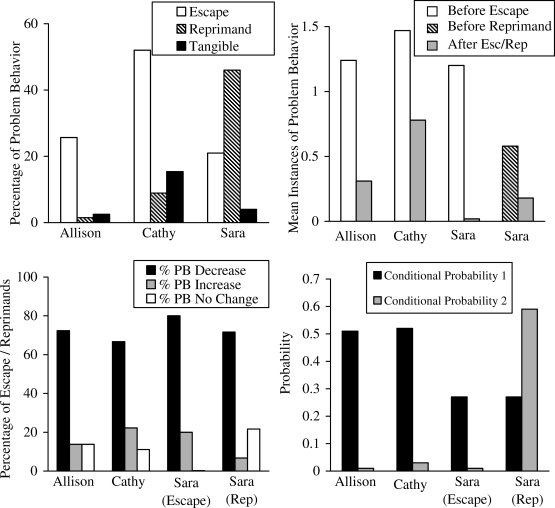
Percentage of task-related problem behavior that was followed by escape and the percentage of all problem behavior that was followed by reprimands or tangible items for each participant (top left). Mean instances of problem behavior 10 s before and 10 s after escape (all participants) or 10 s before and 10 s after reprimands (Sara only; top right). Percentage of escape (all participants) or reprimands (Sara only) that was associated with an increase, decrease, or no change in problem behavior (bottom left). Conditional probability of problem behavior within 10 s of an initial problem behavior (Conditional Probability 1) and the conditional probability of problem behavior within 10 s of an initial instance of problem behavior given an intervening escape (all participants) or an intervening reprimand (Sara only; bottom right).
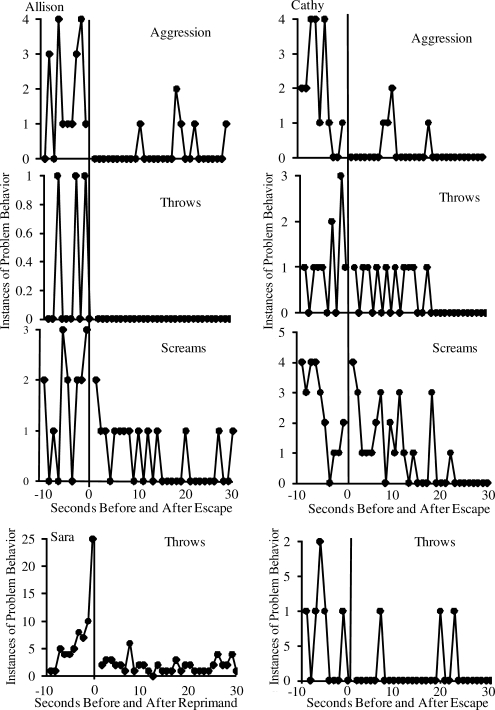
Total frequencies of Chris's aggression, throws, and screams 10 s prior to and 30 s after an escape delivered by Allison and Cathy (top six panels). Total frequency of Bonnie's throws 10 s prior to and 30 s after an escape (bottom left) or a reprimand (bottom right) delivered by Sara.
References
-
- Lerman D.C, Vorndran C.M, Addison L, Kuhn S.C. Preparing teachers in evidence-based practices for young children with autism. School Psychology Review. 2004;33:510–526.
-
- Mortenson B.P, Witt J.C. The use of weekly performance feedback to increase teacher implementation of a pre-referral academic intervention. School Psychology Review. 1998;27:613–627.
MeSH terms
LinkOut - more resources
Full Text Sources
Medical
