Association between inappropriateness of left ventricular mass and left ventricular diastolic dysfunction: a study using the tissue Doppler parameter, e/e'
- PMID: 19949602
- PMCID: PMC2771811
- DOI: 10.4070/kcj.2009.39.4.138
Association between inappropriateness of left ventricular mass and left ventricular diastolic dysfunction: a study using the tissue Doppler parameter, e/e'
Abstract
Background and objectives: The structural significance of the inappropriateness of left ventricular mass (iLVM) is known to be an important prognostic factor for cardiovascular events; however, the functional changes associated with iLVM have not been established. This study was performed to determine if diastolic dysfunction is associated with iLVM using a tissue Doppler technique.
Subjects and methods: Three hundred sixty consecutive subjects, including 221 hypertension patients from the echocardiography database, were analyzed. Regarding the appropriateness of left ventricular (LV) mass, an observed/predicted ratio of LV mass (OPR) >130% was defined as inappropriate. Echocardiographic parameters, including early diastolic peak velocity (E)/late diastolic peak velocity (A), deceleration time (DT), isovolumetric relaxation time (IVRT), and E/early mitral annulus velocity (E'), were compared between the appropriate LV mass (aLVM) group and the iLVM group.
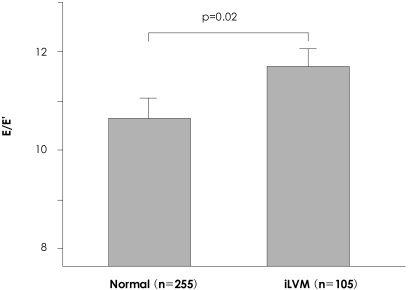
Results: Among transmitral flow parameters, only the E velocity was negatively correlated with the OPR when adjusted for age (adjusted r=-0.107, p=0.04). Based on multiple regression analysis, the OPR (beta=0.163, p=0.003), as well as age (beta=0.286, p=0.0001), systolic blood pressure (beta=0.120, p=0.019), fasting blood glucose (beta=0.098, p=0.042), and male gender (beta=0.157, p=0.002) were independent factors determining E/E'. The cholesterol level was not an independent factor (beta=-0.059, p=0.355). In the iLVM group (n=105), the adjusted E/E' was higher than in the aLVM group (n=255; 11.7+/-3.4 vs. 10.8+/-3.1, p=0.02), while the peak E flow velocity was significantly lower than in the aLVM group (70.9+/-15.1 vs. 75.5+/-17.6, p=0.03).
Conclusion: Inappropriateness of LV mass is independently associated with increased E/E'. Thus, E/E' may be a useful parameter for the evaluation of diastolic dysfunction.
Keywords: Echocardiography; Hypertrophy; Left ventricle.
Figures
References
-
- Levy D, Garrison RJ, Savage DD, Kannel WB, Castelli WP. Prognostic implications of echocardiographically determined left ventricular mass in the Framingham Heart Study. N Engl J Med. 1990;322:1561–1566. - PubMed
-
- de Simone G, Devereux RB, Kimball TR, et al. Interaction between body size and cardiac workload: influence on left ventricular mass during body growth and adulthood. Hypertension. 1998;31:1077–1082. - PubMed
-
- de Simone G, Verdecchia P, Pede S, Gorini M, Maggioni AP. Prognosis of inappropriate left ventricular mass in hypertension. Hypertension. 2002;40:470–476. - PubMed
-
- Palmieri V, de Simone G, Roman MJ, Schwartz JE, Pickering TG, Devereux RB. Ambulatory blood pressure and metabolic abnormalities in hypertensive subjects with inappropriately high left ventricular mass. Hypertension. 1999;34:1032–1040. - PubMed
-
- de Simone G, Pasanisi F, Contaldo F. Link of nonhemodynamic factors to hemodynamic determinants of left ventricular hypertrophy. Hypertension. 2001;38:13–18. - PubMed
LinkOut - more resources
Full Text Sources