


Pulmonary vein isolation of symptomatic refractory paroxysmal and persistent atrial fibrillation: A single centre and single operator experience in the Netherlands
- PMID: 19949645
- PMCID: PMC2773027
- DOI: 10.1007/BF03086286
Pulmonary vein isolation of symptomatic refractory paroxysmal and persistent atrial fibrillation: A single centre and single operator experience in the Netherlands
Abstract
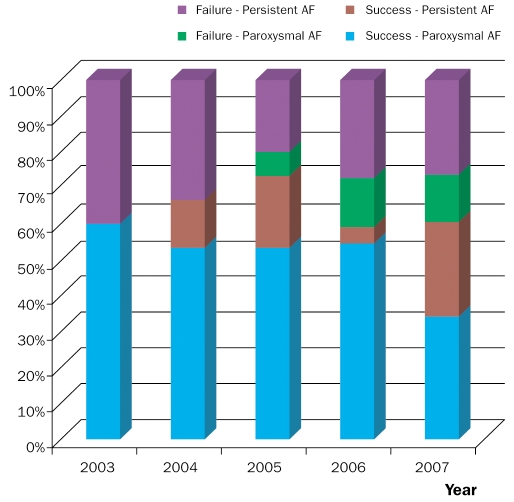
Aim. To investigate long-term outcome and to determine predictors of successful pulmonary vein isolation (PVI) in patients with symptomatic paroxysmal or persistent atrial fibrillation (AF) who are refractory or intolerant to antiarrhythmic drugs.Background. The treatment of AF has traditionally been pharmacological aimed at rate or rhythm control. However, rhythm control remains difficult to establish. PVI is reported to be effective in selected patient groups.Methods. Ninety-nine consecutive patients with a mean age of 54+/-10 years who had paroxysmal or persistent AF were treated in the University Medical Center Groningen. All patients underwent PVI by the same electrophysiologist. Successful PVI was defined as absence of AF on Holter or electrocardiogram (ECG), and no symptoms of AF.Results. After six months of follow-up, 60 (61%) patients were free of AF episodes, both on 96-hour Holter monitoring and on ECGs, and had no symptoms related to AF. Thirty-nine of these 60 patients (65%) were no longer treated with any class I or III antiarrhythmic drugs. Independent determinants of successful PVI were paroxysmal AF (OR 18 [3.5-93], p=0.001), and left pulmonary vein ablation time >55 minutes (OR 15 [2.7-81], p=0.002). Left atrial (parasternal view 42+/-6 vs. 40+/-5 mm, p<0.05 and apical view 61+/-9 vs. 58+/-8 mm, p<0.05) and right atrial (59+/-7 vs. 56+/-5 mm, p<0.05) sizes decreased significantly in the successfully treated patients after six months of follow-up.Conclusion. Independent determinants of a successful outcome after PVI are paroxysmal AF and a longer left atrial ablation time. (Neth Heart J 2009;17:366-72.).
Keywords: atrial fibrillation; outcome; pulmonary vein isolation.
Figures
References
-
- Van Gelder IC, Hagens VE, Bosker HA, Kingma JH, Kamp O, Kingma T, et al. A comparison of rate control and rhythm control in patients with recurrent persistent atrial fibrillation. N Engl J Med. 2002;347:1834–40. - PubMed
-
- Wyse DG, Waldo AL, DiMarco JP, Domanski MJ, Rosenberg Y, Schron EB, et al. A comparison of rate control and rhythm control in patients with atrial fibrillation. N Engl J Med. 2002;347: 1825–33. - PubMed
-
- Hagens VE, Ranchor AV, van Sonderen EF, Bosker HA, Kamp O, Tijssen JG, et al. Effect of rate or rhythm control on quality of life in persistent atrial fibrillation. J Am Coll Cardiol. 2004;43:241–7. - PubMed
-
- Van Gelder IC, Crijns HJ, Tieleman RG, Brugemann J, De Kam PJ, Gosselink AT, et al. Chronic atrial fibrillation. Success of serial cardioversion therapy and safety of oral anticoagulation. Arch Intern Med. 1996;156:2585–92. - PubMed
-
- Lafuente-Lafuente C, Mouly S, Longas-Tejero MA, Mahe I, Bergmann JF. Antiarrhythmic drugs for maintaining sinus rhythm after cardioversion of atrial fibrillation: a systematic review of randomized controlled trials. Arch Intern Med. 2006;166:719–28. - PubMed
LinkOut - more resources
Full Text Sources