


Alterations in brain glucose utilization accompanying elevations in blood ethanol and acetate concentrations in the rat
- PMID: 19951290
- PMCID: PMC2958045
- DOI: 10.1111/j.1530-0277.2009.01099.x
Alterations in brain glucose utilization accompanying elevations in blood ethanol and acetate concentrations in the rat
Abstract
Background: Previous studies in humans have shown that alcohol consumption decreased the rate of brain glucose utilization. We investigated whether the major metabolite of ethanol, acetate, could account for this observation by providing an alternate to glucose as an energy substrate for brain and the metabolic consequences of that shift.
Methods: Rats were infused with solutions of sodium acetate, ethanol, or saline containing (13)C-2-glucose as a tracer elevating the blood ethanol (BEC) and blood acetate (BAcC) concentrations. After an hour, blood was sampled and the brains of animals were removed by freeze blowing. Tissue samples were analyzed for the intermediates of glucose metabolism, Krebs' cycle, acyl-coenzyme A (CoA) compounds, and amino acids.
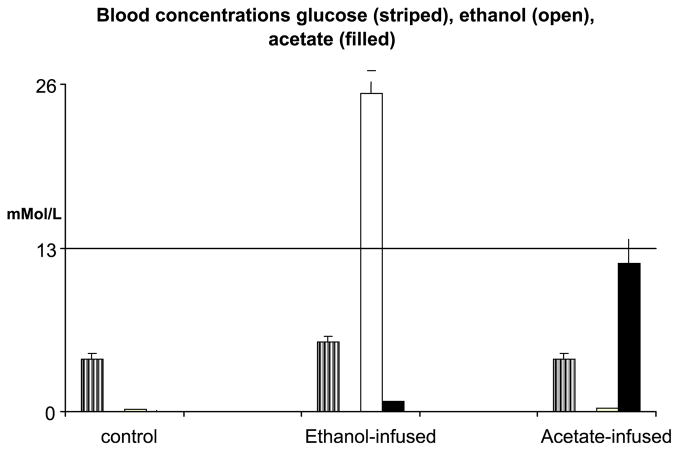
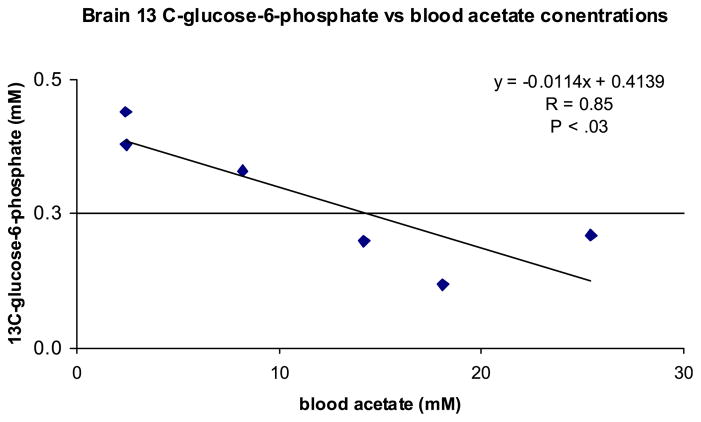
Results: Mean peak BEC and BAcC were approximately 25 and 0.8 mM, respectively, in ethanol-infused animals. Peak blood BAcC increased to 12 mM in acetate-infused animals. Both ethanol and acetate infused animals had a lower uptake of (13)C-glucose into the brain compared to controls and the concentration of brain (13)C-glucose-6-phosphate varied inversely with the BAcC. There were higher concentrations of brain malonyl-CoA and somewhat lower levels of free Mg(2+) in ethanol-treated animals compared to saline controls. In acetate-infused animals the concentrations of brain lactate, alpha-ketoglutarate, and fumarate were higher. Moreover, the free cytosolic [NAD(+)]/[NADH] was lower, the free mitochondrial [NAD(+)]/[NADH] and [CoQ]/[CoQH(2)] were oxidized and the DeltaG' of ATP lowered by acetate infusion from -61.4 kJ to -59.9 kJ/mol.
Conclusions: Animals with elevated levels of blood ethanol or acetate had decreased (13)C-glucose uptake into the brain. In acetate-infused animals elevated BAcC were associated with a decrease in (13)C-glucose phosphorylation. The co-ordinate decrease in free cytosolic NAD, oxidation of mitochondrial NAD and Q couples and the decrease in DeltaG' of ATP was similar to administration of uncoupling agents indicating that the metabolism of acetate in brain caused the mitochondrial voltage dependent pore to form.
Figures
References
-
- Anandatheerthavarada HK, Shankar SK, Bhamre S, Boyd MR, Song BJ, Ravindranath V. Induction of brain cytochrome P-450IIE1 by chronic ethanol treatment. Brain Res. 1993;601:29–85. - PubMed
-
- Barman TE. Enzyme Handbook. Springer-Verlag; Berlin: 1969.
-
- Beavis AD, Garlid KD. The mitochondrial inner membrane anion channel. J Biol Chem. 1987;262(31):15085–15093. - PubMed
-
- Berl S, Clarke DD. Cerebral glutamine/glutamate interrelationships and metabolic compartmentation. In: Haussinger D, Sies H, editors. Glutamine Metabolism in Mammalian Tissues. Springer-Verlag; New York: 1984. pp. 150–222.
-
- Chen YC, Peng GS, Tsao TP, Wang MF, Lu RB, Yin SJ. Pharmacokinetic and pharmacodynamic basis for overcoming acetaldehyde-induced adverse reaction in Asian alcoholics, heterozygous for the variant ALDH2*2 gene allele. Pharmacogenet Genomics. 2009;19(8):588–599. - PubMed
MeSH terms
Substances
Grants and funding
LinkOut - more resources
Full Text Sources
