Comparative Study
. 2010 May;95(5):794-803.
doi: 10.3324/haematol.2009.015495. Epub 2009 Nov 30.

In vitro and in vivo rationale for the triple combination of panobinostat (LBH589) and dexamethasone with either bortezomib or lenalidomide in multiple myeloma

Affiliations
Comparative Study

In vitro and in vivo rationale for the triple combination of panobinostat (LBH589) and dexamethasone with either bortezomib or lenalidomide in multiple myeloma

Enrique M Ocio et al. Haematologica. 2010 May.

Abstract

Background: Combinations of drug treatments based on bortezomib or lenalidomide plus steroids have resulted in very high response rates in multiple myeloma. However, most patients still relapse, indicating the need for novel combination partners to increase duration of response or to treat relapsed disease. We explored the antimyeloma activity of triple combinations of these well-established schemes with panobinostat, a novel deacetylase inhibitor with a multi-targeted profile.

Design and methods: The activity of these combinations was explored in vitro in cell lines by using MTT and annex-in V, ex vivo by flow cytometry, and in vivo using two different murine models of human myeloma: one bearing a subcutaneous plasmacytoma and another with a disseminated myeloma. Moreover, gene expression profiling and immunohistochemical studies were performed.

Results: The addition of panobinostat (LBH589) to dexamethasone and either bortezomib or lenalidomide resulted in clear potentiation in multiple myeloma cell lines, freshly isolated plasma cells, and murine models of multiple myeloma. The quantification of the potency of these combinations by using the Chou-Talalay method showed synergistic combination indices for all of them. This effect derived from the deregulation of a cluster of genes that was completely different from the sum of genes affected by the single agents (895 and 1323 genes exclusively deregulated by panobinostat and dexamethasone plus bortezomib or lenalidomide, respectively). Functional experiments, such as annexin V staining, cell cycle analysis, and immunohistochemical studies also supported this potentiation. Anti-myeloma efficacy was confirmed in an extramedullary plasmacytoma model and a disseminated luciferized model, in which panobinostat also provided a marked benefit in bone disease.

Conclusions: The potent activity, together with the exclusive mechanistic profile, provides the rationale for the clinical evaluation of these drug combinations in multiple myeloma.


Figures
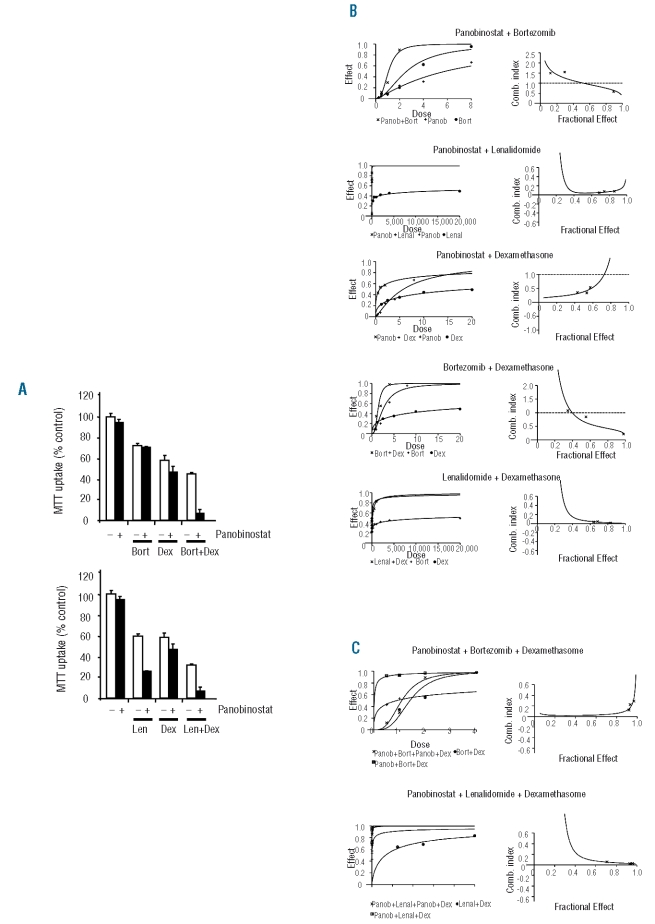
Figure 1.
Figure 1.
Efficacy of the in vitro combinations of panobinostat with other anti-myeloma agents in MM. (A) MTT studies of the double and triple combinations of panobinostat (1 nM) with dexamethasone (5 nM) and lenalidomide (0.5 μM) or bortezomib (2 nM) in the MM1S cell line after 72 h of treatment. Bars represent standard deviation of experiments repeated in quadruplicate. (B) and (C) Quantification of the potency of the different double (B) and triple (C) combinations using the Chou-Talalay method as described in the Design and Methods section. The left panel shows the dose-effect curve of the double combinations as compared to the dose-effect of the agents in monotherapy (B) and of the triple compared with the doubles combinations (C). In the right panel, the (x) indicates the observed CI of each combination in the experiments performed and the line gives an estimation of the CI for these combinations.
Figure 2.
Figure 2.
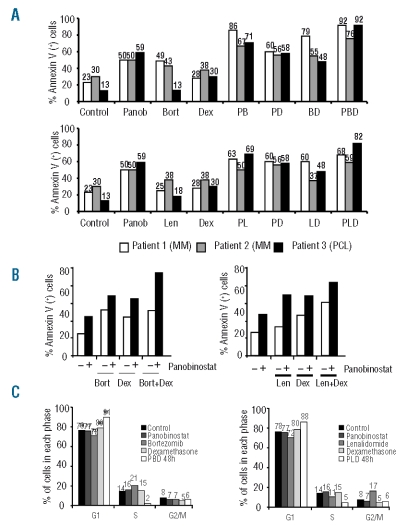
Ex vivo antimyeloma efficacy of the triple combinations (PBD and PLD) and apoptotic and antiproliferative activity. (A) Bone marrow samples from two patients with MM and a patient with plasma cell leukemia (PCL) were treated ex vivo for 24 h with panobinostat (20 nM), dexamethasone (40 nM), bortezomib (5 nM), and lenalidomide (10 μM) in monotherapy and in double and triple combinations. Samples were incubated with annexin V and CD38, CD45, CD56 monoclonal antibodies to analyze the induction of apoptosis in the clonal population of plasma cells (B) Annexin V studies of the double and triple combinations of panobinostat (1 nM) with dexamethasone (10 nM) and bortezomib (2 nM) or lenalidomide (0.5 μM) in the MM1S cell line after 48 h of treatment. (C) MM1S cells were incubated with panobinostat (7 nM), dexamethasone (0.9 μM), lenalidomide (1 μM) and bortezomib (3 nM) as single agents for 48 h and in triple combinations for 24 and 48 h and the cell cycle profile was examined by flow cytometry after propidium Iodide staining. Bars indicate the percentage of cells in each phase of the cell cycle from a representative example.
Figure 3.
Figure 3.
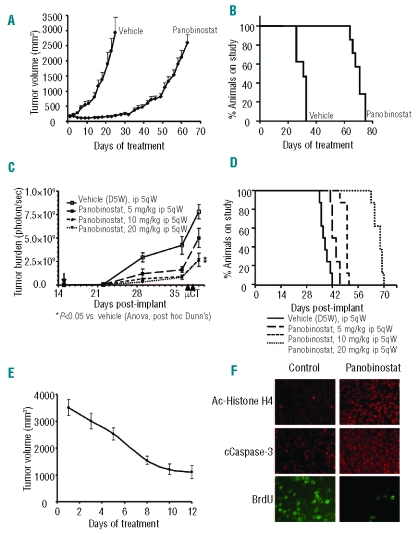
Efficacy of single-agent panobinostat in xenograft models of MM. (A,B) Panobinostat activity in a human subcutaneous plasmacytoma model in NOD-SCID mice. Mice were randomized to receive vehicle control or panobinostat at a dose of 10 mg/kg i.p. 5 days weekly for 21 days or 5 mg/kg on the same schedule on subsequent days. Panobinostat treatment resulted in inhibition of tumor growth (A) and increased survival (B) as compared with the control group (P<0.05). Median survival was 70 days versus 30 days for the panobinostat treated and vehicle groups, respectively (P<0.05). (C,D) Efficacy of panobinostat in a murine model of disseminated human myeloma. Treatment was initiated 15 days after implantation with the doses indicated in the figure. (C) Panobinostat treatment resulted in dose-related reduction in tumor burden. The tumor burden (%T/C) on day 39, post-implant, following treatment with panobinostat at 5, 10, or 20 mg/kg was 64, 34, and 34% of that of animals treated with vehicle. (D) Panobinostat treatment increased the median time to clinical endpoint (Kaplan-Meier). The median TTE for vehicle treated animals was 37 days. The median TTE for panobinostat dosed at 5, 10 and 15 mg/kg was 43, 50 and 68 days, respectively (P<0.05 for all pair-wise comparisons, Holm–Sidak). (E, F) Mice with large plasmacytomas were treated with panobinostat at a dose of 10 mg/kg. Tumors which had decreased in volume by at least 50% following 10 days of treatment were collected and analyzed by immunofluorescence for the presence of acetylated histone H4, cleaved caspase-3 and BrdU uptake (Pictures 40x). Panobinostat treatment increased expression of acetylated histone H4 and cleaved caspase-3, and decreased BrdU nuclear immunofluorescence. (Magnification 40x)
Figure 4.
Figure 4.
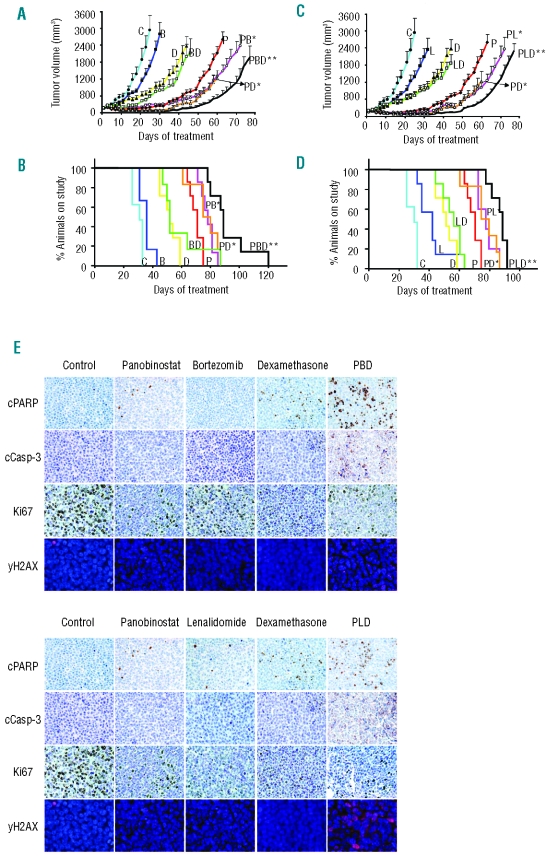
In vivo efficacy of triple combinations of panobinostat with dexamethasone and either bortezomib (PBD) or lenalidomide (PLD). Tumor-bearing mice were treated with vehicle control, panobinostat (10 mg/kg i.p. for the first 21 days and 5 mg/kg the subsequent days), bortezomib (0.1 mg/kg i.p. 5 days weekly), lenalidomide (15 mg/kg i.p., 5 days weekly) and dexamethasone (1 mg/kg ip, 5 days weekly) in monotherapy or in double and triple combinations. (A,C) Tumor volumes of MM1S plasmacytomas following treatment with single agents, double and triple combinations with bortezomib (A) and lenalidomide (C). Statistical differences between groups were analyzed with one-way analysis of variance, and statistical significance was defined as P<0.05. Bars indicate standard error. (B,D) Survival was analyzed in a Kaplan Meier curve, and statistical difference was defined as P<0.05 in the log rank test. (*) indicates statistically significant differences between double combinations and their respective agents in monotherapy. (**) indicates statistically significant differences between triple combinations and their respective double combinations. (E) Immunohistochemical analyses with anti-cleaved caspase-3, anti-cleaved-PARP, anti-Ki-67 and immunofluorescence studies with phospho-H2AX were performed in selected tumors obtained from mice receiving the vehicle control and mice receiving triple combinations. Representative images demonstrate the differences in expression of these particular markers induced by the in vivo treatment with triple combinations. (Magnification 40x).
Figure 5.
Figure 5.
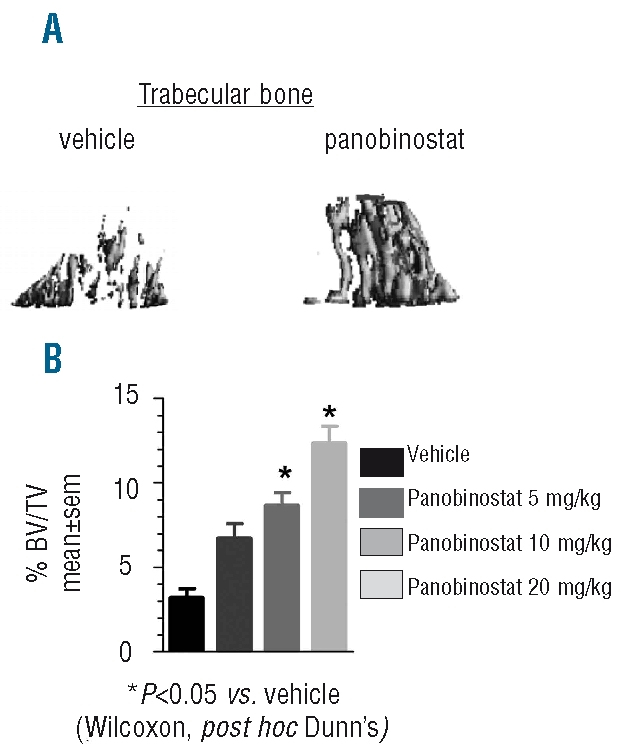
Panobinostat reduces bone density loss in a disseminated MM xenograft mouse model (A) Representative 3-D MicroCT image from trabecular bone in MM xenograft mice treated with vehicle or panobinostat at 15 mg/kg i.p. 5 times weekly. (B) The trabecular bone density of MM xenograft mice was determined by MicroCT on days 37–38, post-implant, following treatment, as indicated.

Comment in

References

    1. Ocio EM, Mateos MV, Maiso P, Pandiella A, San-Miguel JF. New drugs in multiple myeloma: mechanisms of action and phase I/II clinical findings. Lancet Oncol. 2008;9(12):1157–65. - PubMed
    1. Hanahan D, Weinberg RA. The hallmarks of cancer. Cell. 2000;100(1):57–70. - PubMed
    1. Hallek M, Eichhorst BF. Chemo therapy combination treatment regimens with fludarabine in chronic lymphocytic leukemia. Hematol J. 2004;5 (Suppl 1):S20–S30. - PubMed
    1. Kyrgiou M, Salanti G, Pavlidis N, Paraskevaidis E, Ioannidis JP. Survival benefits with diverse chemotherapy regimens for ovarian cancer: meta-analysis of multiple treatments. J Natl Cancer Inst. 2006;98(22):1655–63. - PubMed
    1. Mauri D, Polyzos NP, Salanti G, Pavlidis N, Ioannidis JP. Multiple-treatments meta-analysis of chemo therapy and targeted therapies in advanced breast cancer. J Natl Cancer Inst. 2008;100(24):1780–91. - PubMed

Publication types

MeSH terms