


Serum 25-hydroxyvitamin D levels among US children aged 1 to 11 years: do children need more vitamin D?
- PMID: 19951983
- PMCID: PMC3765249
- DOI: 10.1542/peds.2008-2041
Serum 25-hydroxyvitamin D levels among US children aged 1 to 11 years: do children need more vitamin D?
Erratum in
- Pediatrics. 2009 Dec;124(6):1709
Abstract
Objective: Single-center studies suggest [corrected] that hypovitaminosis D is widespread. Our objective was to determine the serum levels of 25-hydroxyvitamin D (25[OH]D) in a nationally representative sample of U.S. [corrected] children ages 1-11 [corrected] years.
Methods: Data were obtained from the 2001-2006 National Health and Nutrition Examination Survey (NHANES). [corrected] Serum 25(OH)D levels was [corrected] determined by radioimmunoassay and categorized as <25 nmol/L, [corrected] <50 nmol/L, [corrected] and <75 nmol/L. National estimates were obtained by using assigned patient visit weights and reported with 95% confidence intervals (95% CI). [corrected]
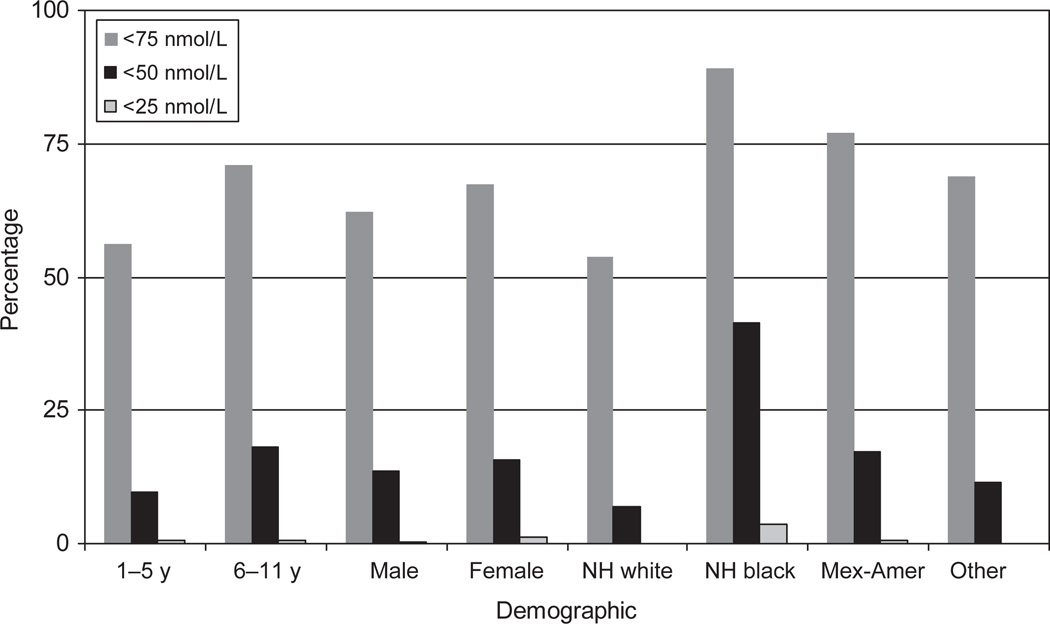
Results: During [corrected] 2001-2006, the mean serum 25(OH)D level for U.S. children ages 1 to 11 years was 68 nmol/L (95% CI, [corrected] 66-70). Children ages 6-11 [corrected] years had lower mean levels of 25(OH)D (66 nmol/L 95% CI, [corrected] 64-68) compared to [corrected] children ages 1-5 [corrected] years (70 nmol/L 95% [corrected] CI, 68-73). [corrected] Overall, the prevalence of <25 nmol/L [corrected] was 1% (95% CI, 0.7-1.4), <50 nmol/L was 18% (95% CI, [corrected] 16-21), and <75 nmol/L was 69% (95% CI, [corrected] 65-73). The prevalence of [corrected] 25(OH)D [corrected] <75 nmol/L was higher among ages [corrected] 6-11 [corrected] years (73%) compared to ages [corrected] 1-5 [corrected] years (63%); females [corrected] (71%) compared to males [corrected] (67%); and non-Hispanic black (92%) and Hispanic (80%) [corrected] compared to [corrected] non-Hispanic whites [corrected] (59%).
Conclusions: Based on [corrected] a nationally representative sample of U.S. children aged 1-11 [corrected] years, millions of children may have suboptimal levels of 25(OH)D, especially non-Hispanic black and Hispanic children. More data in children are needed not only to understand better the health implications of specific serum levels of 25(OH)D but also to determine the appropriate vitamin D supplement requirements for children.
Figures
Comment in
-
Defining vitamin D deficiency in children: beyond 25-OH vitamin D serum concentrations.Pediatrics. 2009 Nov;124(5):1471-3. doi: 10.1542/peds.2009-2307. Epub 2009 Oct 26. Pediatrics. 2009. PMID: 19858159 No abstract available.
References
-
- Holick MF. Vitamin D deficiency. N Engl J Med. 2007;357(3):266–281. - PubMed
-
- Webb AR, Kline L, Holick MF. Influence of season and latitude on the cutaneous synthesis of vitamin D3: exposure to winter sunlight in Boston and Edmonton will not promote vitamin D3 synthesis in human skin. J Clin Endocrinol Metab. 1988;67(2):373–378. - PubMed
-
- Sullivan SS, Rosen CJ, Halteman WA, Chen TC, Holick MF. Adolescent girls in Maine are at risk for vitamin D insufficiency. J Am Diet Assoc. 2005;105(6):971–974. - PubMed
-
- Marks R, Jolley D, Lectsas S, Foley P. The role of childhood exposure to sunlight in the development of solar keratoses and non-melanocytic skin cancer. Med J Aust. 1990;152(2):62–66. - PubMed
-
- Autier P, Dore JF. Influence of sun exposures during childhood and during adulthood on melanoma risk. EPIMEL and EORTC Melanoma Cooperative Group. European Organisation for Research and Treatment of Cancer. Int J Cancer. 1998;77(4):533–537. - PubMed
Publication types
MeSH terms
Substances
Grants and funding
LinkOut - more resources
Full Text Sources
Medical
