Comparative Study
. 2010 Mar 3;41(1):1-8.
doi: 10.1152/physiolgenomics.00167.2009. Epub 2009 Dec 1.

Similarities and differences between smoking-related gene expression in nasal and bronchial epithelium

Affiliations
Comparative Study

Similarities and differences between smoking-related gene expression in nasal and bronchial epithelium

Xiaoling Zhang et al. Physiol Genomics. .

Abstract

Previous studies have shown that physiological responses to cigarette smoke can be detected via bronchial airway epithelium gene expression profiling and that heterogeneity in this gene expression response to smoking is associated with lung cancer. In this study, we sought to determine the similarity of the effects of tobacco smoke throughout the respiratory tract by determining patterns of smoking-related gene expression in paired nasal and bronchial epithelial brushings collected from 14 healthy nonsmokers and 13 healthy current smokers. Using whole genome expression arrays, we identified 119 genes whose expression was affected by smoking similarly in both bronchial and nasal epithelium, including genes related to detoxification, oxidative stress, and wound healing. While the vast majority of smoking-related gene expression changes occur in both bronchial and nasal epithelium, we also identified 27 genes whose expression was affected by smoking more dramatically in bronchial epithelium than nasal epithelium. Both common and site-specific smoking-related gene expression profiles were validated using independent microarray datasets. Differential expression of select genes was also confirmed by RT-PCR. That smoking induces largely similar gene expression changes in both nasal and bronchial epithelium suggests that the consequences of cigarette smoke exposure can be measured in tissues throughout the respiratory tract. Our findings suggest that nasal epithelial gene expression may serve as a relatively noninvasive surrogate to measure physiological responses to cigarette smoke and/or other inhaled exposures in large-scale epidemiological studies.


Figures
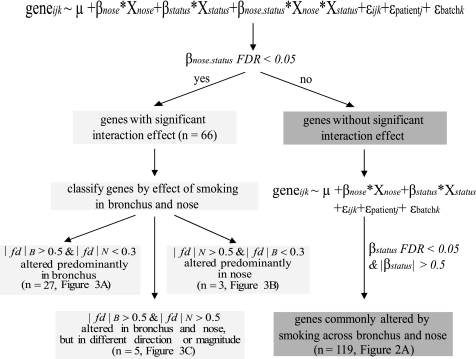
Fig. 1.
Fig. 1.
Methodology for identifying genes that are commonly and site-specifically differentially expressed in response to tobacco smoke exposure. For each gene, the relationship between gene expression in log2 scale, site, status, and the interaction between site and status was examined with a mixed linear regression model. |fd| B represents the absolute log2 magnitude of the difference between current and never smoker in bronchial samples (fdB = βstatus), and fdN is the magnitude of the difference in nasal samples (fdN = βstatus +βnose.status). FDR, false discovery rate.
Fig. 2.
Fig. 2.
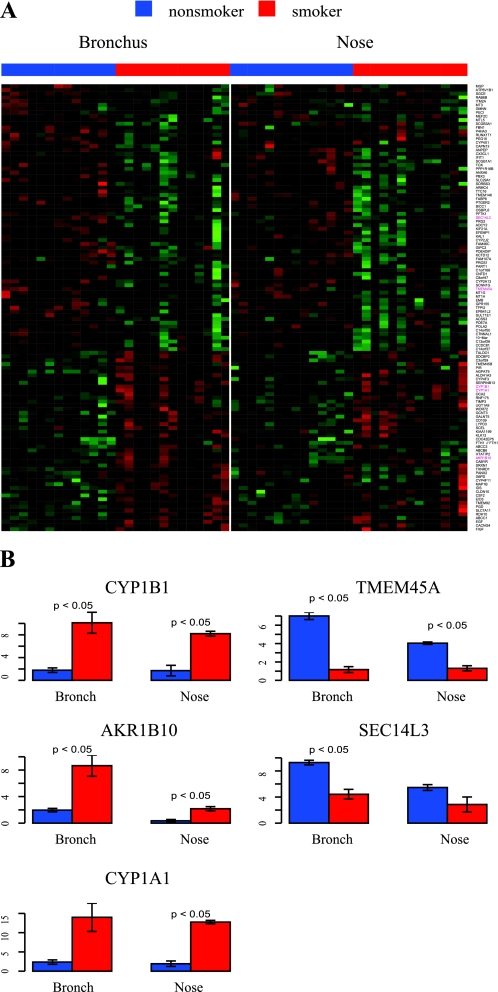
A: similarity between bronchial and nasal gene expression. Gene expression estimates for the 119 genes (see Supplemental Table S4) that vary between smokers and nonsmokers were z-score normalized within each tissue and organized using hierarchical clustering (green indicates lower than average expression, red indicates higher than average expression). B: real-time PCR validation of select genes (colored pink in A) in 3 smokers and 3 nonsmokers. The y-axis represents relative log2 expression. Error bars indicate SE. Differences in expression were evaluated using Student's t-test.
Fig. 3.
Fig. 3.
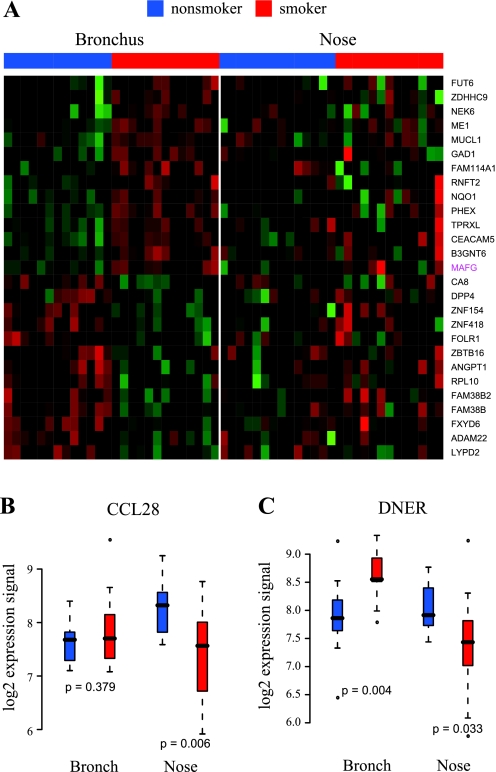
Site-specific changes in gene expression induced by smoking. A: heat map of 27 genes differentially expressed as a result of smoking more dramatically in bronchial epithelium. B: CCL28 is differentially expressed between smokers and nonsmokers in nose, but not in bronchus. C: DNER is upregulated by smoking in bronchus but is downregulated in nose.
Fig. 4.
Fig. 4.
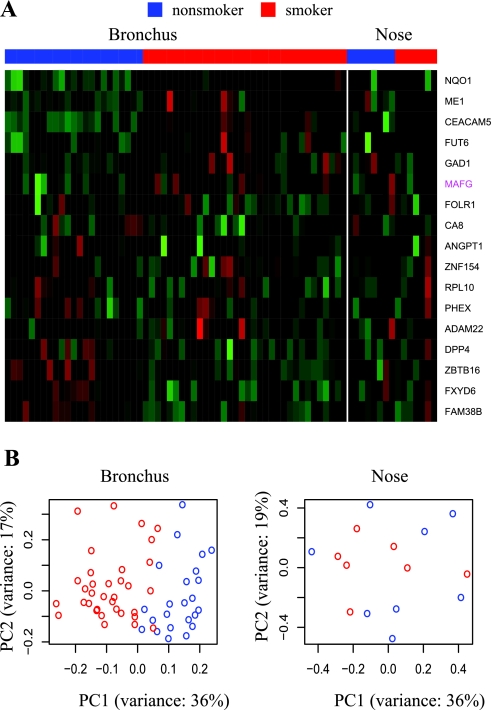
In silico validation of genes more dramatically altered by smoking in bronchus (see Fig. 3A), using an independent U133A data. Among 27 genes, 17 genes with corresponding U133A probe sets were identified. A: heat map of the expression profiles of these 17 genes in previously published U133A datasets consisting of bronchial and nasal samples from current and never smokers. B: principal component analysis (PCA) of 17 genes in U133A bronchus and nose data. Each point represents a subject (red: smokers, blue: nonsmokers).

References

    1. Beane J, Sebastiani P, Liu G, Brody JS, Lenburg ME, Spira A. Reversible and permanent effects of tobacco smoke exposure on airway epithelial gene expression. Genome Biol 8:R201, 2007 - PMC - PubMed
    1. Beane J, Sebastiani P, Whitfield TH, Steiling K, Dumas YM, Lenburg ME, Spira A. A prediction model for lung cancer diagnosis that integrates genomic and clinical features. Cancer Prev Res (Phila Pa) 1: 56–64, 2008 - PMC - PubMed
    1. Boon K, Osorio EC, Greenhut SF, Schaefer CF, Shoemaker J, Polyak K, Morin PJ, Buetow KH, Strausberg RL, De Souza SJ, Riggins GJ. An anatomy of normal and malignant gene expression. Proc Natl Acad Sci USA 99:11287–11292, 2002 - PMC - PubMed
    1. Gentleman RC, Carey VJ, Bates DM, Bolstad B, Dettling M, Dudoit S, Ellis B, Gautier L, Ge Y, Gentry J, Hornik K, Hothorn T, Huber W, Iacus S, Irizarry R, Leisch F, Li C, Maechler M, Rossini AJ, Sawitzki G, Smith C, Smyth G, Tierney L, Yang JY, Zhang J. Bioconductor: open software development for computational biology and bioinformatics. Genome Biol 5:R80, 2004 - PMC - PubMed
    1. Greenlee RT, Hill-Harmon MB, Murray T, Thun M. CA Cancer J Clin 51: 15–36, 2001 - PubMed

Publication types