


Exercise without weight loss does not reduce C-reactive protein: the INFLAME study
- PMID: 19952828
- PMCID: PMC2919641
- DOI: 10.1249/MSS.0b013e3181c03a43
Exercise without weight loss does not reduce C-reactive protein: the INFLAME study
Abstract
Purpose: Numerous cross-sectional studies have observed an inverse association between C-reactive protein (CRP) and physical activity. Exercise training trials have produced conflicting results, but none of these studies was specifically designed to examine CRP. The objective of the Inflammation and Exercise (INFLAME) study was to examine whether aerobic exercise training without dietary intervention can reduce CRP in individuals with elevated CRP.
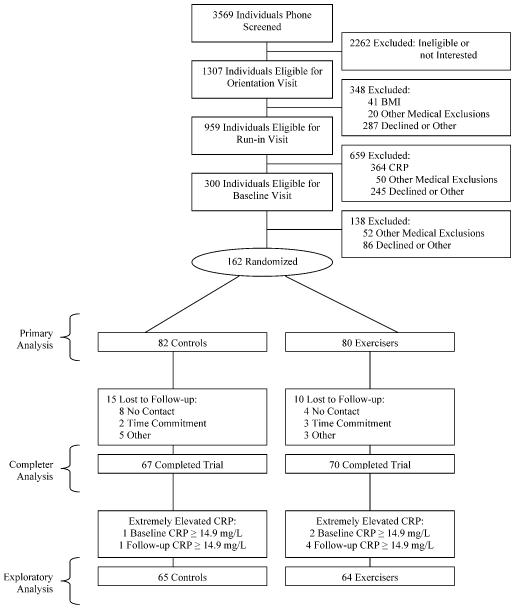
Methods: The study was a randomized controlled trial of 162 sedentary men and women with elevated CRP (> or = 2.0 mg·L(-1)). Participants were randomized into a nonexercise control group or an exercise group that trained for 4 months. The primary outcome was change in CRP.
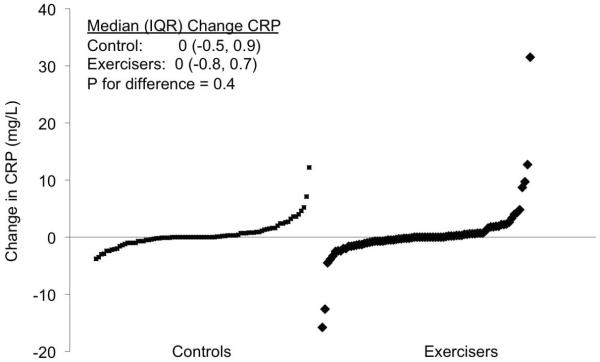
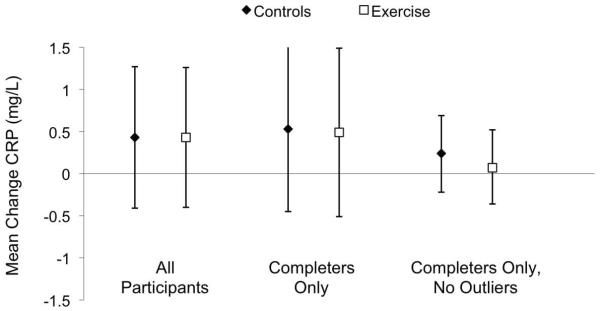
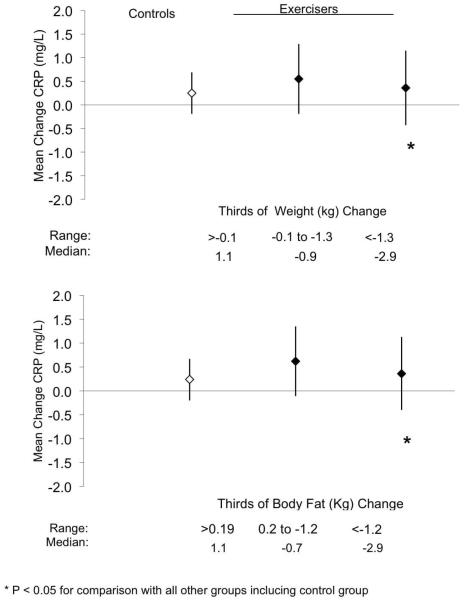
Results: The study participants had a mean (SD) age of 49.7 (10.9) yr and a mean body mass index of 31.8 (4.0) kg·m(-2). The median (interquartile range (IQR)) and mean baseline CRP levels were 4.1 (2.5-6.1) and 4.8 (3.4) mg·L(-1), respectively. In the exercise group, median exercise compliance was 99.9%. There were no differences in median (IQR) change in CRP between the control and exercise groups (0.0 (-0.5 to 0.9) vs 0.0 (-0.8 to 0.7) mg·L(-1), P = 0.4). The mean (95% confidence interval) change in CRP adjusted for gender and baseline weight was similar in the control and exercise groups, with no significant difference between groups (0.5 (-0.4 to 1.3) vs 0.4 (-0.5 to 1.2) mg·L(-1), P = 0.9). Change in weight was correlated with change in CRP.
Conclusions: Exercise training without weight loss is not associated with a reduction in CRP.
Trial registration: ClinicalTrials.gov NCT00113061.
Figures
References
-
- Esposito K, Marfella R, Ciotola M, Di PC, Giugliano F, Giugliano G, D’Armiento M, D’Andrea F, Giugliano D. Effect of a mediterranean-style diet on endothelial dysfunction and markers of vascular inflammation in the metabolic syndrome: a randomized trial. JAMA. 2004 Sep 22;292(12):1440–6. - PubMed
-
- Forbes GB, Kreipe RE, Lipinski B. Body composition and the energy cost of weight gain. Hum Nutr Clin Nutr. 1982;36(6):485–7. - PubMed
-
- Hamer M. The relative influences of fitness and fatness on inflammatory factors. Prev.Med. 2007 Jan;44(1):3–11. - PubMed
-
- Kasapis C, Thompson PD. The effects of physical activity on serum C-reactive protein and inflammatory markers: a systematic review. J Am Coll.Cardiol. 2005 May 17;45(10):1563–9. - PubMed
Publication types
MeSH terms
Substances
Associated data
Grants and funding
LinkOut - more resources
Full Text Sources
Medical
Research Materials
Miscellaneous
