


Comparison of surveillance methods applied to a situation of low malaria prevalence at rural sites in The Gambia and Guinea Bissau
- PMID: 19954532
- PMCID: PMC2791766
- DOI: 10.1186/1475-2875-8-274
Comparison of surveillance methods applied to a situation of low malaria prevalence at rural sites in The Gambia and Guinea Bissau
Abstract
Background: Health record-based observations from several parts of Africa indicate a major decline in malaria, but up-to-date information on parasite prevalence in West-Africa is sparse. This study aims to provide parasite prevalence data from three sites in the Gambia and Guinea Bissau, respectively, and compares the usefulness of PCR, rapid diagnostic tests (RDT), serology and slide-microscopy for surveillance.
Methods: Cross-sectional surveys in 12 villages at three rural sites were carried out in the Gambia and Guinea Bissau in January/February 2008, shortly following the annual transmission season.
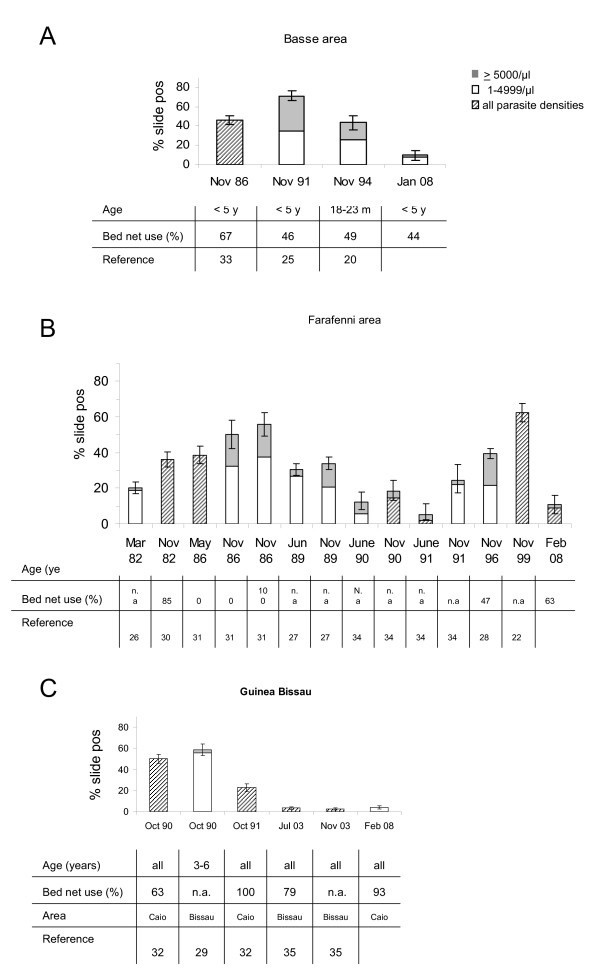
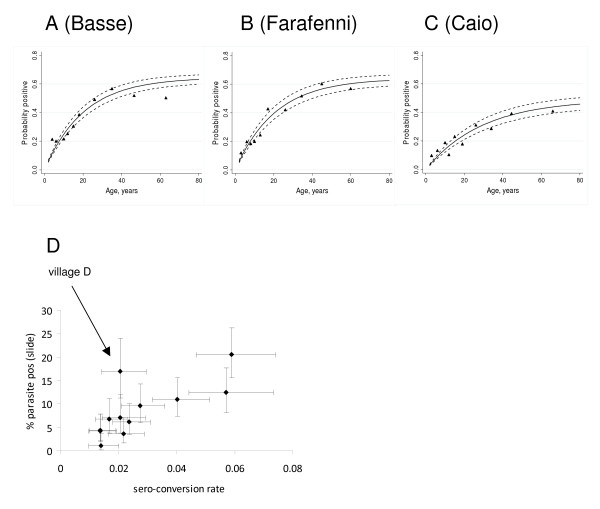
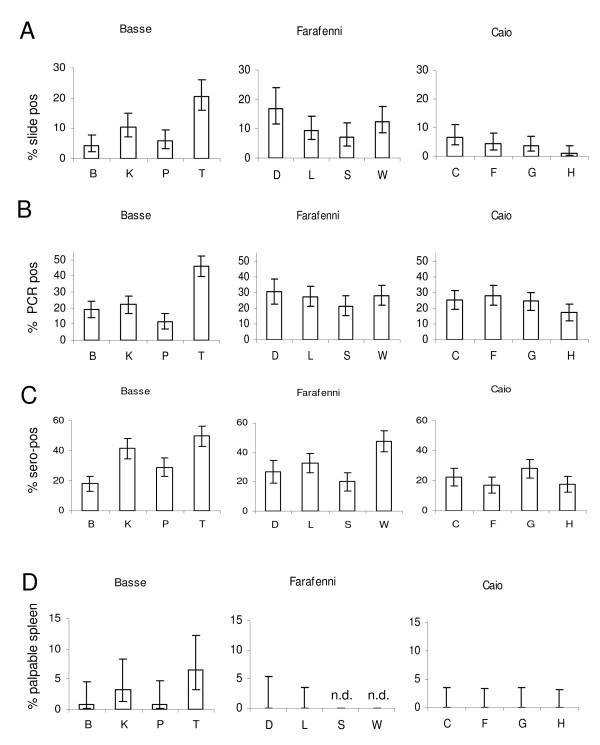
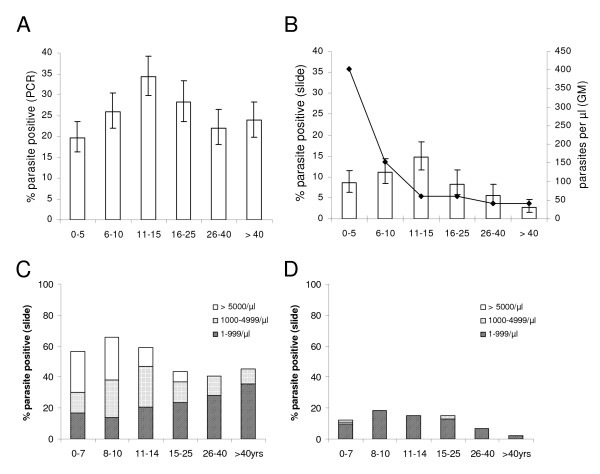
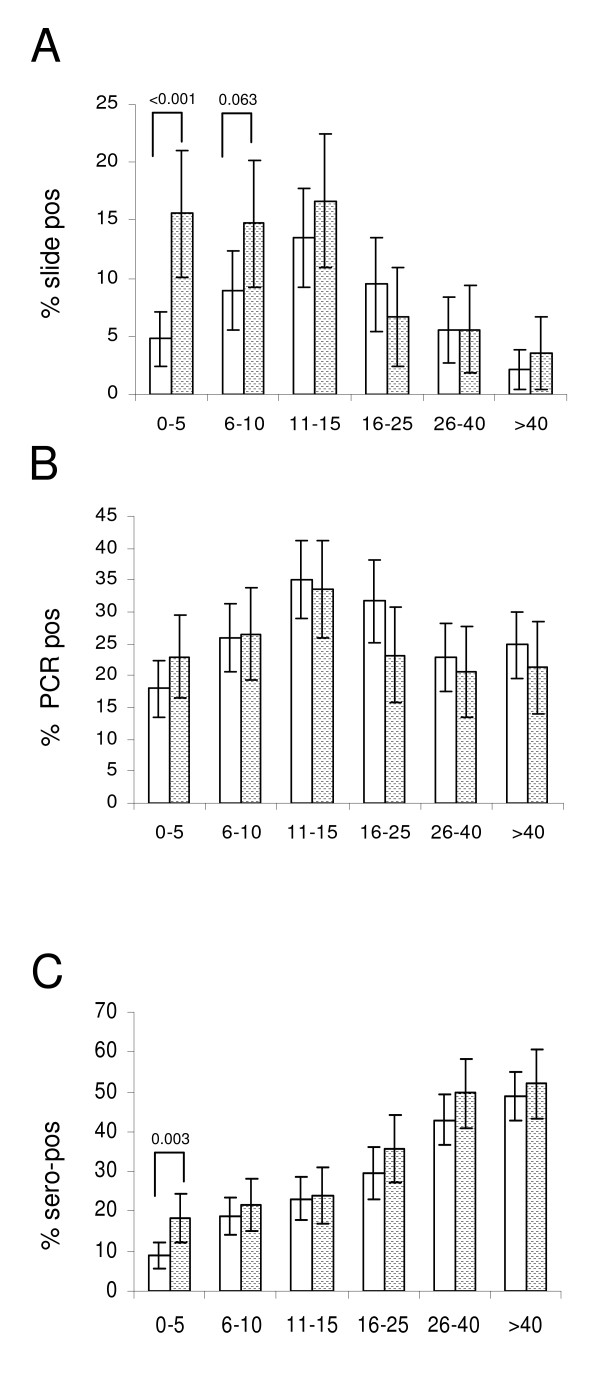
Results: A surprisingly low microscopically detectable parasite prevalence was detected in the Gambia (Farafenni: 10.9%, CI95%: 8.7-13.1%; Basse: 9.0%, CI95%: 7.2-10.8%), and Guinea Bissau (Caio: 4%, CI95%: 2.6-5.4%), with low parasite densities (geometric mean: 104 parasites/microl, CI95%: 76-143/microl). In comparison, PCR detected a more than three times higher proportion of parasite carriers, indicating its usefulness to sensitively identify foci where malaria declines, whereas the RDT had very low sensitivity. Estimates of force of infection using age sero-conversion rates were equivalent to an EIR of approximately 1 infectious bite/person/year, significantly less than previous estimates. The sero-prevalence profiles suggest a gradual decline of malaria transmission, confirming their usefulness in providing information on longer term trends of transmission. A greater variability in parasite prevalence among villages within a site than between sites was observed with all methods. The fact that serology equally captured the inter-village variability, indicates that the observed heterogeneity represents a stable pattern.
Conclusion: PCR and serology may be used as complementary tools to survey malaria in areas of declining malaria prevalence such as the Gambia and Guinea Bissau.
Figures
References
-
- Ceesay SJ, Casals-Pascual C, Erskine J, Anya SE, Duah NO, Fulford AJ, Sesay SS, Abubakar I, Dunyo S, Sey O, Palmer A, Fofana M, Corrah T, Bojang KA, Whittle HC, Greenwood BM, Conway DJ. Changes in malaria indices between 1999 and 2007 in The Gambia: a retrospective analysis. Lancet. 2008;372:1545–1554. doi: 10.1016/S0140-6736(08)61654-2. - DOI - PMC - PubMed
-
- Nyarango PM, Gebremeskel T, Mebrahtu G, Mufunda J, Abdulmumini U, Ogbamariam A, Kosia A, Gebremichael A, Gunawardena D, Ghebrat Y, Okbaldet Y. A steep decline of malaria morbidity and mortality trends in Eritrea between 2000 and 2004: the effect of combination of control methods. Malar J. 2006;5:33. doi: 10.1186/1475-2875-5-33. - DOI - PMC - PubMed
Publication types
MeSH terms
Grants and funding
LinkOut - more resources
Full Text Sources
