. 2009 Dec 22;106(51):21655-9.
doi: 10.1073/pnas.0912384106. Epub 2009 Dec 2.

CRM1 mediates nuclear-cytoplasmic shuttling of mature microRNAs

Affiliations

CRM1 mediates nuclear-cytoplasmic shuttling of mature microRNAs

Daniela Castanotto et al. Proc Natl Acad Sci U S A. .

Abstract

Drosha-processed microRNAs (miRNAs) have been shown to be exported from the nucleus to the cytoplasm by Exportin 5, where they are processed a second time to generate mature miRNAs. In this work we show that miRNAs also use CRM1 for nuclear-cytoplasmic shuttling. Inhibition of CRM1 by Leptomycin B results in nuclear accumulation of miRNA guide sequences. Nuclear to cytoplasmic transport can be actively competed by synthetic small interfering RNAs, indicating that this pathway is shared by different classes of processed small RNAs. We also find that CRM1 coimmunoprecipitates with Ago-1, Ago-2, Topo2alpha, EzH2, and Mta, consistent with a role of Argonautes and small RNAs in chromatin remodeling.


Conflict of interest statement

The authors declare no conflict of interest.

Figures
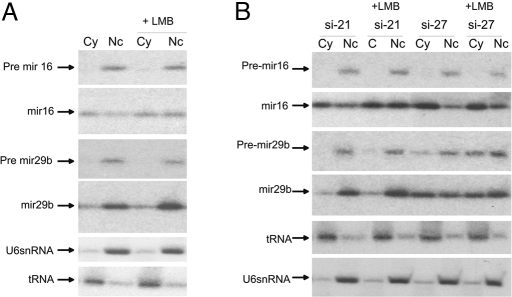
Fig. 1.
Fig. 1.
Nuclear and cytoplasmic fractionations indicate that mature miRNAs are shuttled through the nucleus. The nuclear (Nc) and cytoplasmic (Cy) fractionations of HCT116 parental cells (A) or HCT116 transfected with a 21-mer (si-21) or 25/27-mer (si-27) siRNA (B) with or without 6 h of LMB treatment (20 ng/mL). The RNA fractions were electrophoresed in a denaturing acrylamide gel, blotted onto a nylon membrane, and hybridized with probes complementary to mir16 or mir29b. Both the premiRNAs (pre-mir16 and pre-mir29b) and the corresponding guide sequences (mir16 and mir29b) are shown. Probes specific for U6 snRNA (nuclear) and tRNA (cytoplasmic) were used to determine the relative purities of the fractions.
Fig. 2.
Fig. 2.
Coimmunoprecipitations show association of CRM1 with RISC components. (A) Lysates collected from pcDNA3fhis-RHA transfected 293 cells were coimmunoprecipitated with an anti-RHA antibody (RHA; Upper) or with an anti-CRM1 antibody (CRM1; Lower) and probed with specific antibodies to detect CRM1 or RHA, respectively (indicated with arrows on the left side of the blots). Nonspecific antibodies of the same type and species of the anti-RHA or anti-CRM1 antibody (IgG) were used as nonspecific controls for the coimmunoprecipitations. (B) Lysates collected from Ago2-Flag (Ago-2) or the Flag nonspecific control expressing cell lines were coimmunoprecipitated with an anti-Flag antibody. The Western blot was probed with antibodies against Dicer, CRM1, or RHA. Small amounts of unrelated proteins are carried over during the procedure, thus we used an anti-HSP90 antibody to probe for HSP90 (indicated with an arrow on the left side of the blot), which served as loading control. (C) Lysates collected from Ago-2 expressing cell lines were coimmunoprecipitated with an anti-CRM1 antibody with (+) or without (−) RNase added to the reaction. IgG, nonspecific antibodies of the same type and species were used as a nonspecific control. The blot was probed with specific antibodies against Dicer, RHA, Ago-1, or Ago-2. An antibody against HSP90 was used as loading control. (D) Northern analysis of RNA yielded from lysates of cell lines stably expressing Ago-2 immunoprecipitated with an anti-CRM1 antibody (CRM1). IgG, nonspecific antibodies of the same type and species were used as a nonspecific control. Enrichment of mir16 and mir29b guide sequences is detected in presence of specific anti-CRM1 antibodies. A small amount of total RNA is nonspecifically carried through during the immunoprecipitation, thus a probe complementary to the endogenous U6snRNA (U6) was used as loading control.
Fig. 3.
Fig. 3.
Coimmunoprecipitations indicate interactions of RISC factors with chromatin remodeling factors. (A) Lysates collected from Ago2-Flag (Ago-2) or the Flag nonspecific control (Flag) expressing cell lines were coimmunoprecipitated with an anti-Flag antibody. The Western blot was probed with antibodies against Topo 2α, EzH2, and Mta2. An antibody against HSP90 was used as loading control. (B) Lysates collected from Ago2-Flag (Ago-2) expressing cell lines were coimmunoprecipitated with an anti-CRM1 antibody with (+) or without (−) RNase added to the reaction. IgG, nonspecific antibodies of the same type and species were used as a nonspecific control. The blot was probed with specific antibodies against Topo 2α, EzH2, and Mta2. An antibody against α-tubulin (α-Tub) was used as loading control.

References

    1. Ruby JG, Jan CH, Bartel DP. Intronic microRNA precursors that bypass Drosha processing. Nature. 2007;448:83–86. - PMC - PubMed
    1. Winter J, Jung S, Keller S, Gregory RI, Diederichs S. Many roads to maturity: microRNA biogenesis pathways and their regulation. Nat Cell Biol. 2009;11:228–234. - PubMed
    1. Kim VN. microRNA precursors in motion: Exportin-5 mediates their nuclear export. Trends Cell Biol. 2004;14:156–159. - PubMed
    1. Robb GB, Brown KM, Khurana J, Rana TM. Specific and potent RNAi in the nucleus of human cells. Nat Struct Mol Biol. 2005;12:133–137. - PubMed
    1. Langlois MA, et al. Cytoplasmic and nuclear retained DMPK mRNAs are targets for RNA interference in myotonic dystrophy cells. J Biol Chem. 2005;280:16949–16954. - PubMed

Publication types

LinkOut - more resources
