


Isolation with migration models for more than two populations
- PMID: 19955477
- PMCID: PMC2877539
- DOI: 10.1093/molbev/msp296
Isolation with migration models for more than two populations
Abstract
A method for studying the divergence of multiple closely related populations is described and assessed. The approach of Hey and Nielsen (2007, Integration within the Felsenstein equation for improved Markov chain Monte Carlo methods in population genetics. Proc Natl Acad Sci USA. 104:2785-2790) for fitting an isolation-with-migration model was extended to the case of multiple populations with a known phylogeny. Analysis of simulated data sets reveals the kinds of history that are accessible with a multipopulation analysis. Necessarily, processes associated with older time periods in a phylogeny are more difficult to estimate; and histories with high levels of gene flow are particularly difficult with more than two populations. However, for histories with modest levels of gene flow, or for very large data sets, it is possible to study large complex divergence problems that involve multiple closely related populations or species.
Figures
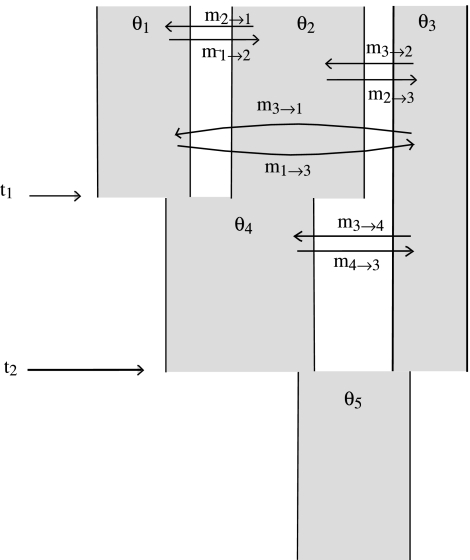
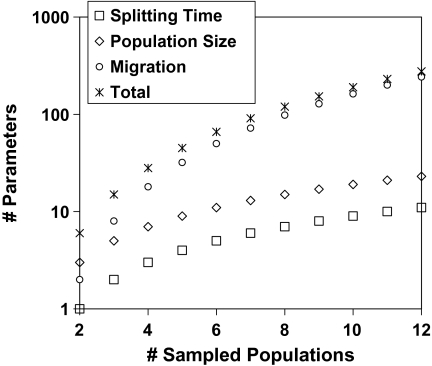


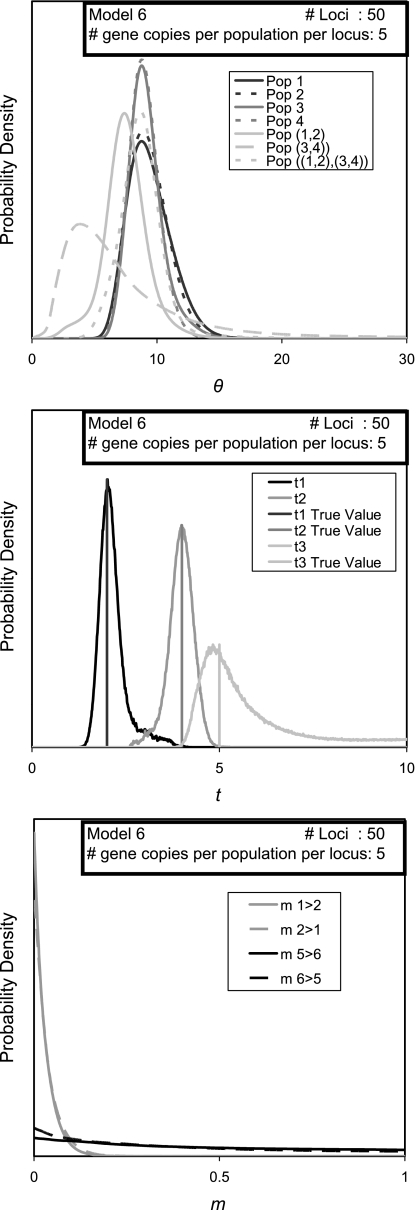
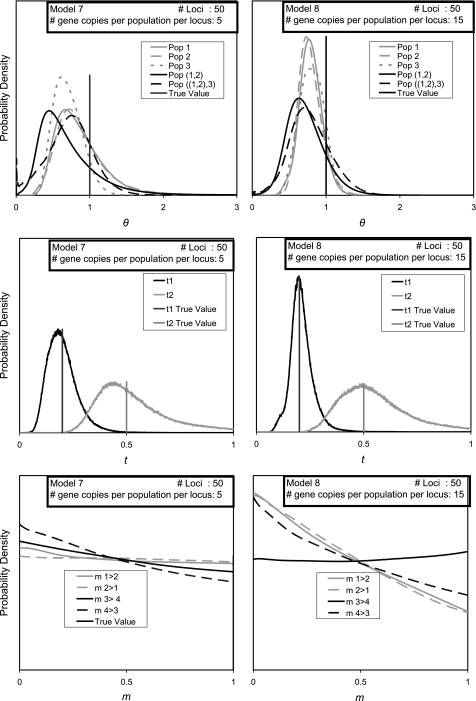

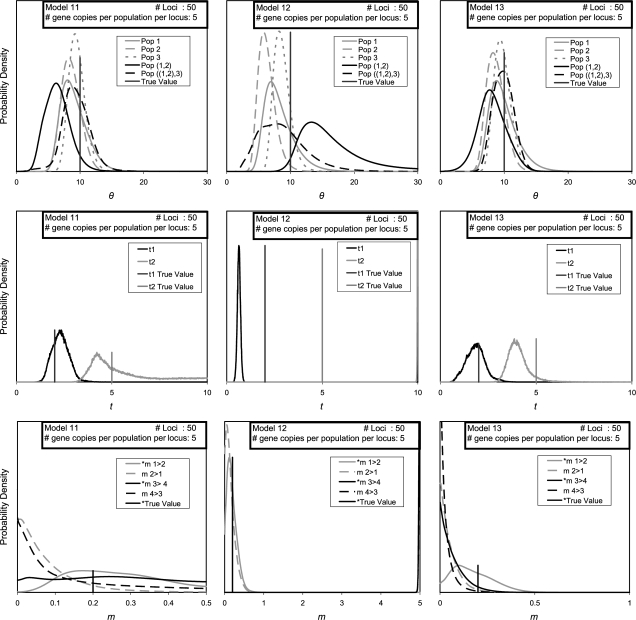

 distribution.
References
-
- Arbogast BS, Edwards SV, Wakeley J, Beerli P, Slowinski JB. Estimating divergence times from molecular data on phylogenetic and population genetic timescales. Annu Rev Ecol Syst. 2002;33:707–740.
-
- Arnold ML. Natural hybridization and evolution. New York: Oxford University Press; 1997.
-
- Avise JC. The history and purview of phylogeography: a personal reflection. Mol Ecol. 1998;7:371–379.
-
- Barton NH. The role of hybridization in evolution. Mol Ecol. 2001;10:551–568. - PubMed
Publication types
MeSH terms
Grants and funding
LinkOut - more resources
Full Text Sources
Other Literature Sources
